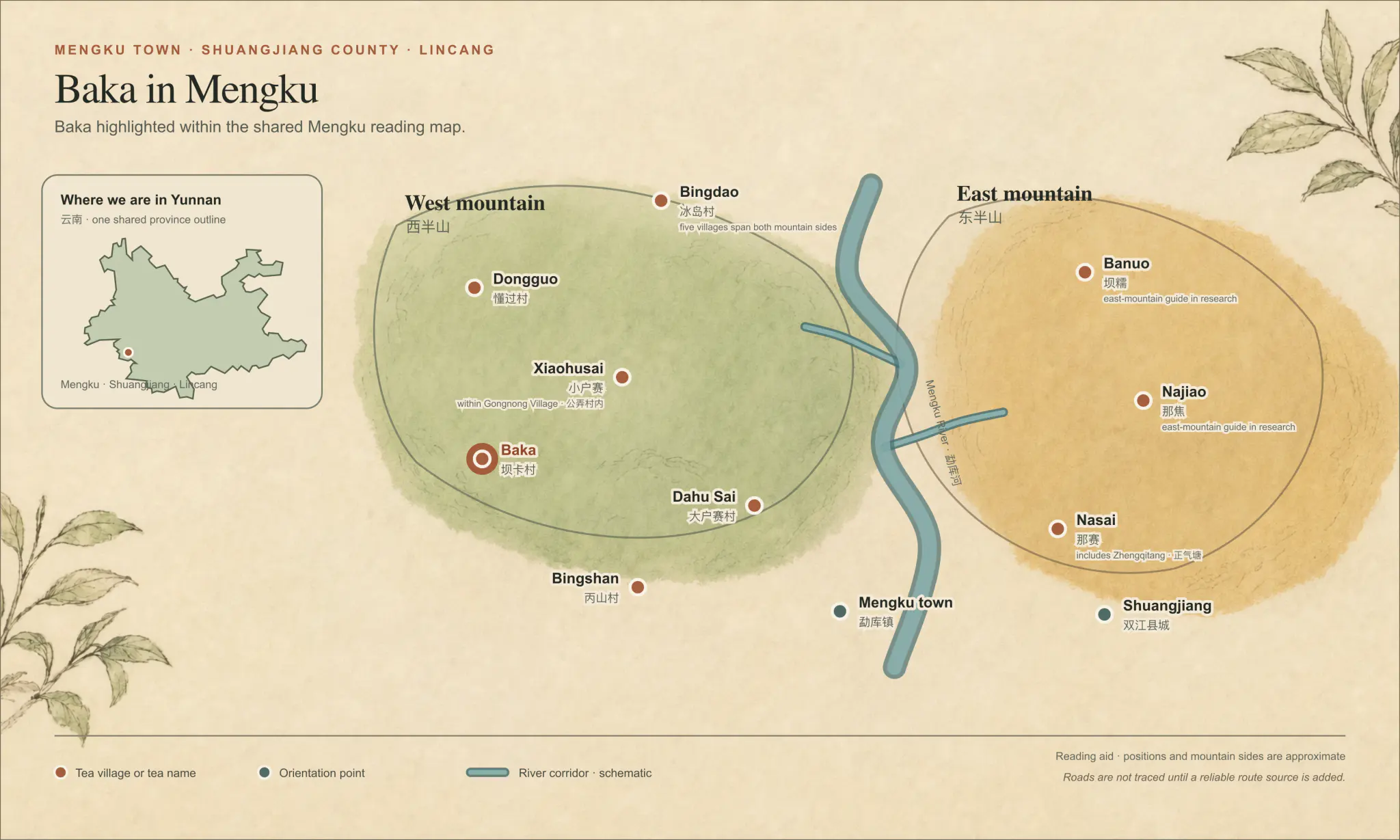
Orientation guide notes and sources
Boundary confidence: Not publication-grade: the existing illustration has no verified locality geometry or reusable geographic-data licence in this pass.
- ImperfecTea legacy orientation illustration; no external geographic-data licence established in this pass
Baka (坝卡) is a village in Mengku Town, Shuangjiang County. It is usually grouped with western Mengku teas. The most useful first check is the Chinese name: several quite different places look similar in English.
Check which Baka is meant
| Name | Where it belongs |
|---|---|
| Baka 坝卡 | Mengku; the subject of this guide |
| Bawai 坝歪 | Bingdao’s five-village cluster |
| Banuo 坝糯 | Eastern Mengku |
| Baka-nan 坝卡囡 | Bulang Mountain, Menghai County |
A detailed review of Baka-nan can’t tell us how this Baka tastes. That mix-up is easy to make in English search results. Keep the characters on purchase and tasting notes.
What do we know about the tea?
There isn’t enough independently documented tasting evidence here to give Baka a reliable village profile. Start with the lot’s actual aroma, bitterness and finish instead of borrowing a description from Bingdao.
A 2019 Gu Cha Ju account reported Baka leaf entering Bingdao-directed trade as demand grew. It is an attributed market account, not proof that the two places taste alike or that a particular cake was substituted.
A municipal search record also points to an ancient-tea-garden notice for Baka, but the original notice was unavailable. Its area and status remain unconfirmed. The retained illustration is for orientation and doesn’t establish a garden boundary.
A useful first comparison
Try a documented Baka sample beside Banuo or Bawai from a similar harvest. Keep the water, dose and timing the same. A starting ratio of 7 g per 100 ml with short infusions will let you follow the bitterness and sweet return.
Before paying for a narrow claim, ask which locality and maker supplied the leaf and whether it was kept separate through pressing. This source set doesn’t support a dependable Baka price range.
Sources and limits
All sources accessed 19 July 2026.
- Yunnan administrative-village coding standard DB53/T 1176.9-2023 - Baka as a village under Mengku Town.
- Lincang municipal fourth-batch cultivated ancient-tea-resource notice - search-indexed Baka Village garden lead; original page was unavailable, so no area or status is treated as established in this guide.
- Lincang Agriculture and Rural Affairs Bureau on Mengku large-leaf tea - regional cultivar and traceability context; not a Baka lot audit.
- National Agricultural Exhibition Center: Shuangjiang Mengku ancient tea gardens and tea-culture system - regional agricultural-heritage context; not proof of a Baka wrapper.
- Gu Cha Ju / 网茶会习茶社, “Detailed flavours of Mengku noted mountains” (2019) - Chinese tea-community report of Baka/Bingdao market movement; attributed reporting, not a controlled tasting or official trade statistic.
- Ai Pu Cha, tea-friend review of Baka-nan / 坝卡囡 - used only to document that a similarly rendered name is a different, explicitly sampled product; it is not evidence about Baka / 坝卡 in Mengku.
Evidence limits: The illustration is not a verified map, and no reusable geographic-data licence was established. No controlled multi-producer Baka tasting series, defensible garden-elevation range or normalized dated price comparison was found.
Quick answers
Frequently asked questions
What does the Baka tea name identify?
Baka is an administrative village in Mengku Town, Shuangjiang County, Lincang, Yunnan.
What does Baka tea taste like?
No controlled village tasting set exists; test each documented lot for aroma, bitterness, astringency, salivation, texture and finish instead of expecting a fixed Baka profile.
What is Baka commonly confused with?
Baka 坝卡 is not Bingdao-cluster Bawai 坝歪, Mengku East's Banuo 坝糯 or Menghai's Baka-nan 坝卡囡.
What should I ask before buying Baka tea?
What Chinese place name, smaller locality, season and maker does this lot claim?