A field lesson in zisha · 紫砂
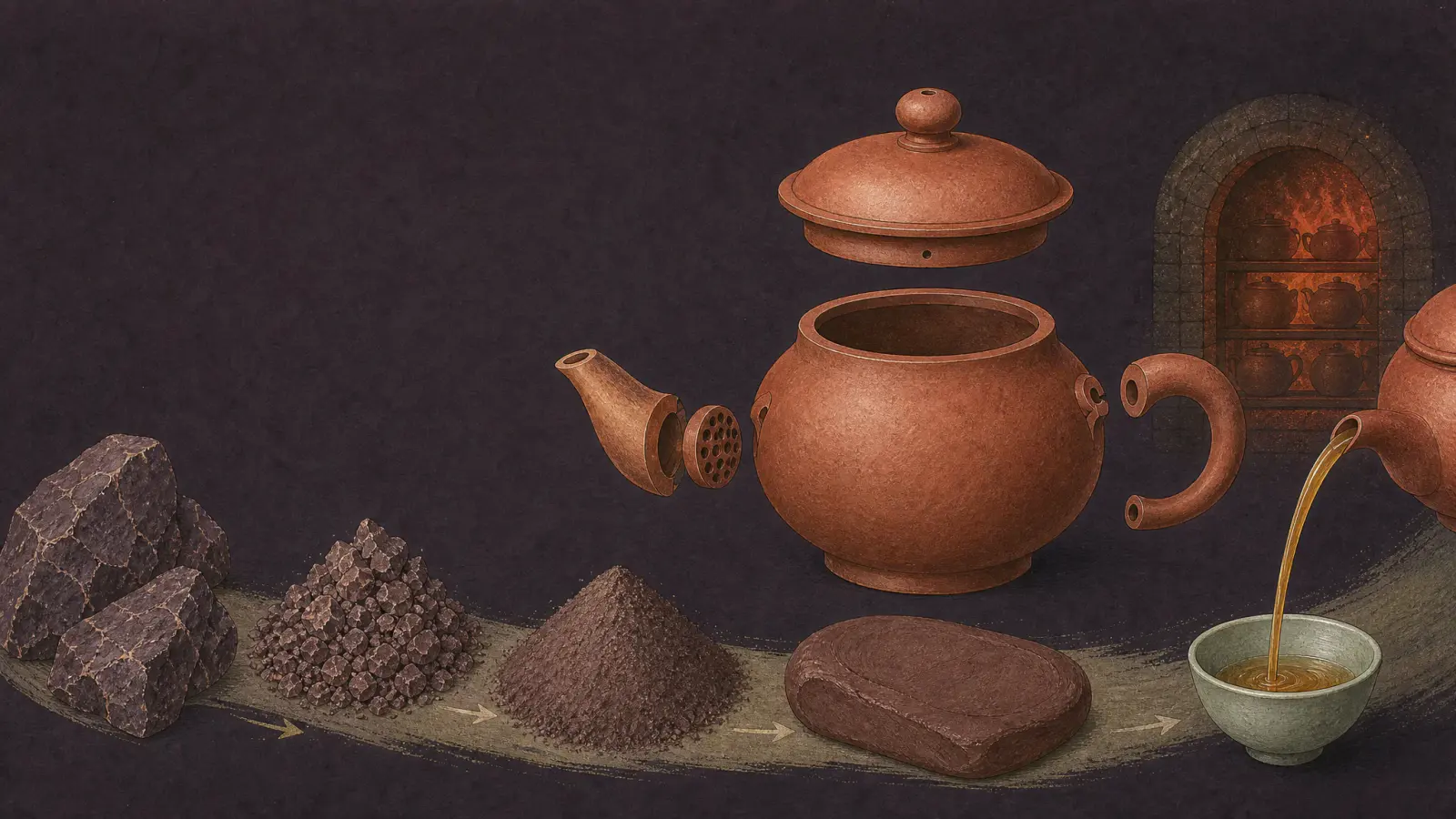
A teapot begins as stone.
Follow one handful of Yixing ore through preparation, forming, firing, and use. Then learn what the finished pot can tell you, and what it cannot.
Commissioned teaching illustration. The cutaway is schematic, not an authentication reference.
Lesson one Material journey
Clay is a process, not a color.
“Zisha” is often treated as if it names one stable substance. The archive shows a chain of choices. Material is selected, broken down, graded, mixed, rested, worked, joined, dried, and fired before it ever holds tea.
Unearth 矿料
Ore is not finished clay
The archive describes zini ore as purple-red with fine pale specks. Its mineral body includes hydromuscovite with varying amounts of kaolin, quartz, mica, and iron compounds.
Break down 粉碎与筛分
Particle size is chosen
Traditional processing combined crushing, sieving, and water-assisted refining. Mechanical pulverizing entered factory production in 1959, changing the speed and consistency of preparation.
Mix and rest 练泥
Workability is made
Water, mixing, resting, and de-airing turn mineral particles into workable clay. Vacuum clay processing arrived at the Zisha Craft Factory in 1966 and shortened the older preparation cycle.
Build 泥片成型
The body is assembled
Yixing work is closely associated with beaten slabs, coils, paddling, joining, and compression. The book treats control of clay firmness as part of the craft, not a background detail.
Fit 配盖
Wet pieces must agree after shrinking
Body, rim, and lid can be formed at different degrees of firmness so that they arrive at a calibrated fit. Clay mix, kiln temperature, and firing method all affect shrinkage.
Fire 烧成
Heat fixes one outcome
Yixing moved from wood-fired hillside dragon kilns to tunnel, downdraft, shuttle, gas, and electric kilns. Atmosphere and temperature help determine the final color and body.
Lesson two Names on the clay
Three families. No podium.
Clay labels help organize a conversation, but they are not grades from worst to best. The archive’s terms also do not always match the way a modern shop uses the same words.
紫泥
Zini · purple clay
Described as purple-red in the raw state and dark red after firing, with relatively high strength and low drying shrinkage.
本山绿泥 / 段泥
Benshan lüni and duanni
The source places pale Benshan green clay between purple-clay strata and rock. It says the lower-yield material may be used as slip or mixed with purple clay to make duan clay.
红泥
Red-clay families
The book describes an orange-yellow raw material from beneath a tender-clay layer that can fire vermilion, purple-red, or crabapple red depending partly on iron content.
Clay descriptions above are condensed from the working translation of page 365. Check the Chinese page image when terminology matters.
Inside the workshop
Made by timing as much as by hand.
In the book’s 1981 lesson on a Double-Line Bamboo Drum pot, the body, rim, and lid are worked at different firmnesses. The maker anticipates how each part will move as moisture leaves and the kiln contracts the body.
Tools are not backstage equipment. In this tradition, knowing how to make and arrange them is part of knowing how to make the pot.
Paraphrased from the working translations, pp. 390–400
Lesson three Form follows the session
Read the pot as a small machine.
The archive reduces practical quality to four ideas: safety, suitability, convenience, and feel. A celebrated silhouette still has to hold leaves, move water, balance in a hand, and come clean afterward.
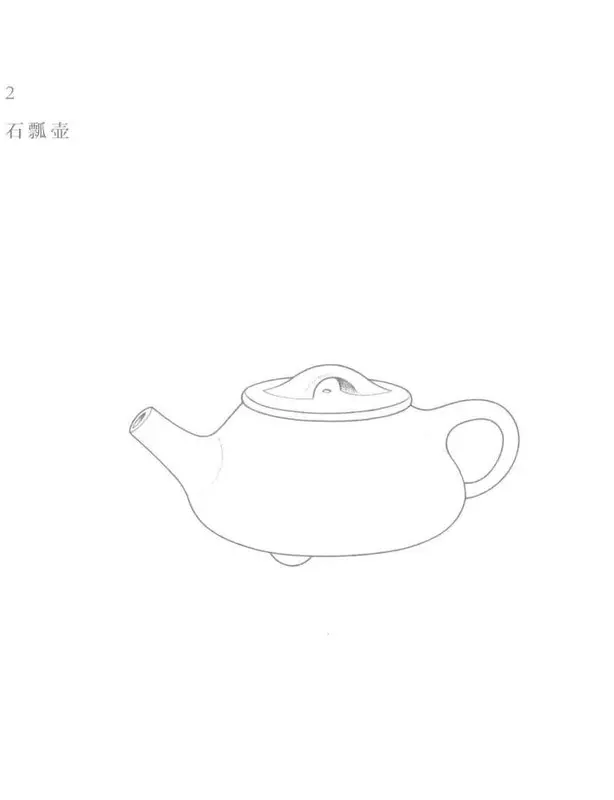 石瓢壶 · source plate, book p. 139
Body
How much room do the leaves have, and how quickly does the vessel shed heat?
Opening
Can you load and remove the leaf without fighting the pot?
Lid and gallery
Does the lid sit securely at a normal pouring angle without binding?
Air hole
Does air enter freely enough to keep the stream moving?
Spout and filter
Does the pour start cleanly, stay coherent, and stop without dribbling?
Handle and foot
Does a full pot balance in the hand and sit without rocking?
Lesson four Attractive mistakes
Six claims that sound better than they prove.
A good-looking pot can invite a good story. Slow the story down. Separate what you can observe from what a seller says, what documents support, and what remains unknown.
“The color proves the clay.”
Color also moves with firing, iron content, blending, surface treatment, lighting, and photography.
“The seal proves the maker.”
A seal is an impressed mark. Marks can be copied, reused, misread, or detached from reliable provenance.
“The lid trick proves quality.”
Stopping a pour by covering the air hole tests part of the air-and-water path. It does not identify the clay or maker.
“Fully handmade means it will brew better.”
A forming method says little about whether the capacity, heat behavior, filter, spout, and balance suit your tea table.
“Rare clay makes better tea.”
Rarity, price, and prestige do not establish a predictable result in your cup.
“A famous form is a safe choice.”
The same named form can vary in volume, wall thickness, opening, pour speed, and handling.
Lesson five Before you assign it a tea
A five-minute test beats a week of folklore.
You do not need to season a new pot, dedicate it immediately, or trust your first impression. Start with water, handling, and a porcelain control.
- 01
Fill
Measure the real working capacity, not just the seller’s headline number.
- 02
Hold
Lift it full. Check the thumb position, wrist angle, lid security, and center of gravity.
- 03
Pour
Time a normal pour and watch the stream, air intake, stop, and dribble.
- 04
Clean
Remove wet leaves, rinse, and see whether the opening and filter are practical to maintain.
- 05
Compare
Brew beside porcelain before assigning a pot to one tea or inventing a flavor story.
After brewing: empty the leaves, rinse thoroughly, and let the pot dry with the lid off. Avoid leaving wet tea inside overnight. Soap residue can be difficult to clear from an unglazed body.
Continue to the first-pot guide →The evidence boundary
What this archive knows.
This lesson is built from 紫音希声, a 659-page illustrated Chinese monograph centered on Gu Jingzhou, plus its local OCR and working English translation. It is strongest on named works, workshop practice, tools, forming, and one major maker’s standards.
It cannot authenticate a pot offered online. It cannot reconstruct a clay recipe from a photograph. It cannot turn an uncertain OCR name into a reliable biography. When the source is quiet, this site should stay quiet too.
- Book pages
- 659
- Working English pages
- 578
- Illustrated forms indexed
- 77
- Names indexed
- 226