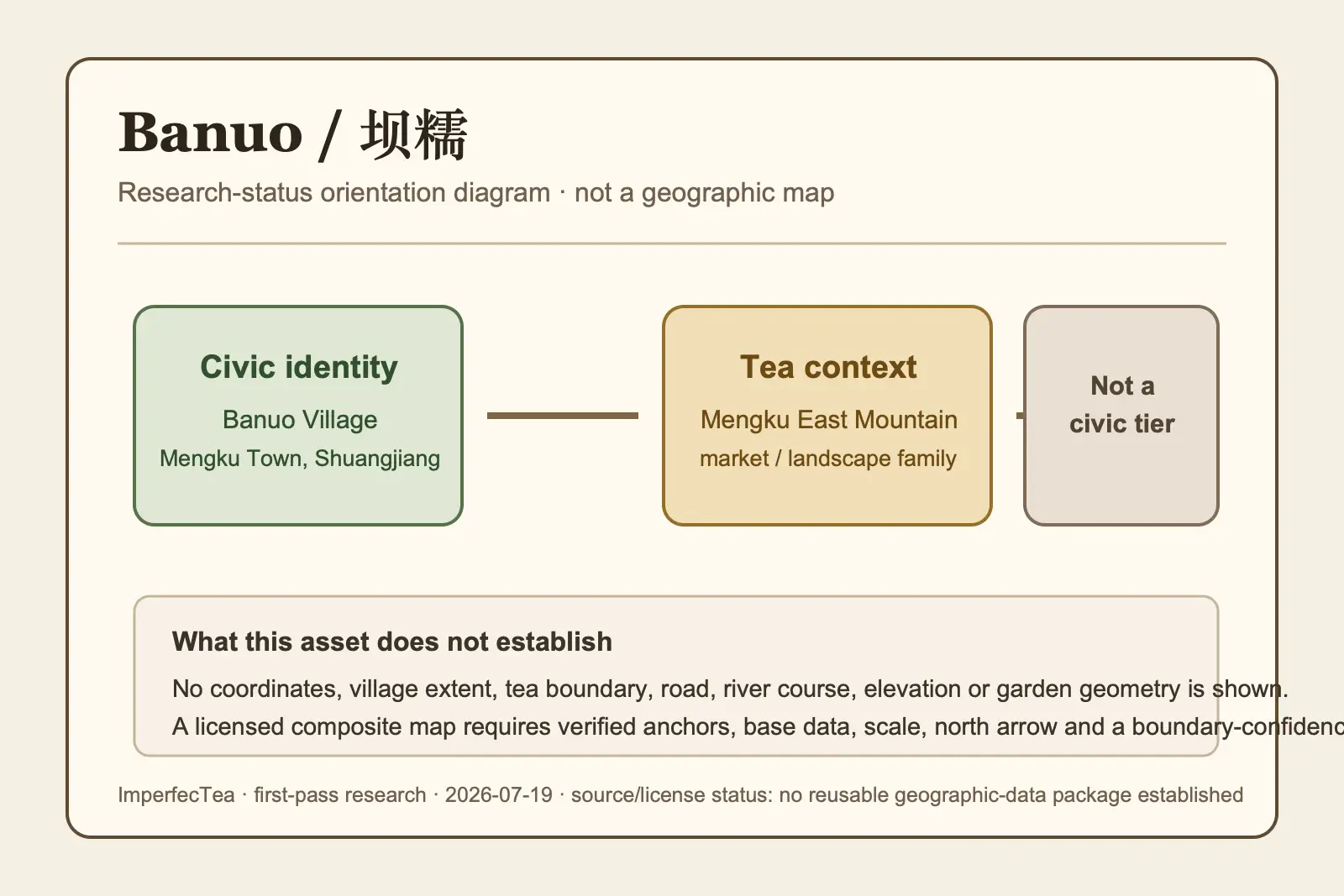
Place relationship diagram notes and sources
Diagram status: Not publication-grade: this first-pass orientation diagram deliberately contains no geographic geometry, coordinates, or boundary claim.
- ImperfecTea first-pass research-status diagram; no reusable geographic-data licence established
Banuo (坝糯) is a Mengku village known for tengtiao (藤条茶), a system of pruning and plucking that gives tea branches a vine-like form. It belongs to the eastern Mengku tea grouping in Shuangjiang County, Lincang.
What the tasting study found
Wang Xinyu and colleagues compared sun-dried tea from Banuo, Bingdao, Xiaohusai and Huangshan across spring, summer and autumn. They described the Banuo samples as full, strong and slightly astringent.
That is a useful expectation for a tasting. The study also found seasonal differences within origins, so it doesn’t predict every Banuo cake. A spring Banuo and autumn Xiaohusai would compare more than their villages.
What tengtiao tells you
Tengtiao describes garden management, not a separate cultivar or an age category. A seller using the term should be able to explain how the supplying garden was managed.
An official 2024 notice records a Banuo ancient tea garden of 321.2 mu and includes boundary coordinates. That establishes a particular protected resource. It doesn’t make every cake carrying the village name ancient-tree tea.
Banuo is also distinct from Baka (坝卡) and Bawai (坝歪). “Mengku East” is broader than the village and can describe a blend.
Taste and buy by lot
Compare Banuo with a sourced Najiao or Nasai-area tea from the same season. Notice whether the middle infusions retain body and how quickly the bitter or drying part clears. Keep the harvest and maker beside the tasting note.
The question I’d put to a seller is whether this is a separated Banuo garden lot or a wider eastern Mengku blend. Then ask who made the maocha and when it was pressed. The garden designation and the recipe both need to connect to the tea for sale.
Sources and limits
All sources accessed 19 July 2026.
- Yunnan administrative-village coding standard DB53/T 1176.9-2023 - civic hierarchy.
- Lincang municipal fourth-batch cultivated ancient-tea-resource recognition notice - Banuo Village garden entry and survey-boundary coordinates.
- Wang Xinyu et al., 2023 four-mountain Shuangjiang sun-dried-tea comparison - controlled Banuo sample evidence; not a retail-lot audit.
- Yunnan.cn, “Vine-pruned tea: a horticultural wonder” (2022) - reported local garden-management context.
- Gu Cha Ju / 网茶会习茶社, “From Banuo to Dahu Sai” (2020) and 51 Puer, “Our firsthand Mengku tea” - attributed Chinese field/community reporting, used only where labelled as such.
- Chen Sheng Academy’s regional tasting overview - commercial comparison vocabulary only; not used for hard geography or a village flavour law.
Evidence limits: The illustration is deliberately non-geographic. No licensed composite map, controlled multi-producer Banuo tasting set, village-wide environmental audit or two comparable dated price observations were found.
Quick answers
Frequently asked questions
What does the Banuo tea name identify?
Banuo is an administrative village in Mengku Town, Shuangjiang County, Lincang, Yunnan.
What does Banuo tea taste like?
One controlled sensory study supports floral aroma, sweetness, body and returning sweetness in its tested material; season, processing and provenance keep those prompts from becoming guarantees.
What is Banuo commonly confused with?
Banuo 坝糯 is not Baka 坝卡, Bingdao-cluster Bawai 坝歪 or a synonym for all Mengku East tea.
What should I ask before buying Banuo tea?
Is this lot from the recognized Banuo garden, another village garden or a broader blend, and who processed it?