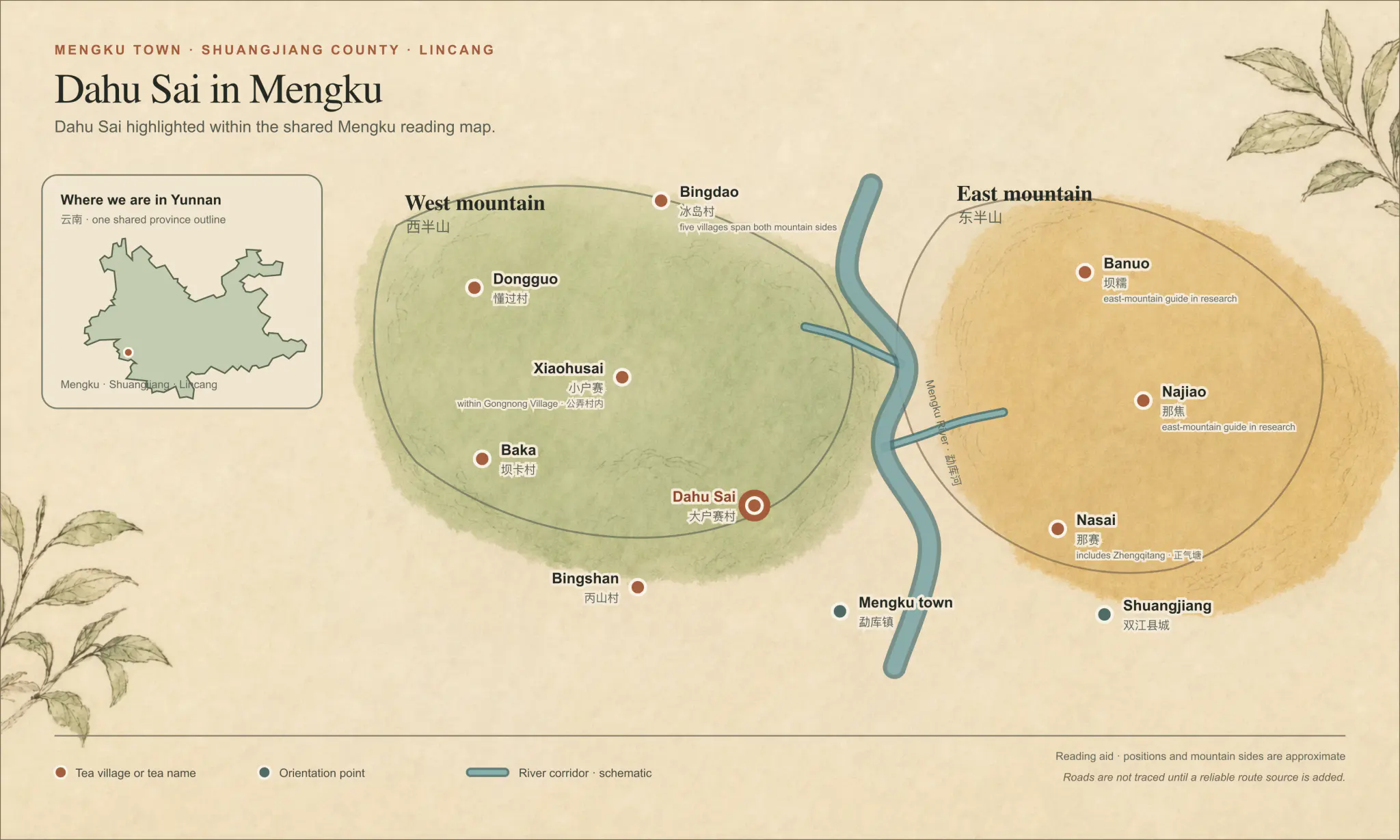
Orientation guide notes and sources
Boundary confidence: Not publication-grade: the existing illustration uses unsupported approximate positions and no licensed locality geometry.
- ImperfecTea existing orientation illustration; no external geographic data license established in this pass
Dahu Sai (大户赛) is an administrative village in Mengku Town, Shuangjiang County. Tea sellers usually place it on the western, Bangma Mountain side of Mengku.
What the tea may offer
Commercial and specialist accounts describe full raw tea with a bitter opening, salivation and returning sweetness. Some mention flowers or honey and a lasting finish. The accounts aren’t a matched tasting across producers, so use them as possibilities for a sample rather than a village guarantee.
Try it beside a similarly aged Dongguo or Xiaohusai. Keep the brewing steady and notice whether the bitter part clears while the body lasts. More bitterness alone doesn’t make it the better tea.
Who is growing and making it?
The local reporting gives Dahu Sai more substance than a wrapper description. A 2021 People’s Daily Online report identifies Li Zhongwen as a village party secretary, forest ranger, grower and primary-processing workshop operator.
In 2024, Xinhua reported on farmer Li Minghua and an ancient-tree adoption scheme. Its routine included spring picking, summer rest and autumn topping. That describes the participating trees; it shouldn’t be extended to every household or garden.
Read the village name carefully
Dahu Sai is distinct from Xiaohusai. The broader “Mengku West Mountain” label describes a tea-market area and isn’t another level of local administration.
The sources don’t establish a representative elevation range, tree-age inventory or uniform processing style for Dahu Sai. Ask for the supplying garden or household, harvest and maker, especially if a seller wants an old-tree premium. A photograph of a large tree won’t connect that tree to the cake.
Sources and limits
All web sources accessed 18 July 2026.
- Yunnan administrative-village coding standard DB53/T 1176.9-2023 - lists Dahu Sai Village under Mengku Town.
- People’s Daily, Minsheng Weekly (2021) - tea-industry livelihood context in Dahu Sai; not a geography or provenance audit.
- People’s Daily Online Yunnan (2021) - broad route and local tea context; quoted ancient-tea figures are local reporting, not an inventory used here.
- Shuangjiang tea development plan (2023) - Mengku large-leaf, heritage and traceability policy context.
- Wang Xinyu et al., Shuangjiang sun-dried tea comparison (2023) - origin and season both matter in sampled Shuangjiang teas; not a Dahu Sai profile.
- People’s Daily, Seeking ancient tea trees on Daxueshan (2019) - named field visit reporting freshly sun-dried maocha offered in Dahu Sai; a visit observation, not a village sensory standard.
- Xinhua Yunnan, More than 1,000 ancient tea trees in Shuangjiang receive new adopters (2024) - named Dahu Sai farmer and the reported adoption-management routine; no tree dating or lot authentication.
- Lincang Discipline Inspection Commission, Chashan Gully (2021) - calls Dahu Sai and Xiaohusai natural villages in a local landscape caption; conflicts with the standard’s administrative-village rendering and is recorded, not harmonised by assumption.
Conflicts and unknowns: Current official records confirm the administrative village but were not found to enumerate its natural villages or map tea plots. A local 2021 caption calls Dahu Sai a natural village; its relationship to the standard-coded village name remains unresolved. High-elevation, ancient-tree and flavor claims vary across trade writing and lack field methods or comparable tasting evidence. No reusable locality geometry, garden ecology study, independent multi-producer Dahu Sai tasting series, tree-age inventory or two comparable current price observations was secured.
A note on what is still missing: The existing SVG/PNG/WebP asset predates this evidence pass. Its approximate positions and embedded visual material have no documented reusable geographic-data basis, so it is not a composite map. We claim no external map-data or image licence, and no controlled ImperfecTea Dahu Sai tasting was available. The guide keeps those limits in view rather than smoothing them over.
Quick answers
Frequently asked questions
What does the Dahu Sai tea name identify?
Dahu Sai is an administrative village in Mengku Town, Shuangjiang County, Lincang, Yunnan.
What does Dahu Sai tea taste like?
Public evidence cannot support one village fingerprint; compare lot-specific aroma, bitterness, astringency, sweetness, texture and finish while recording harvest and maker.
What is Dahu Sai commonly confused with?
Dahu Sai is a village claim inside Mengku, not a synonym for Mengku West, Bingdao or one standardized tea style.
What should I ask before buying Dahu Sai tea?
Which smaller garden or household supplied the leaf, in what season, and who processed the lot?