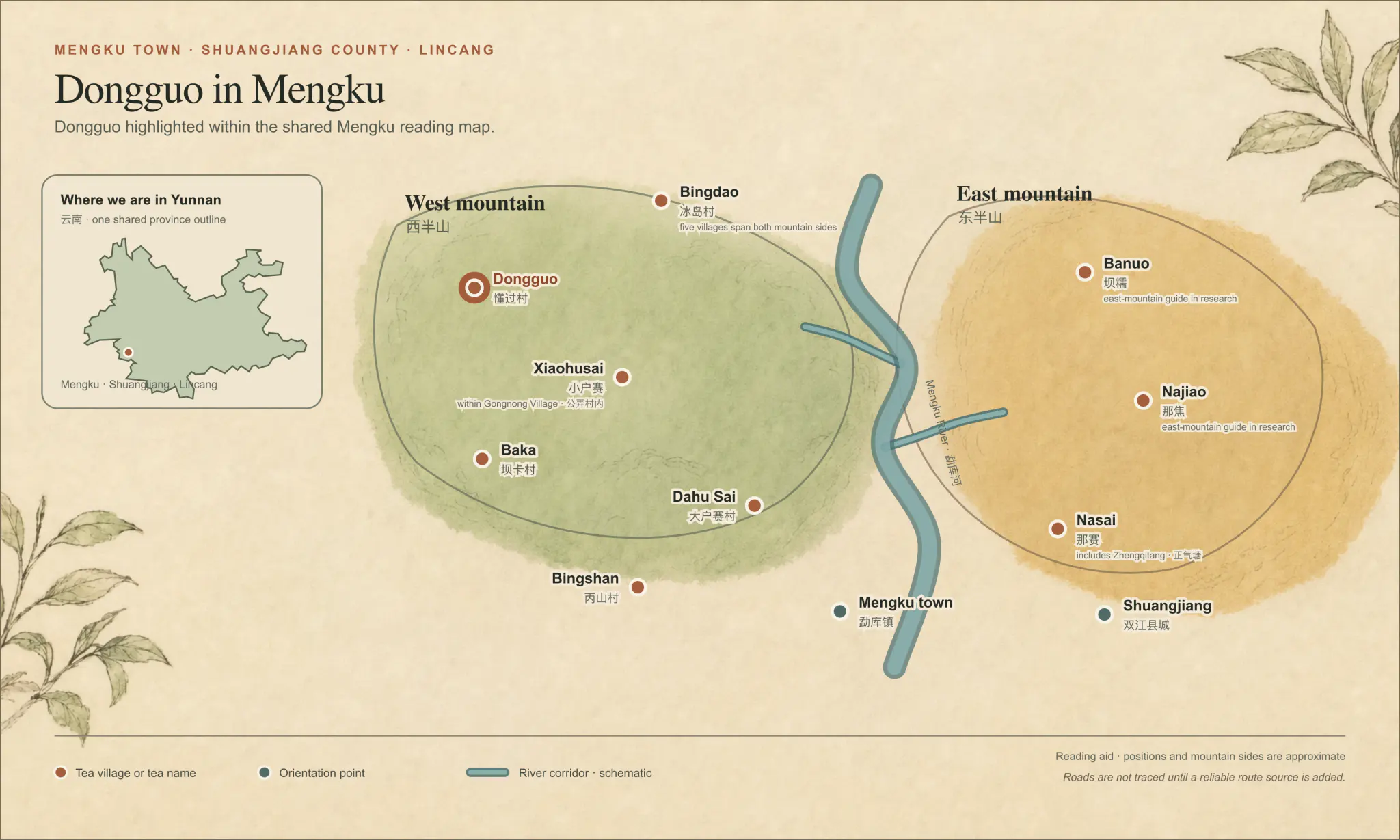
Place relationship diagram notes and sources
Diagram status: No published geographic boundary: this is a non-geographic evidence-status diagram only.
- Yunnan administrative-village coding standard DB53/T 1176.9-2023
- ImperfecTea original hierarchy diagram, 2026-07-18
Dongguo (懂过) is a village in Mengku Town on the western side of the Nanmeng River. Molie (磨烈, also written 慕烈 in some accounts) is a smaller locality name sold within Dongguo, so it makes a narrower claim than the village name alone.
What might Dongguo taste like?
Trade descriptions often mention floral or fruity aroma, firm bitterness and returning sweetness. There isn’t a matched tasting across independently sourced producers here to establish a Dongguo or Molie profile.
A 2025 sensory study included a 2020 Molie old-tree tea, listing Dongguo Village as its origin, among 43 teas used to develop a flavour wheel. That documents the sample’s stated origin. It doesn’t publish enough grower or garden detail to authenticate other Molie cakes.
Where the smaller names fit
Molie should not be treated as another township or as a synonym for all Dongguo. Field accounts also discuss Waizhai, Yizhai and Baqishan, but a narrower label still needs a supplying household or garden.
The useful distinction when shopping is between leaf grown in a stated locality, a Dongguo village blend and tea merely processed or traded through Dongguo. Those can all reach a shop under similar wording.
Comparing a sample
Put Dongguo beside a sourced western Mengku tea from the same season, then compare Molie if you want to explore the narrower claim. Keep water, dose and timing fixed. Record aroma and texture as well as how quickly bitterness clears.
Smoke, sourness or a hard green edge should prompt a processing question before being treated as a local characteristic. Ask who made the maocha, whether it was blended and how it was stored. The available evidence doesn’t support one garden-elevation range or ageing timetable for the whole village.
Sources and limits
Sources were accessed 18-19 July 2026; the 2025 sensory-method study was accessed on 19 July.
- Yunnan administrative-village coding standard DB53/T 1176.9-2023 - Dongguo Village listed under Mengku Town.
- Xinhua Yunnan, Dongguo tea-livelihood report (2024) - current village tea-industry context; the page timed out during this pass, so numerical claims are not repeated without checking the original report.
- Pu’er Magazine field account, republished by iPucha (2021) - reported natural-village names, local history and orientation; specialist field account, not an administrative register or audit.
- People’s Daily Overseas Edition field report (2016) - Nanmeng River / Ma’an-east and Bangma-west orientation.
- Shuangjiang tea development plan (2023) - Mengku large-leaf, heritage and traceability policy context.
- Wang Xinyu et al., Shuangjiang sun-dried tea comparison (2023) - origin and season matter in sampled Shuangjiang teas; not a Dongguo profile.
- Zhang Chunhua et al., “Construction and Sensory Characteristics of the Flavor Wheel of Raw Pu-erh Tea” (2025) - a 2020 Molie old-tree sample is listed as originating in Dongguo Village within a 43-sample sensory-method study; it does not publish a Dongguo-wide profile.
Conflicts and unknowns: The official standard verifies Dongguo’s administrative status but not the precise rank of Molie or other reported natural villages. The accessible specialist field account supplies four names but its historical, acreage, age and production figures are not independently audited here. The 2025 sensory study records one Molie sample but not a grower, garden, production method or Dongguo-specific sensory score. No licensed locality geometry, garden-level climate/elevation/soil study, independent multi-producer Dongguo tasting set, verified tree-age inventory or like-for-like current prices was obtained.
What the visuals and tasting cannot tell us yet: The SVG/PNG/WebP package is an original ImperfecTea evidence-status diagram and carries no external geographic-data licence because it is not a geographic composite. Its labels show hierarchy only, and the positions are not verified mapping. No controlled ImperfecTea Dongguo or Molie tasting was available. Treat the diagram as orientation and the tasting language as questions to test, not as proof.
Quick answers
Frequently asked questions
What does the Dongguo tea name identify?
Dongguo is an administrative village in Mengku Town, Shuangjiang County, Lincang, Yunnan.
What does Dongguo tea taste like?
Available lots invite testing perfume, bitterness, astringency, texture and sweet return, but sparse independent evidence makes any universal Dongguo or Molie profile unsafe.
What is Dongguo commonly confused with?
Dongguo, Molie, Waizhai, Yizhai and broad Mengku West labels make claims at different scales.
What should I ask before buying Dongguo tea?
Does this lot claim Dongguo broadly or a named smaller locality such as Molie, and who made it?