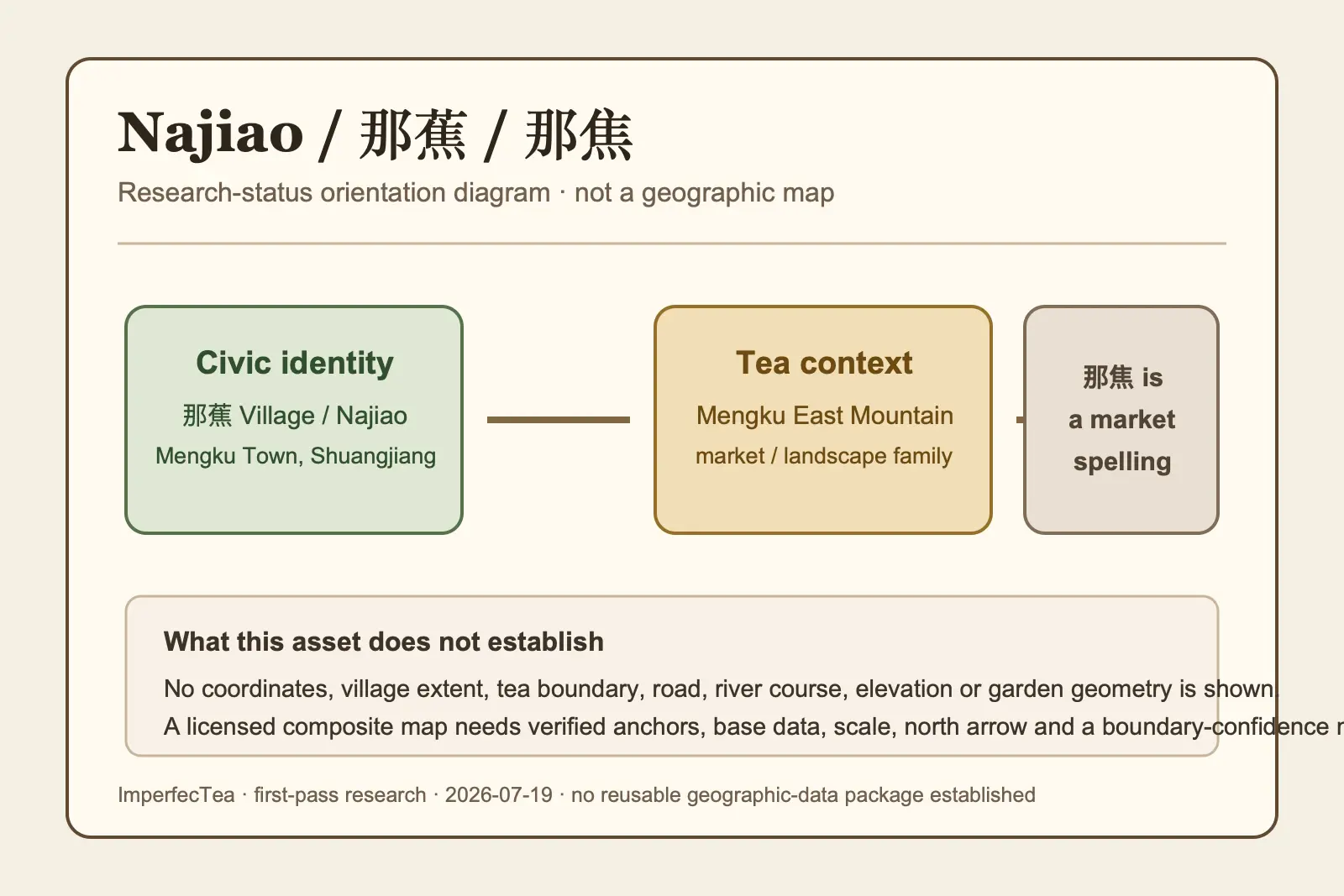
Place relationship diagram notes and sources
Diagram status: Not publication-grade: this first-pass orientation diagram deliberately contains no geographic geometry, coordinates, or boundary claim.
- ImperfecTea first-pass research-status diagram; no reusable geographic-data licence established
Najiao’s official name is 那蕉村. Tea listings often use 那焦 instead. Both spellings are worth searching, but keep the official characters when asking about the village in Mengku Town, Shuangjiang County.
What do we know about the tea?
Najiao is usually grouped with eastern Mengku. Tea-community and product accounts mention bitterness, returning sweetness and a substantial middle, but the evidence is too limited to define a village profile.
Compare a sourced Najiao with Banuo or Nasai-area tea from the same season. Record what the sample does rather than looking for a required “East Mountain” taste.
Vine-pruned tea and village management
Provincial agricultural reporting and local accounts describe tengtiao, the vine-like pruning and picking system, in Najiao’s tea economy. It is a management practice. It doesn’t identify a cultivar, verify old trees or establish that every garden uses it.
The administrative village is clear, while the current smaller-settlement roster and garden boundaries are less secure. A narrow garden name from a seller needs supporting records of its own.
What I would ask
Ask whether the tea is Najiao-only material or a broader eastern Mengku blend, then establish the harvest and maocha maker. If tengtiao or ancient-tree material carries a premium, ask how the source garden and picking were documented.
The available record doesn’t support a dependable current price series or one garden elevation for all Najiao tea. Precise-looking sales figures won’t fill that gap.
Sources and limits
All sources accessed 19 July 2026.
- Yunnan administrative-village coding standard DB53/T 1176.9-2023 - official civic spelling and hierarchy.
- Yunnan Department of Agriculture and Rural Affairs / People’s Daily Online Yunnan, “Tea fragrance on Shuangjiang’s road to rural revitalisation” (2022) - named Najiao village-leader account of management and livelihood.
- 老闪的茶, “Nasai ancient-tree tea” (2024), republished by Baidu Health - Chinese tea-community contextual reporting that names Najiao in the East-Mountain village conversation; used only at reporting level.
- Yunnan.cn, “Vine-pruned tea: a horticultural wonder” (2022) - contextual explanation of vine-pruned-tea management in nearby Banuo, not a Najiao census.
- Xiao Chunlei, “Dianqing and Dianhong,” Fujian Literature / China Writers Association site (2023) - regional tea-history context only, not a Najiao geographical or sensory source.
Evidence limits: The illustration is deliberately non-geographic. No licensed composite map, controlled multi-producer Najiao tasting series, garden-ecology audit or normalized current price pair was found.
Quick answers
Frequently asked questions
What does the Najiao tea name identify?
Najiao is an administrative village in Mengku Town, Shuangjiang County, Lincang, Yunnan.
What does Najiao tea taste like?
Sparse reports suggest testing aroma, bitterness, astringency, texture and sweet return, but no blind multi-producer comparison supports a universal Najiao profile.
What is Najiao commonly confused with?
Official Najiao 那蕉, commercial 那焦 and the broader Mengku East label are related search terms, not equal origin evidence.
What should I ask before buying Najiao tea?
Which Chinese spelling, smaller locality, season, garden or household, and maker does this Najiao lot claim?