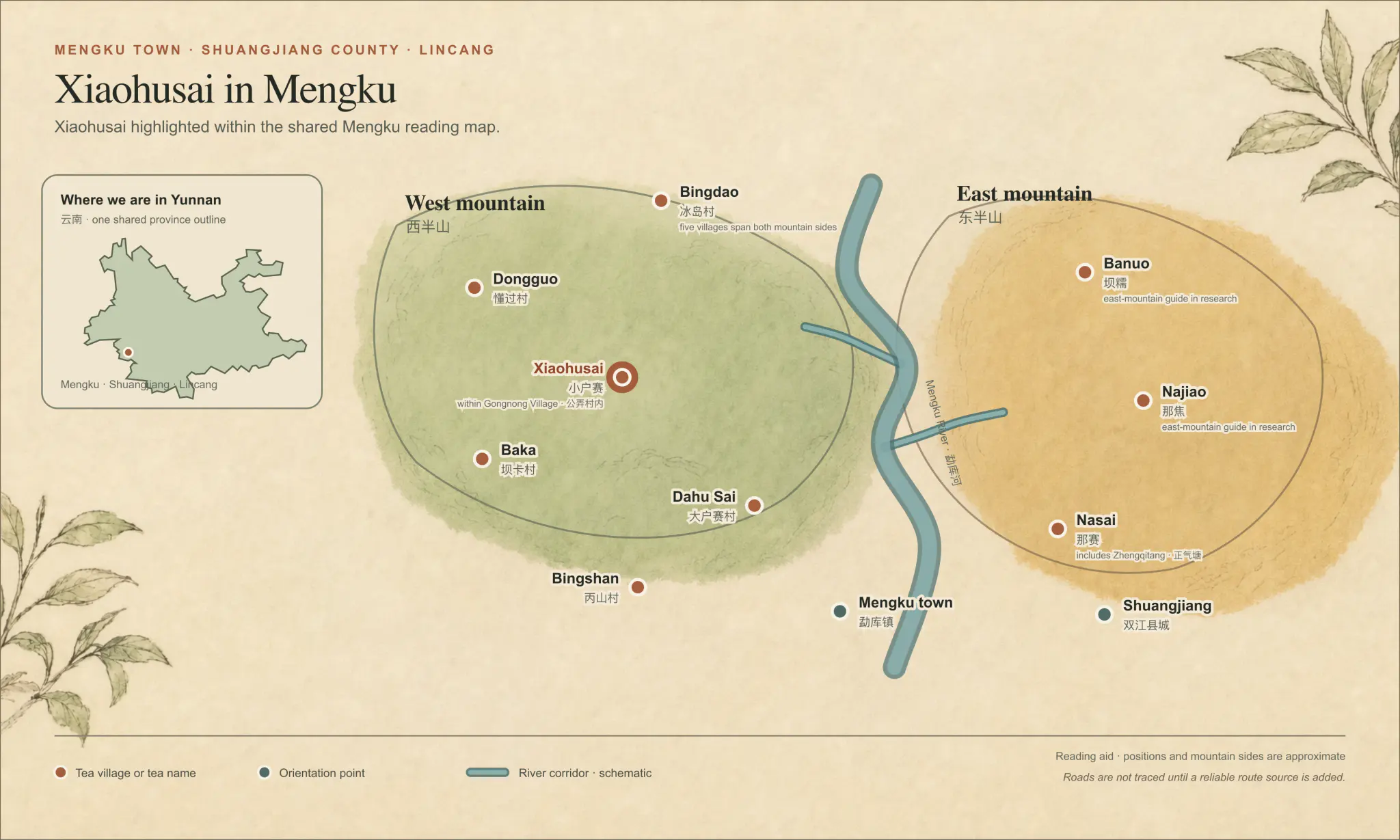
Orientation guide notes and sources
Boundary confidence: Not publication-grade: existing locality positions and geographic shapes have no licensed, verified data basis in this pass.
- ImperfecTea legacy orientation illustration; no external geographic-data licence established in this pass
Xiaohusai (小户赛) is a natural-village locality under Gongnong Village, Mengku Town. Sellers sometimes call it Sai Bingdao (赛冰岛), or “rival to Bingdao.” That describes its market positioning; Xiaohusai has its own address.
What the sampled tea showed
A 2023 study comparing four Shuangjiang origins across three seasons described its Xiaohusai teas as full or intense, with returning sweetness. It also found significant differences by season and origin.
Flowers, honey and thick texture recur in trade descriptions, but the controlled study is a better starting point: expect variation, and keep the harvest attached to the tasting note. It doesn’t authenticate another cake carrying the name.
One name, smaller settlements
Institutional reporting identifies Xiaohusai Natural Village and documents spring-harvest work. A long-running tea-community field account describes a cluster of Yizhai, Liangzizhai and Wazizhai. Their current administrative rank wasn’t confirmed in an official roster, so a seller using one of those narrower names should explain it.
Lincang reporting also describes Lahu tea practice and livestream training. The village is part of a working contemporary tea trade, with the same need to connect garden, processor and batch as elsewhere.
A first comparison
Try Xiaohusai beside a sourced Banuo from the same season, or Dongguo if you want another western Mengku reference. Brew them identically and watch whether the body lasts after the first fragrance fades.
Ask which settlement or garden supplied the sample, who made the maocha and whether the lot was blended. Neither the Bingdao comparison nor nearby Daxueshan wild-tea stories establish tree age or origin. The available sources don’t support one elevation or ageing trajectory for all Xiaohusai.
Sources and limits
All web sources accessed 19 July 2026.
- Yunnan administrative-village coding standard DB53/T 1176.9-2023 - Gongnong’s administrative status under Mengku Town; it does not list Xiaohusai as an administrative village.
- Lincang Agriculture and Rural Affairs Bureau (2024) - Gongnong/Xiaohusai relationship in tea-industry context.
- Workers’ Daily field report (2024) - Xiaohusai Natural Village labour context and named party-branch source.
- Lincang Daily (2026) - named Xiaohusai training and reported Lahu roasting practices.
- People’s Daily, Minsheng Weekly (2024) - household tea-livelihood context.
- Shuangjiang market-regulation enforcement notice (2024) - producer-identity/licence case involving 786 Xiaohusai-labelled cakes; not a leaf-origin finding.
- Houyue Ancient-tree Tea field account (2019) - reported three-settlement naming and local distinctions; community/producer evidence, not an official roster or survey.
- Ai Pu Cha local tea article - Chinese tea-community Daxueshan/West-Mountain and local-history context, attributed rather than treated as documentary history.
- Wang Xinyu et al. (2023), Journal of Food Safety & Quality - sampled Shuangjiang origin-and-season comparison; not a universal commercial profile.
A note on what is still missing: The existing SVG/PNG/WebP is a legacy orientation illustration. It has no reusable geographic-data licence or verified locality geometry, so it is not a composite map. We located no controlled ImperfecTea Xiaohusai tasting, independent commercial tasting series across several producers or defensible dated price range. Those gaps stay visible beside the useful evidence.
Quick answers
Frequently asked questions
What does the Xiaohusai tea name identify?
Xiaohusai is a tea-famous natural-village locality under Gongnong Village, Mengku Town, Shuangjiang County, Lincang.
What does Xiaohusai tea taste like?
Controlled samples were full or intense with returning sweetness; flowers, honey, salivation and thick texture remain useful prompts whose balance changes by season and process.
What is Xiaohusai commonly confused with?
Xiaohusai is under Gongnong Village; it is not Bingdao, and Mengku West is only a broader market and landscape grouping.
What should I ask before buying Xiaohusai tea?
Which reported settlement or garden supplied this Xiaohusai lot, in what season, and who made the maocha?