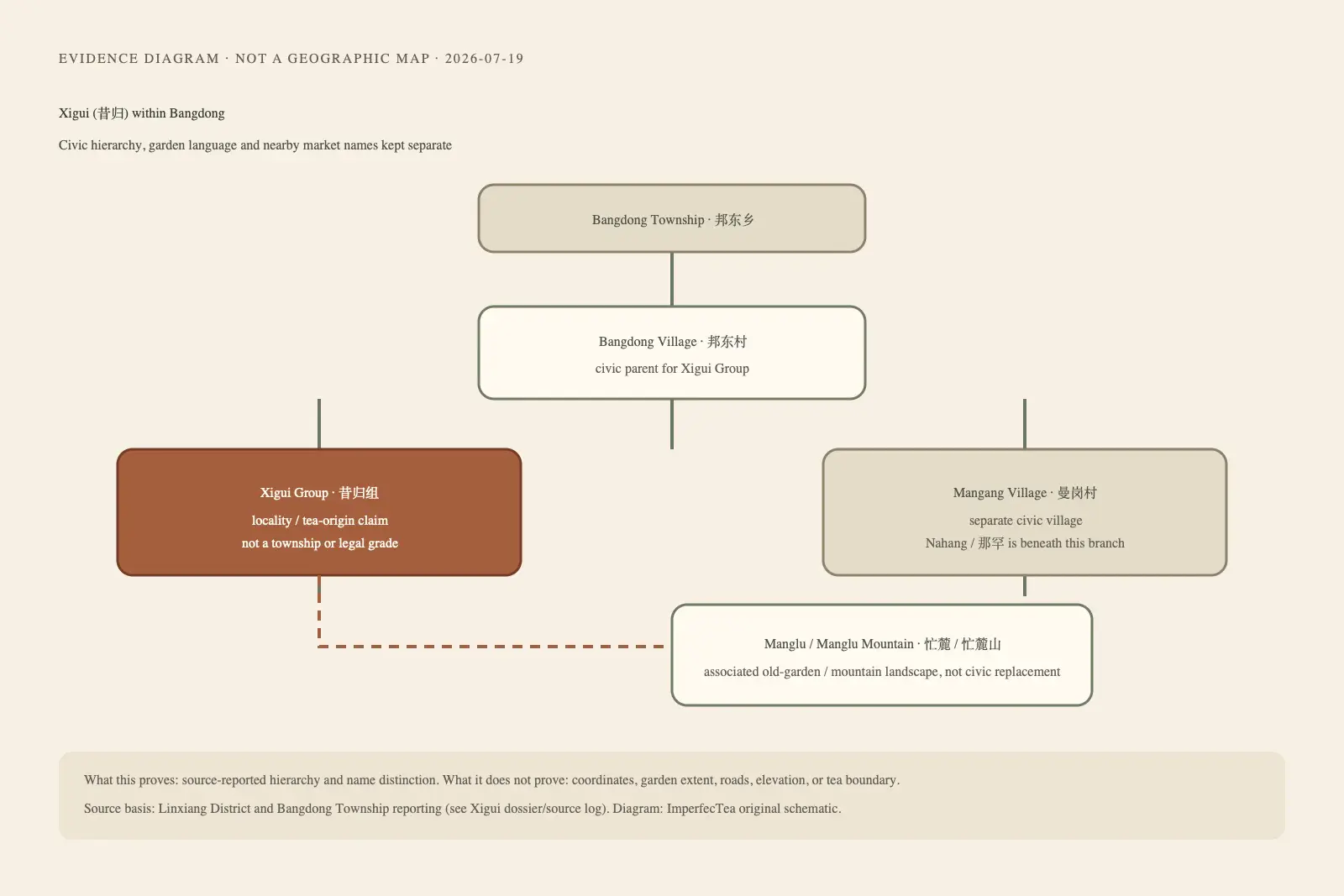
Place relationship diagram notes and sources
Diagram status: Not publication-grade: this evidence diagram deliberately does not assert coordinates, boundaries, routes, or garden geometry.
- Linxiang District and Bangdong Township government sources listed in the dossier; schematic prepared 2026-07-19
Xigui (昔归) is a locality inside Bangdong Village, Bangdong Township, in Lincang’s Linxiang District. It is associated with the old gardens of Manglu Mountain (忙麓山), close to the Lancang River. Xigui, Manglu and the wider Bangdong township are related names with different meanings.
What does the tasting record suggest?
Named drinking accounts describe orchid-like fragrance, sweetness, bitterness that clears and a lasting sweet return. The samples differ in age, source and brewing, so they don’t establish a fixed Xigui profile.
The wider Bangdong comparison is useful here: specialist tastings include both full, satisfying Xigui-labelled teas and a bitter, thin example. Paying for the name doesn’t remove the need to sample the batch.
What the garden record can tell us
Institutional reporting documents protected old gardens and a local tea economy involving roads, visitors and processing. Protection status doesn’t certify the age, organic management or origin of every retail cake.
“Rock rhyme,” or yanyun, also appears in Xigui sales language. It can describe a drinker’s impression, but the sources here don’t establish a direct soil-to-flavour explanation. No representative garden-level climate or soil series supports one for the locality.
Ask where the claim narrows
A Bangdong tea is not automatically Xigui. Ask whether the source is Xigui Group, a particular Manglu garden or a wider township blend. Then establish the harvest, processor and storage.
Compare the sample with a broader Bangdong tea of similar age before paying the premium. Use the same water and timing, and record how the body and finish hold through later infusions. Those observations help you choose the cup; the lot records must support the origin.
Sources and limits
All web sources accessed 19 July 2026.
- Linxiang District industry-services reply (2020) - Xigui/Manglu 600-mu and Xiaoguangshan 176-mu protected-garden scopes; conservation/project context.
- Bangdong Township tea-industry investigation report (2019) - Bangdong Village, Xigui Group hierarchy; dated 2017 local output/average-price statistic with limited comparability.
- Bangdong Township 2026 budget - current Bangdong Village Xigui-area and Xigui-group project usage.
- Lincang commerce-bureau report - protected Xigui/Manglu and Xiaoguangshan garden total; brand/traceability context.
- People’s Daily Overseas Edition field report (2019) - growers’ reported concern about visitor picking and local conservation pressure.
- Nanmingjiaren tea-community tasting article (2025) - attributed, product/time-specific sensory language; not independent provenance verification.
- Media report on Xigui cultural naming and processing heritage (2023) - reports historical names 蛮鹿/锡规 and calls 昔归团茶制作技艺 a provincial intangible-heritage item; useful cultural reporting, not a village register.
Evidence limits: The Xigui asset is a source-attributed hierarchy diagram, not a licensed composite map, and it claims no coordinates or boundaries. No controlled multi-producer tasting set or current comparable price range was found.
Quick answers
Frequently asked questions
What does the Xigui tea name identify?
Xigui is a village group inside Bangdong Village, Bangdong Township, Linxiang District, Lincang, Yunnan.
What does Xigui tea taste like?
Named accounts report orchid fragrance, soft sweetness, bitterness, salivation and returning sweetness; sparse unmatched samples cannot make those traits an authentication rule.
What is Xigui commonly confused with?
Xigui group, Manglu Mountain, Bangdong Village and Bangdong Township are connected but distinct geographic and market scopes.
What should I ask before buying Xigui tea?
Which Xigui or Manglu garden, season, household and processor can be connected to this lot?