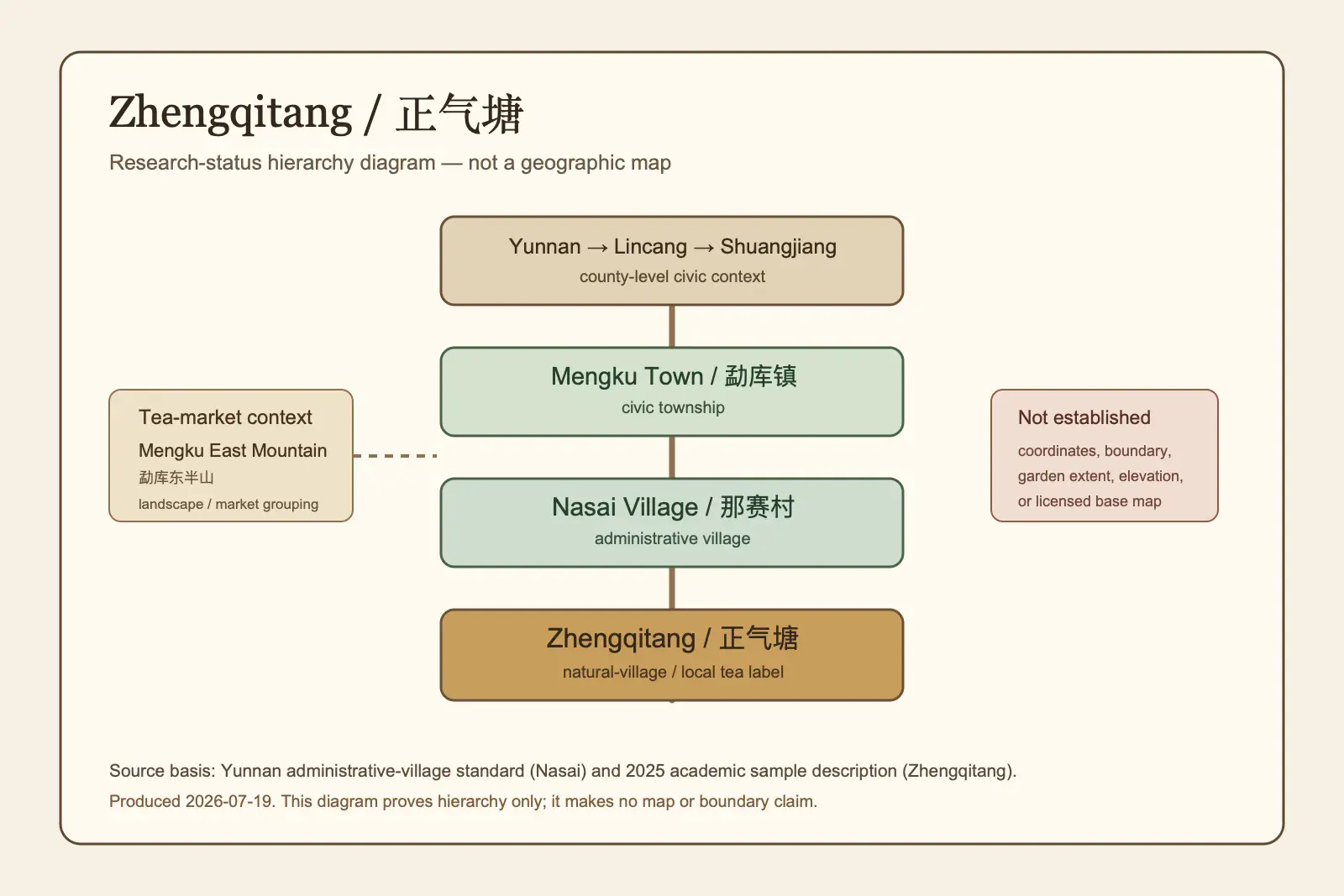
Place relationship diagram notes and sources
Diagram status: Not publication-grade: this first-pass orientation diagram deliberately contains no geographic geometry, coordinates, or boundary claim.
- ImperfecTea first-pass research-status diagram; no reusable geographic-data licence established
Zhengqitang (正气塘) is a natural village under Nasai Village in Mengku Town, Shuangjiang County. It belongs to the eastern Mengku tea grouping. “Little Bingdao” is a market nickname, not its location.
What the tasting notes say
A Gu Cha Ju review of a 2017 cake reported fresh floral aroma, sweetness and salivation, with a later bitter or drying edge that cleared. A separate account of a 2019 sample described a floral, balanced cup with modest dryness.
These are individual drinking reports. They support trying a sample, but not a guarantee of cooling, thickness or a Bingdao-like flavour.
Nasai is the parent
A 2025 tea-science paper identifies Zhengqitang as a natural village beneath Nasai. The experiment used its maocha in a ripe-pu-erh fermentation comparison. That supports the locality relationship; it doesn’t establish a raw-tea profile or a village-wide ripe tradition.
Nasai and Zhengqitang are therefore different scales of claim. A “Nasai Zhengqitang” lot needs to say whether it comes from the smaller locality or is a wider blend. The illustration on this page shows that relationship and doesn’t map garden boundaries.
Local and producer accounts also associate the area with tengtiao management. Ask whether that practice applies to the supplying garden, rather than treating it as a cultivar or an age category.
Compare within eastern Mengku
Taste a documented Zhengqitang beside a disclosed Nasai lot or a nearby Banuo or Najiao. Match the harvest and brewing conditions, then record the aroma and how long the finish lasts.
Before buying, ask who made the maocha, whether it was kept separate through pressing and how it has been stored. The nickname adds no evidence to those answers.
Sources and limits
All sources were accessed 19 July 2026. Detailed claim confidence, working translations, conflicts and next-pass tasks are in the accompanying dossier and source log.
- Yunnan DB53/T 1176.9-2023 administrative village and community code standard - official civic placement of Nasai Village under Mengku Town.
- Yang Sirun et al., “Quality Characteristics of Pu-erh Ripe Tea in Lincang Tea Area” (2025) - academic sample description identifies Zhengqitang as a natural village under Nasai Village Committee; limited to standardized ripe processing.
- 荣瑞祥, “How to distinguish Najiao and Zhengqitang tea” (2021) - named tea-specialist comparison and reported local hierarchy; used at reporting level.
- 网茶会习茶社 via 古茶居, “Zhengqitang tasting” (2019) - attributable product-specific tasting, not a regional profile.
- 读茗人, “Zhengqitang evaluation” (2022) - attributable sample note, not independent market evidence.
- 老闪的茶, “Nasai ancient-tree tea” (2024), republished by Baidu Health - Chinese tea-community reporting; personal tasting and price image are not treated as a market range.
Evidence limits: The illustration is deliberately non-geographic. No licensed composite map, controlled multi-producer Zhengqitang tasting series, garden-ecology audit, method-backed tree-age evidence or normalized current price pair was found.
Quick answers
Frequently asked questions
What does the Zhengqitang tea name identify?
Zhengqitang is a natural village under Nasai Village, Mengku Town, Shuangjiang County, Lincang, Yunnan.
What does Zhengqitang tea taste like?
Named lots report floral aroma, sweetness, salivation and returning sweetness with a later clearing grip; unmatched community accounts do not establish a village law.
What is Zhengqitang commonly confused with?
Zhengqitang is nested under Nasai and marketed within Mengku East; it is not part of Bingdao despite the nickname 'Little Bingdao.'
What should I ask before buying Zhengqitang tea?
Is this a single Zhengqitang lot or a broader Nasai blend, and which garden, season and maker support the claim?