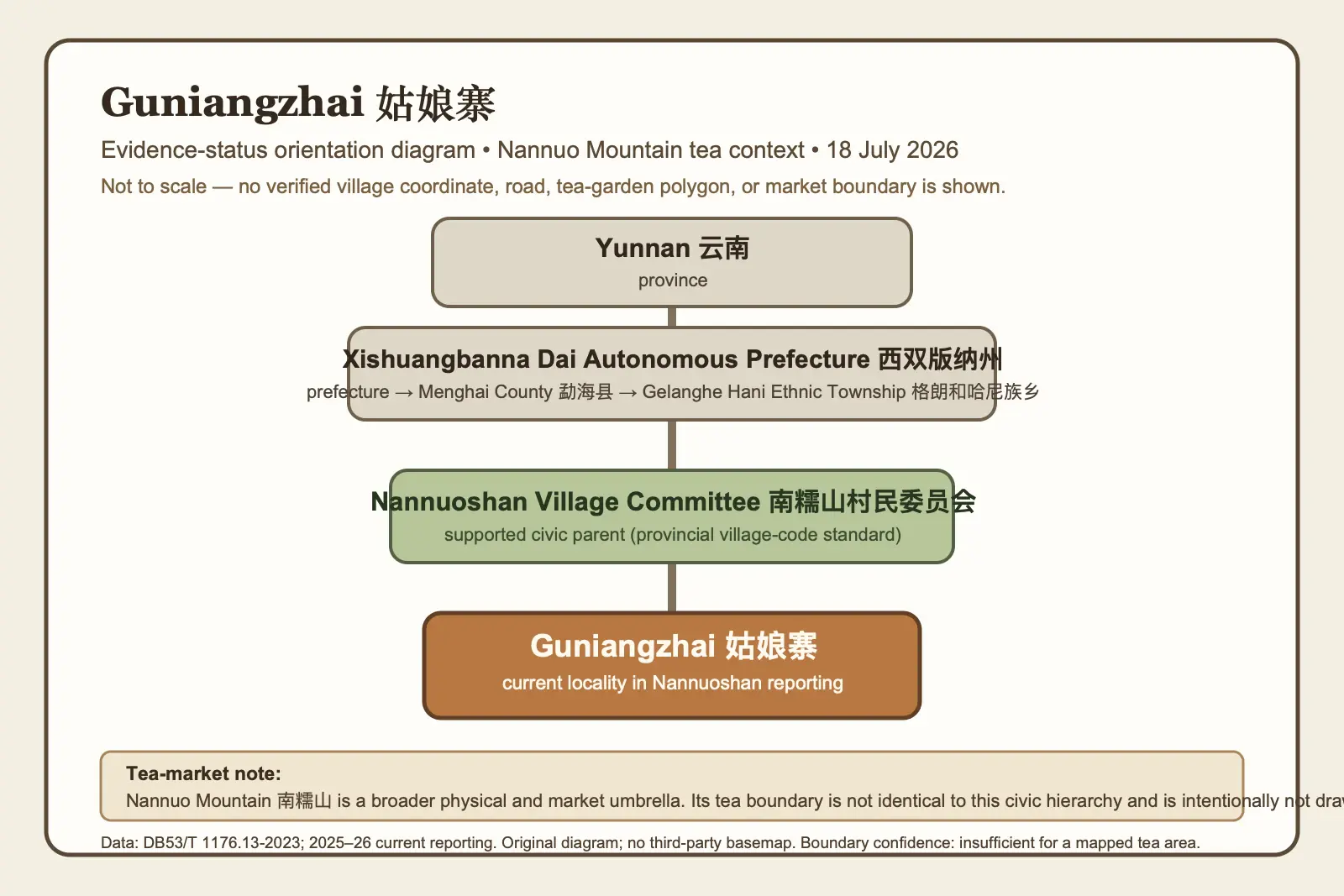
Place relationship diagram notes and sources
Diagram status: The hierarchy through Nannuoshan Village Committee and the current Guniangzhai locality are supported. No licensed base map, surveyed locality coordinate, or authoritative Guniangzhai tea-garden boundary was found; the diagram is not to scale.
- Yunnan provincial village-code standard DB53/T 1176.13-2023
- Yunnan/Xishuangbanna reporting (2025)
- Songjiang District People's Government reporting (2025–26)
Guniangzhai (姑娘寨) is a current locality under Nannuoshan Village Committee, Gelanghe Hani Ethnic Township, Menghai County. Provincial and local reporting describes tea production, visitors and small hospitality businesses there.
What can we say about the tea?
There isn’t enough independently documented Guniangzhai tasting evidence in this source set to describe a village profile. Broader Nannuo tastings range from fragrant and sweet to bitter, drying or thin. Those notes can’t simply be assigned to this smaller locality.
For a sourced Guniangzhai sample, record its aroma and texture and how it changes through the session. Compare it with a similarly aged Nannuo tea rather than trying to find a promised honey note or body sensation.
The locality is clearer than the garden boundary
Current reporting supports the place under Nannuoshan. It doesn’t supply a surveyed tea boundary, representative garden elevation or a tree-age inventory. “Guniangzhai” on a wrapper therefore needs a household or garden explanation if the seller is claiming more than village-area material.
The same applies to nearby Nannuo names. Banpo Laozhai and Shitou Xinzhai are separate localities, even when a merchant groups their teas together.
Before buying
Ask who supplied the leaf, who processed it and whether the cake is a village blend or a separated lot. The harvest and storage should be clear enough to make a sample comparison useful.
A modest claim with those details is easier to assess than an ancient-tree story built around the village name alone.
Sources and limits
Research was completed 18 July 2026. The hierarchy through Nannuoshan Village Committee is based on the Yunnan provincial village-code standard. Current Guniangzhai context is corroborated by Yunnan/Xishuangbanna reporting, Songjiang’s 2025 report, and its 2026 project report. The name story comes only from a secondary historical profile and remains reported. A Chinese tea-community profile adds attributed local-history and tasting language, while a specialist producer’s Nannuo overview supports only the limited point that Guniangzhai is a recognized tea-community name. Broad Nannuo variation is illustrated, not proven for this village, by TeaDB’s 2014 tasting report.
Quick answers
Frequently asked questions
What does the Guniangzhai tea name identify?
A current village locality beneath Nannuoshan Village Committee in Gelanghe Hani Ethnic Township, Menghai County; its exact controlled natural-village rank remains unverified.
What does Guniangzhai tea taste like?
No village fingerprint is supported; broader Nannuo teas can be floral, sweet, bitter, drying or textured, so a Guniangzhai lot needs disclosed sample provenance.
What is Guniangzhai commonly confused with?
Guniangzhai is one locality within Nannuoshan, not a synonym for the whole mountain or proof of a seller's garden claim.
What should I ask before buying Guniangzhai tea?
Who made this Guniangzhai lot, from which garden and season?