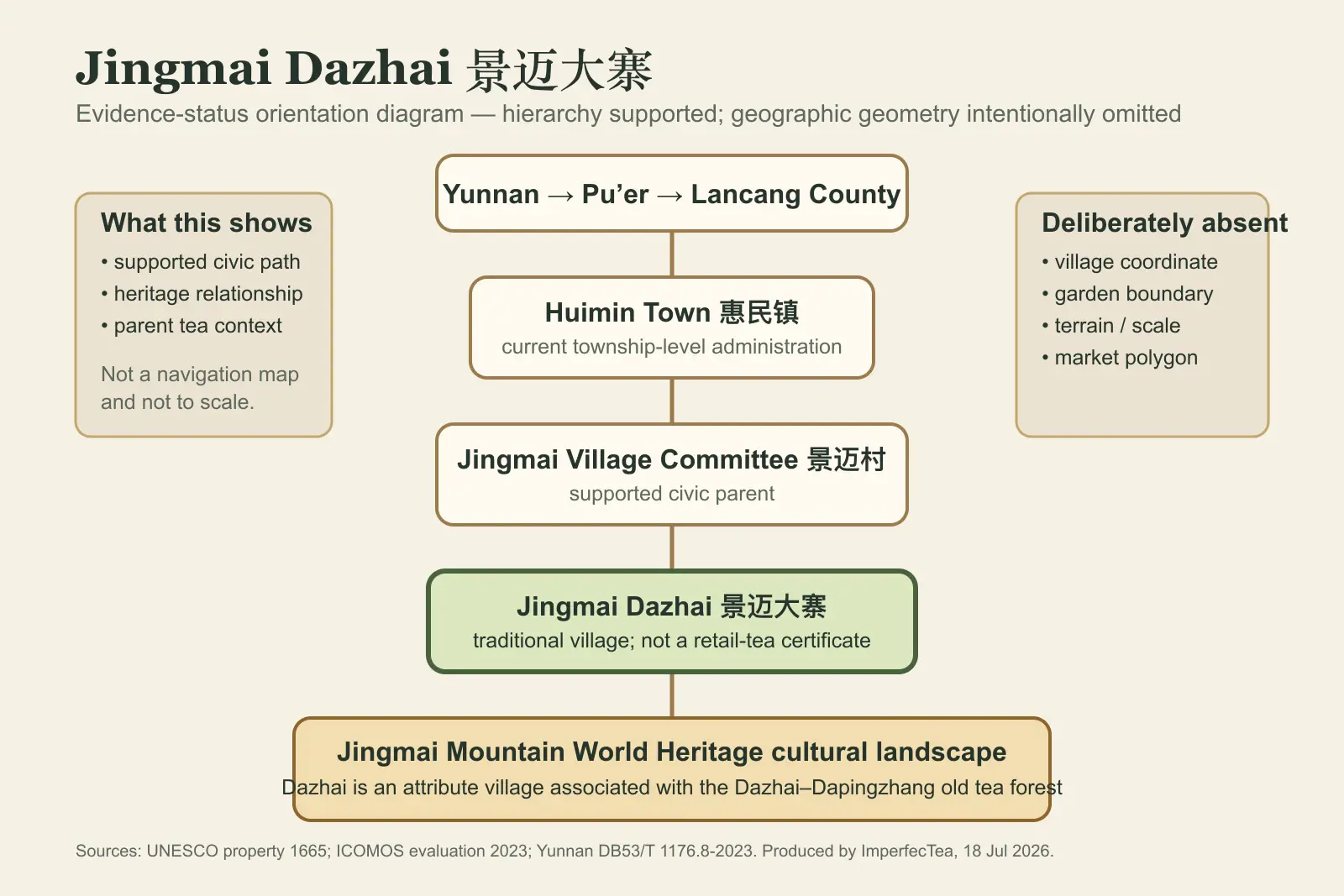
Place relationship diagram notes and sources
Diagram status: The administrative path and Jingmai Dazhai's status as a named World Heritage traditional village are supported. No reusable authoritative geometry or independently verified village/garden coordinate was obtained for this pass; the original diagram is not to scale.
- UNESCO World Heritage property 1665 and ICOMOS evaluation
- Yunnan DB53/T 1176.8-2023 administrative-village standard
Jingmai Dazhai (景迈大寨) is one of the traditional villages named in Jingmai Mountain’s 2023 World Heritage inscription. The heritage evaluation associates it with the Jingmai Dazhai and Dapingzhang old-tea-forest cluster.
That is a well-documented landscape relationship. It doesn’t certify individual cakes.
What might the tea taste like?
A producer-hosted note by Ke Feng for Yunque Manor’s 2022 spring Dazhai cake describes orchid and honey aromas, a little initial astringency and a strong sweet return. It is an account of that producer’s tea, not an independent village comparison.
Broader Jingmai tastings often mention flowers, honey and citrus. They make useful prompts for a sample, but there isn’t enough Dazhai-specific evidence here to promise one flavour or texture.
Village, forest and heritage property
The village name, the associated forest cluster and the whole Jingmai cultural landscape describe different areas. A commercial “Jingmai” blend may be broader again. Ask which garden or household is meant when a seller narrows the name to Dazhai.
World Heritage recognition concerns the living land-use system and its communities. It doesn’t establish a cake’s tree age, organic status or harvest source.
Try a local comparison
Compare a documented Dazhai sample with another named Jingmai village tea, using similar harvests, storage and brewing. Notice whether the fragrance lasts and how the grip develops.
Before buying, ask who made the maocha and whether it remained a separate lot. The forest name should connect to a garden record, not just appear beside a heritage logo.
Sources and limits
Research was completed 18 July 2026. The primary basis for the identity, village/forest pairing, property composition, physical setting and cultural-landscape distinction is the ICOMOS evaluation, read alongside UNESCO property 1665 and the World Heritage Committee decision. The current civic path is supported by the Yunnan administrative-village standard. The 2026 Jingmai aroma study and limited specialist tasting records are context for a wider Jingmai hypothesis, not a Dazhai authentication test.
This second pass also records three Chinese-language sources at their appropriate weight: a named Dazhai household-practice account in Farmers’ Daily; a field-reporting project with named Dazhai growers in Red Star News’ COP15 feature; and Ke Feng’s Yunque Manor product note. The first two improve reported lived-practice context. The latter is a clearly producer-affiliated, dated lot claim, useful for a stated sample, never for verifying geography, tree age or a general price range.
Quick answers
Frequently asked questions
What does the Jingmai Dazhai tea name identify?
A traditional village under Jingmai Village Committee, Huimin Town, Lancang County, within the Jingmai Mountain World Heritage cultural landscape.
What does Jingmai Dazhai tea taste like?
Broader Jingmai evidence suggests flowers, honey or citrus with variable bitterness and sweet return; no independent multi-producer set supports a Dazhai-only fingerprint.
What is Jingmai Dazhai commonly confused with?
Jingmai Dazhai village, Dapingzhang forest, the UNESCO property and a broad Jingmai market label are not the same provenance claim.
What should I ask before buying Jingmai Dazhai tea?
Which Dazhai garden, household, season and maker produced this lot?