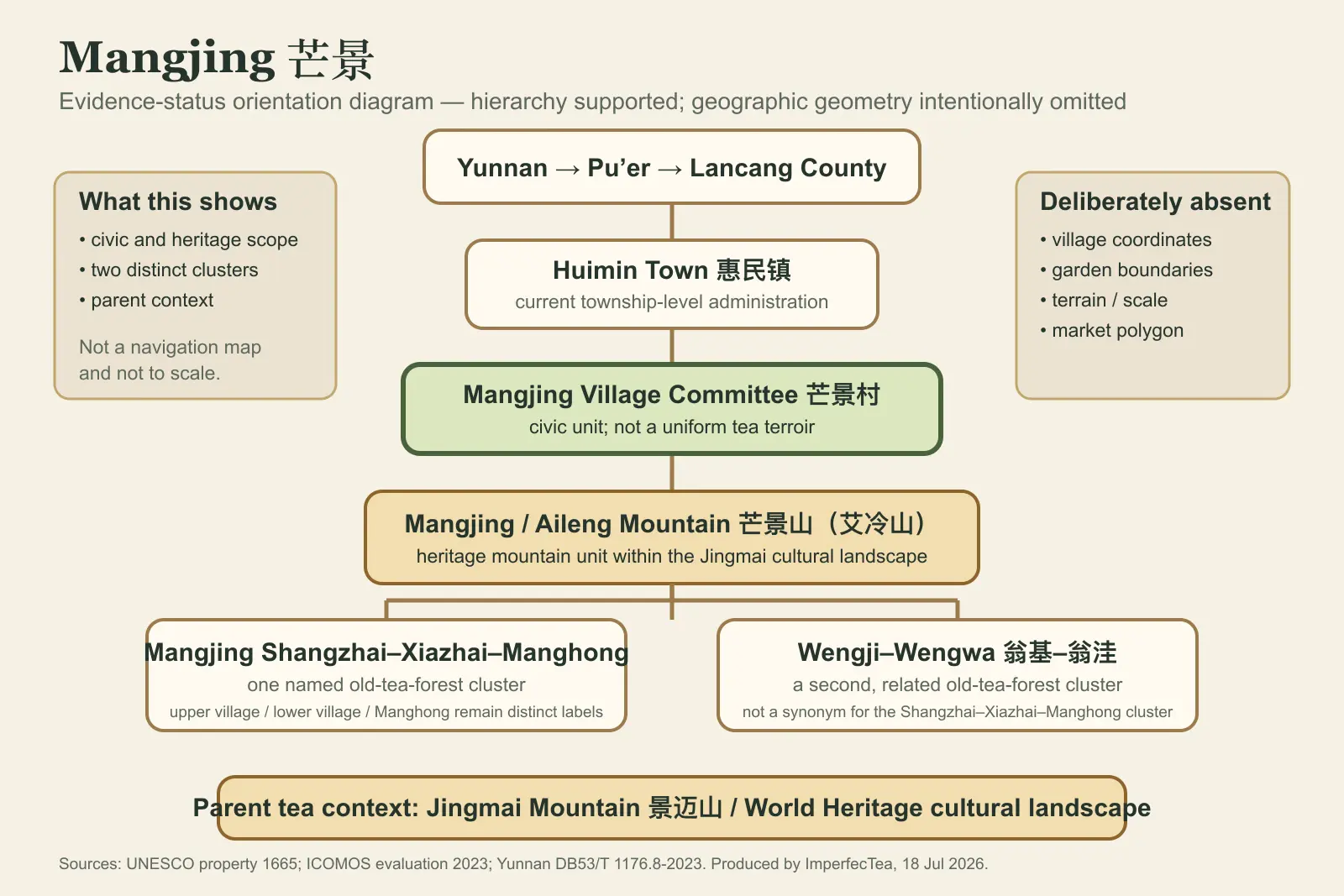
Place relationship diagram notes and sources
Diagram status: The civic and heritage hierarchy is supported. No reusable authoritative geometry, independently verified village coordinate, or surveyed tea-garden boundary was obtained; this original diagram is not to scale.
- UNESCO World Heritage property 1665 and ICOMOS evaluation
- Yunnan DB53/T 1176.8-2023 administrative-village standard
- Journal of Qujing Normal University (2022), Mangjing Shangzhai Blang field study
Mangjing (芒景) can mean a village committee under Huimin Town, the upper or lower settlements, or the southern mountain unit of Jingmai’s heritage landscape. The mountain is also called Aileng. Ask which meaning a tea label uses.
The villages don’t all taste alike
A 2024 Yunnan Agricultural University study made sun-dried maocha under a common protocol from seven Jingmai village gardens, including Mangjing Shangzhai and Xiazhai. It found measurable differences. In its aroma screen, Xiazhai was the one sample without a detected flower-aroma type.
That finding belongs to the sampled material and method. It doesn’t mean Xiazhai tea can never smell floral. It does show why upper and lower Mangjing shouldn’t be merged into one guaranteed taste.
What the heritage geography tells us
Mangjing Shangzhai and Xiazhai are separate place names. Manghong, Wengji and Wengwa also belong to the southern Jingmai context. The heritage documents identify two old-tea-forest clusters on this side and describe a living Blang-managed landscape.
Those records establish relationships between villages and forests. They don’t certify the garden, tree age or organic status of a commercial cake.
A useful comparison
If you can find clearly sourced upper- and lower-village samples from similar harvests, brew them together. Keep the water, ratio and timing the same, and note the aroma before deciding whether the names help explain it.
For any Mangjing purchase, ask which settlement and household supplied the leaf, who made the maocha and whether it was blended. A committee-wide tea can be honestly described as such; a smaller claim needs a smaller sourcing record.
Sources and limits
Research was refreshed 19 July 2026. The identity, cluster names, property composition and scope distinctions rest chiefly on the ICOMOS evaluation, UNESCO property 1665 and the World Heritage Committee decision. The present administrative backbone comes from the Yunnan administrative-village standard. The 2022 Mangjing Shangzhai Blang-language field study is specific to community context, not tea provenance. A 2024 Yunnan Agricultural University study compares standardised Shangzhai and Xiazhai samples; it does not authenticate retail tea. Local village tea rules and a Nan Kang profile add attributed, Chinese-language stewardship context. Wider Jingmai context comes from a 2026 aroma study and clearly limited tasting records.
Quick answers
Frequently asked questions
What does the Mangjing tea name identify?
Mangjing Village Committee in Huimin Town, Lancang County, covering several Blang villages and forest clusters within the Jingmai Mountain heritage landscape.
What does Mangjing tea taste like?
Standardized research samples separated Shangzhai and Xiazhai chemically, but no retail Mangjing fingerprint is supported; broader Jingmai florals and sweetness remain hypotheses to test.
What is Mangjing commonly confused with?
Mangjing committee, Mangjing mountain unit, its named villages and a broad Jingmai blend are different geographic and sourcing claims.
What should I ask before buying Mangjing tea?
Which Mangjing village, forest or garden supplied this lot?