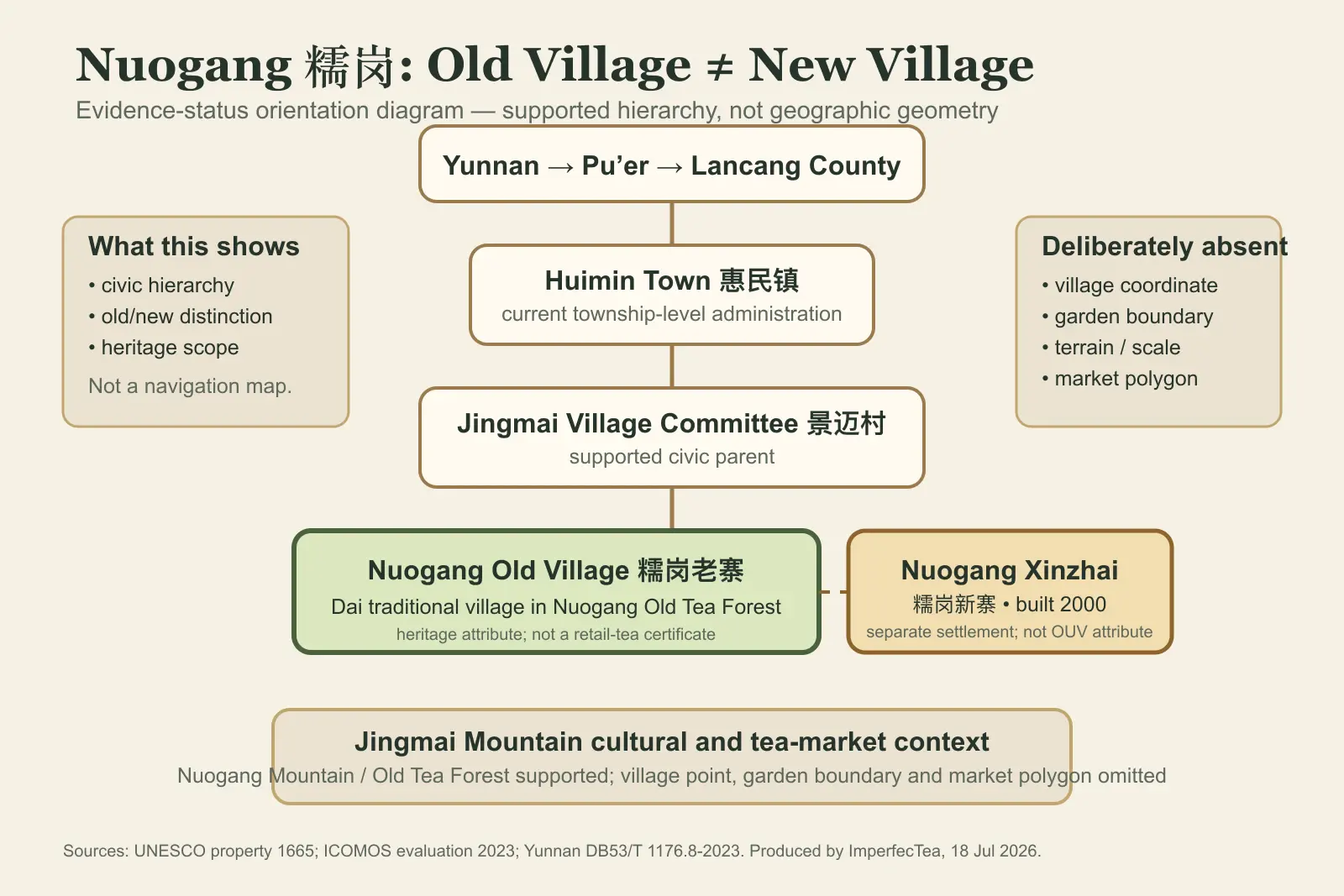
Place relationship diagram notes and sources
Diagram status: The administrative path and the distinction between Nuogang Old Village and Nuogang Xinzhai are supported by ICOMOS and local institutional reporting. No reusable authoritative village or tea-garden geometry was secured; this original diagram is not to scale.
- UNESCO World Heritage property 1665 and ICOMOS evaluation
- Yunnan DB53/T 1176.8-2023 administrative-village standard
- Yunnan/People's Daily local reporting
Nuogang Old Village (糯岗老寨) is a Dai village associated with the Nuogang Old Tea Forest in Jingmai’s World Heritage landscape. Nuogang Xinzhai (糯岗新寨) is a separate settlement, built in 2000 to protect the older village from development.
A short “Nuogang” label should say which place or garden it means.
What might the tea taste like?
The source set doesn’t contain enough independent Nuogang samples to define a village profile. Broader Jingmai teas often show flowers, honey or citrus, with varying bitterness and astringency. Those notes can guide a first tasting, but shouldn’t be reassigned to every Nuogang cake.
Look for the aroma you actually find, then watch whether it and the texture persist. Record any sweet return separately from sweetness in the initial sip.
Old village and new village
Heritage documents place Xinzhai within the inscribed property but distinguish it from the attributes recognised for Outstanding Universal Value. That is a heritage distinction, not a tea grade.
The old village, new settlement, forest cluster and wider Jingmai commercial area are different scopes. None establishes a particular cake’s garden, tree age or organic status.
Before buying
Ask which household and garden supplied the leaf, the harvest and maocha maker, and whether it remained a separate lot. The old-village name needs to connect to that sourcing record.
Compare a sample with another named Jingmai village tea from similar conditions. Match the brewing and let the differences you enjoy guide the next purchase.
Sources and limits
Research was completed 19 July 2026. The identity, old/new-village distinction, Nuogang Mountain/Old Tea Forest relationship, property composition, physical setting and conservation context rest principally on the ICOMOS evaluation, read with UNESCO property 1665 and the World Heritage Committee decision. The current administrative backbone is supported by the Yunnan administrative-village standard. Named Chinese local accounts add household tea-work and direct-market context, and a 2023 Yunnan feature exposes a conflicting local name explanation; neither is used to authenticate tea, fix a garden boundary, or assign a village flavor.
Quick answers
Frequently asked questions
What does the Nuogang tea name identify?
Nuogang Old Village lies under Jingmai Village Committee in Huimin Town, Lancang County, within Jingmai Mountain's World Heritage cultural landscape.
What does Nuogang tea taste like?
No Nuogang-only profile is supported; broader Jingmai evidence suggests floral, honeyed or citrus notes with variable grip, but transparent lot provenance must lead.
What is Nuogang commonly confused with?
Nuogang Laozhai and Nuogang Xinzhai are separate settlements, and an unspecified Nuogang label does not prove old-village leaf.
What should I ask before buying Nuogang tea?
Does this Nuogang lot come from the old village or new village, and which garden?