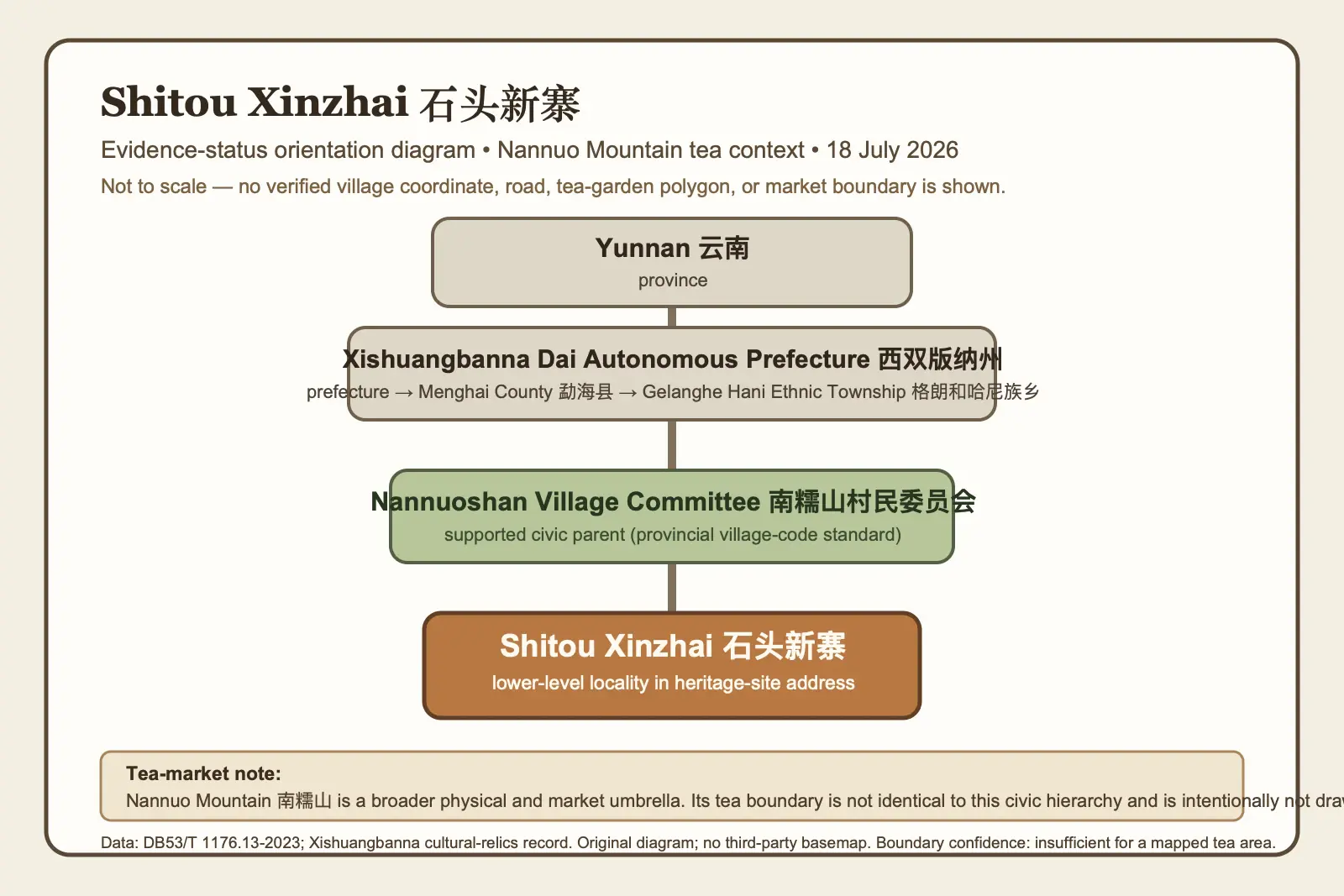
Place relationship diagram notes and sources
Diagram status: The civic hierarchy and heritage-site address are supported. No licensed base map, surveyed locality coordinate, or authoritative Shitou Xinzhai tea-garden boundary was found; the diagram is not to scale.
- Yunnan provincial village-code standard DB53/T 1176.13-2023
- Xishuangbanna cultural-relics record
- Yunnan Academy of Agricultural Sciences Tea Research Institute chronology
Shitou Xinzhai (石头新寨) is a locality under Nannuoshan Village Committee, Gelanghe Hani Ethnic Township, Menghai County. Its clearest historical anchor is the protected former Nannuo tea-factory site.
What do we know about its tea?
There isn’t enough independent, clearly sourced Shitou Xinzhai tasting evidence to define a village profile. A producer’s Nannuo overview includes the locality and describes a wider green-to-honeyed, sweet-returning style. The shorter “Shitouzhai” label may also cover more than this settlement.
Those descriptions are reasons to ask about a sample, not a guarantee. Broader Nannuo notes can’t identify the smaller village’s tea.
The factory history
From 1938 to 1940, the Sipu tea experimental project associated with Bai Mengyu brought mechanised tea work to this part of Nannuo. The surviving factory site records a meeting of local leaf, labour and public investment.
That history gives the place a specific role in tea production. It doesn’t establish that today’s cakes use the same gardens, methods or material.
Ask what “Shitou” covers
For a village-labelled tea, ask the seller for the full Chinese name and supplying household or garden. Then confirm the harvest, processor and whether it was blended before pressing.
Compare a sourced sample with a broad Nannuo or Banpo of similar age and storage. Keep brewing steady and record the aroma and texture you find. A factory-site photograph supports the history, while the batch records have to support the product.
Sources and limits
Sources were accessed 18 July 2026. The provincial village-code standard supports the civic chain through Nannuoshan Village Committee. The heritage record supports the factory site’s Shitou Xinzhai address. The Tea Research Institute chronology and historical reporting support the 1938 to 1940 factory narrative, while preserving conflicts over establishment, construction and completion dates. This second pass adds two Chinese tea-community sources: Dao Ge and Wang Lei’s sponsored but named 2020 on-foot account, used for attributed settlement and observed garden context, and Houyue’s 2019 regional producer guide, used only as broad Nannuo/石头寨 sensory context. Neither turns into a village boundary, laboratory ecology study or Shitou Xinzhai tasting certificate.
Quick answers
Frequently asked questions
What does the Shitou Xinzhai tea name identify?
A lower-level village locality beneath Nannuoshan Village Committee in Gelanghe Hani Ethnic Township, Menghai County, supported by heritage-site reporting.
What does Shitou Xinzhai tea taste like?
No village fingerprint is supported; declared teas may reflect broader Nannuo florals, sweetness, bitterness or grip, while processing and storage can dominate the cup.
What is Shitou Xinzhai commonly confused with?
Shitou Xinzhai is a supported narrow locality, while Shitouzhai can be broader and the factory site is not a garden boundary.
What should I ask before buying Shitou Xinzhai tea?
Which Shitou Xinzhai garden, households and maker are documented for this lot?