Place relationship diagram notes and sources
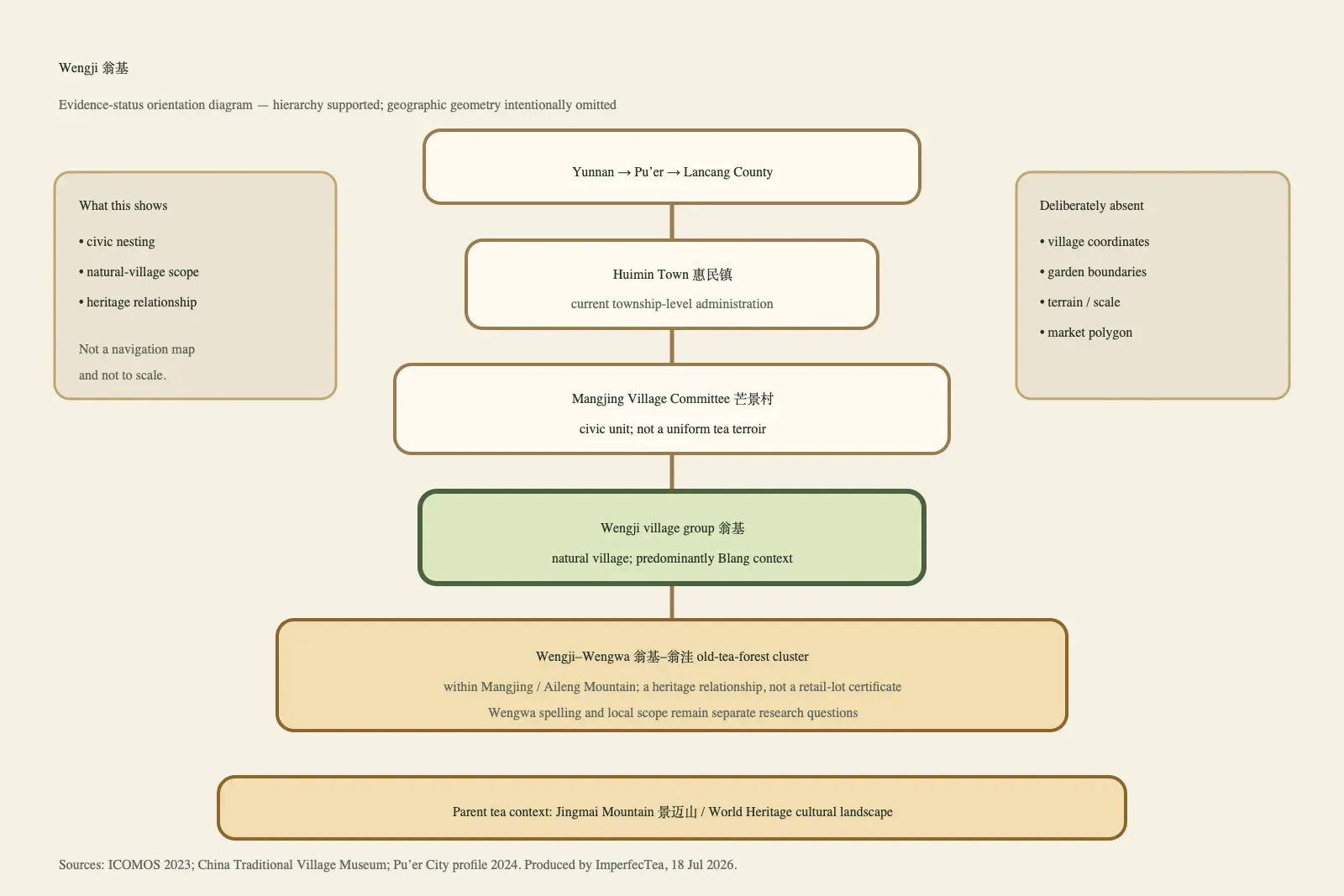
Diagram status: Wengji's natural-village status, civic nesting, and Wengji-Wengwa heritage-cluster relationship are supported. No reusable authoritative village point, surveyed garden boundary, or licensed composite geometry was obtained; this original diagram is not to scale.
- ICOMOS evaluation of World Heritage property 1665
- China Traditional Village Museum record 53082810403
- Pu'er City 2024 village profile
Wengji (翁基) is a natural village under Mangjing Village Committee in Huimin Town, Lancang County. Heritage documents pair Wengji and Wengwa as an old-tea-forest cluster in the southern part of Jingmai’s cultural landscape.
What the sampled leaf showed
A Yunnan Agricultural University study collected spring 2022 leaf from a named Wengji garden and six other Jingmai village gardens. The researchers made sun-dried tea under a common protocol and used five certified tasters.
The Wengji sample scored 92.8 for aroma and 91.4 for taste. The authors grouped it with clean, persistent aromas and rich cups with returning sweetness. Those results describe that processed sample. They don’t predict every retail Wengji cake.
Broader Jingmai and seller notes often mention flowers or honey. Taste for them if they interest you, but keep the garden, season and processing attached to any conclusion.
Village and forest cluster
Wengji and Wengwa share a heritage forest-cluster name while remaining separate villages. Wengji’s Blang community and traditional-village record explain how the landscape is managed and lived in. They don’t certify a product’s tree age or origin.
A “Jingmai Wengji” label should narrow further to the supplying household or garden if it claims a specific old-forest lot.
A useful comparison
Try Wengji beside another named Mangjing-side tea from a similar harvest. Match the water, dose and timing and compare the persistence of aroma and sweetness.
Ask who made the maocha, whether the material was kept separate and how it was stored. Those details connect the heritage setting to the particular tea for sale.
Sources and limits
Research updated 19 July 2026. The hierarchy and cluster relationship rest chiefly on the ICOMOS evaluation, UNESCO property 1665, the China Traditional Village Museum record and a Pu’er City 2024 village profile. The seven-village Jingmai study supplies a standardized Wengji-garden sample and trained-panel result, but is limited to its defined ancient-tree samples and processing. A named 2024 Wengji household interview contributes contemporary local production-and-livelihood context, not a generalized sensory claim. Wider Jingmai sensory material is deliberately not promoted to a Wengji signature.
Quick answers
Frequently asked questions
What does the Wengji tea name identify?
A Blang natural village under Mangjing Village Committee, Huimin Town, Lancang County, within the Jingmai Mountain World Heritage landscape.
What does Wengji tea taste like?
No Wengji-only fingerprint is supported; broader Jingmai samples make floral, honeyed or citrus notes useful prompts, not authentication, with grip and sweetness varying.
What is Wengji commonly confused with?
Wengji village, Wengwa village, their shared forest cluster, Mangjing committee and broad Jingmai tea are different provenance scales.
What should I ask before buying Wengji tea?
Which Wengji garden and household supplied this lot, and who made it?