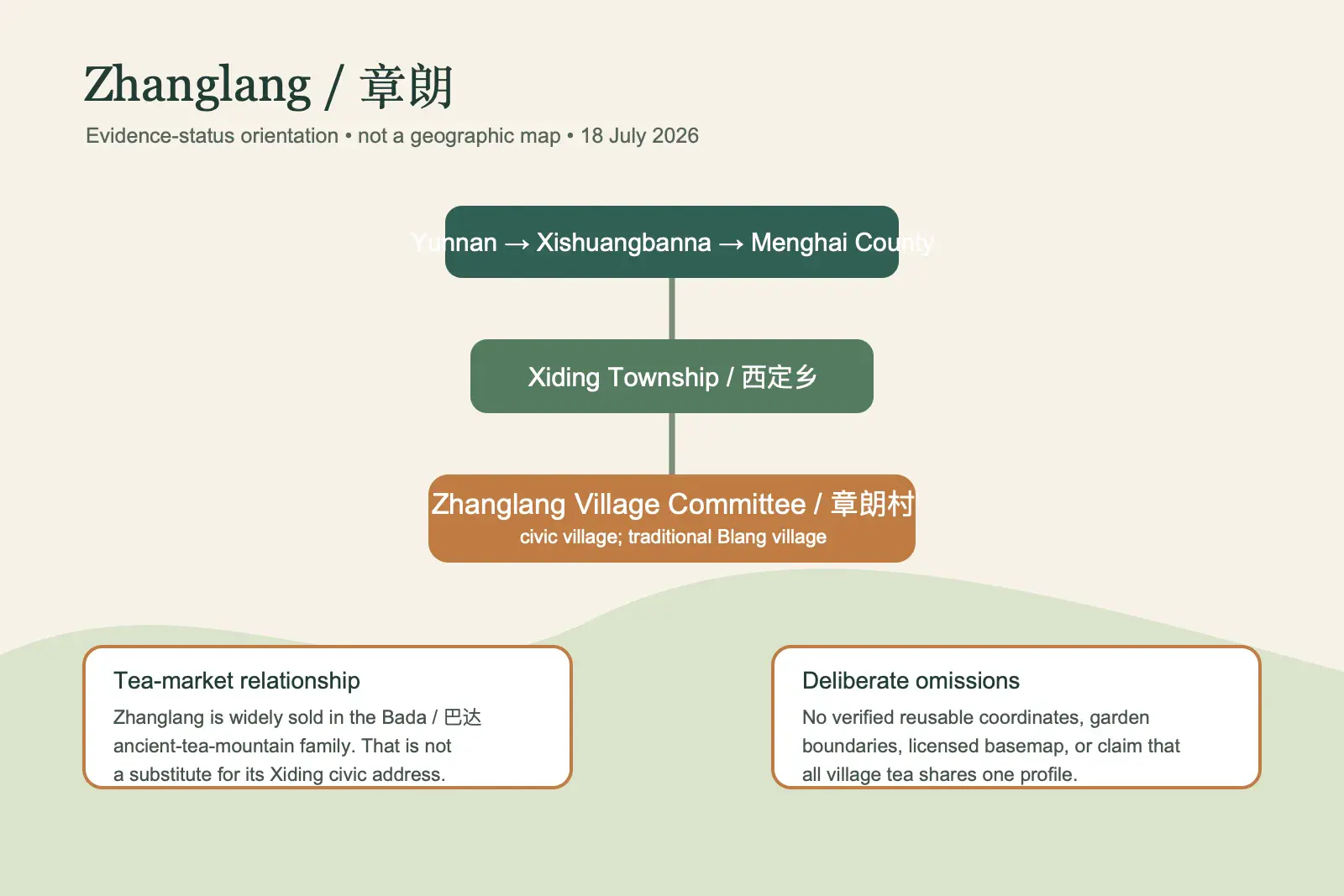
Place relationship diagram notes and sources
Diagram status: Zhanglang's county and Xiding Township affiliation, village status, and Bada market relationship are supported. No reusable authoritative village coordinate, surveyed garden boundary, or licensed composite geometry was obtained; this original diagram is not to scale.
- Yunnan provincial reporting on Zhanglang Village
- Menghai County Media Centre reporting on Bada Ancient Tea Mountain
- Menghai township-level sun-dried tea study
Zhanglang (章朗) is a Blang village in Xiding Township, Menghai County. It is often sold within the older Bada tea-region grouping. Xiding gives the current administrative setting; Bada supplies the historical and market context.
What can we say about the tea?
A 2023 study comparing sun-dried teas from seven Menghai townships described its Xiding samples with a clear or fresh-green aroma category. That is broader than Zhanglang and doesn’t establish a village flavour.
Zhanglang product accounts variously mention flowers, bitterness and returning sweetness. The evidence isn’t a controlled village tasting set. Try a sample for its own texture and finish, with the sourcing claim kept separate.
Gardens and village records
Public reporting describes extensive tea land, organic-garden registrations and counted old trees, alongside a Blang cultural institution and working tea households. Village-wide records don’t prove that a particular cake is organic or ancient-tree material.
A narrow claim needs the actual garden and harvest connected to the batch. The same village can contain different material and management practices.
Before buying
Ask which part of Zhanglang supplied the leaf, who processed it and whether the lot was mixed. If the seller invokes an organic registration, ask which garden and product it covers.
Compare a sourced Zhanglang with another disclosed Bada-area tea of similar age and storage. Keep the brewing steady, and notice whether the aroma and sweetness last after the opening cups.
Sources and limits
Research completed and sources accessed 19 July 2026. The civic and cultural framing rests primarily on Yunnan reporting on Zhanglang, provincial traditional-village material, and Menghai County Media Centre reporting on Bada. The China Environment News field account is used only for its named village and community-practitioner observations; its source chain and narrative scope do not authenticate products. The Menghai township aroma study is explicitly limited to its township samples and does not become a Zhanglang taste signature.
Quick answers
Frequently asked questions
What does the Zhanglang tea name identify?
A current village committee in Xiding Hani and Bulang Ethnic Township, Menghai County, and the clearest civic anchor for the older Bada tea region.
What does Zhanglang tea taste like?
No village fingerprint is supported; available lots range through floral sweetness, spice, citrus, green vegetables, resin and variable bitterness, texture and sweet return.
What is Zhanglang commonly confused with?
Zhanglang is a current village inside Bada's historical and market geography, not proof that all Bada tea comes from Zhanglang.
What should I ask before buying Zhanglang tea?
Which Zhanglang household, garden and season supplied this lot?