Orientation guide notes and sources
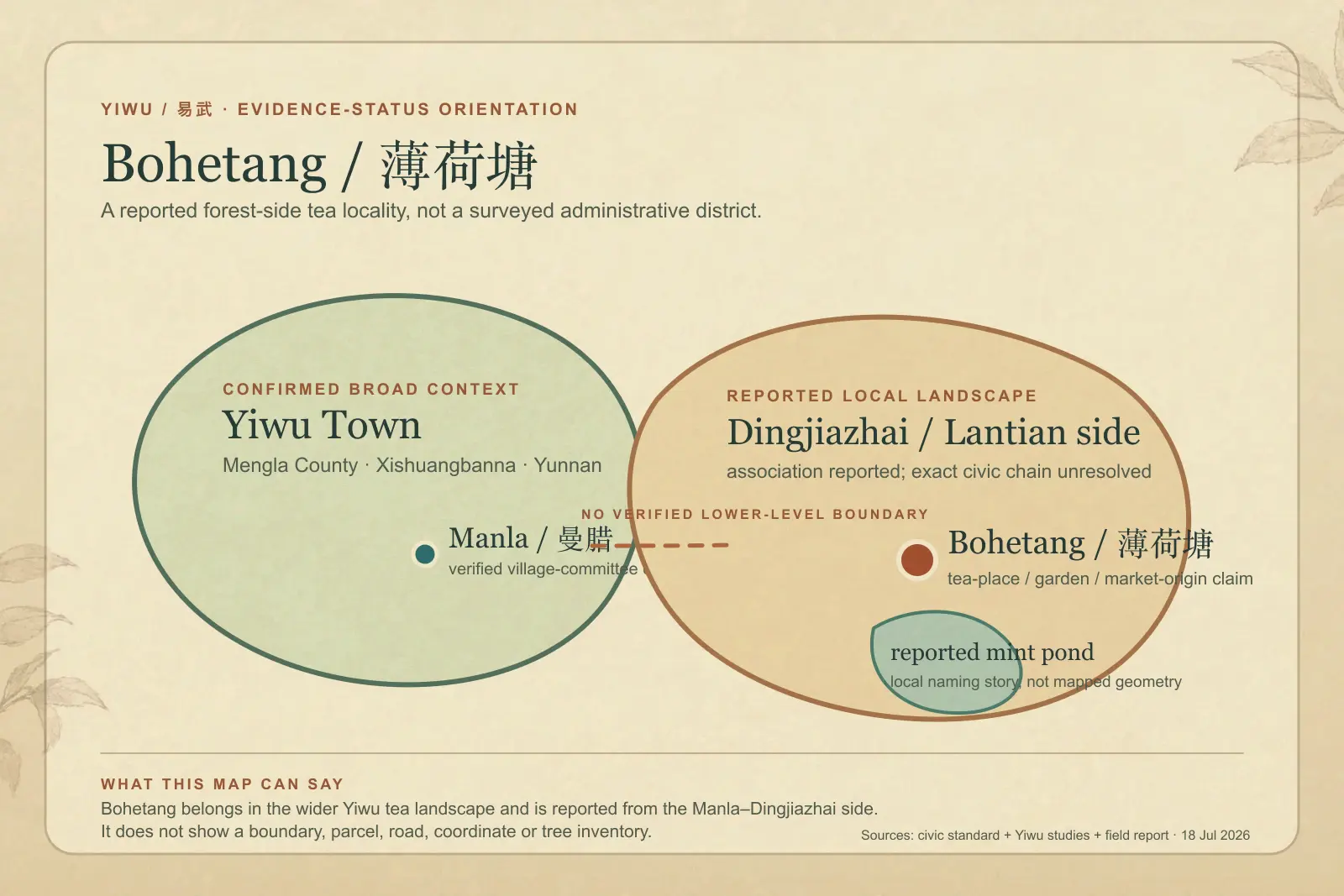
Boundary confidence: The Yiwu Town and Manla Village Committee context is supported, but Bohetang's civic rank, mapped extent, garden boundary and verified locality coordinates remain unresolved. This is an orientation diagram, not a geographic composite map.
- DB53/T 1176.13-2023 administrative village codes
- Journal of Natural Resources, 2023
- Yunnan Daily field report, 2023
Bohetang (薄荷塘) is a garden-origin name in the wider Yiwu landscape. It is often sold as rare, tall-tree forest tea, but it isn’t a verified administrative village or a surveyed appellation.
What might the tea taste like?
A 2023 product tasting described flowers, green sweetness, light bitterness and a smooth texture, followed by sweetness and a cooling sensation. Another seller’s 2024 lot was described as thicker and darker in character. A Yunnan Daily field account used floral and honeyed language.
The descriptions suggest looking for fragrance and body, but they depend on claimed sourcing. They aren’t a blind comparison and won’t authenticate another Bohetang sample.
Where the name leads
The 2023 field report approaches Bohetang through the Manla and Dingjiazhai side of Yiwu and describes a ridge separating it from Wangong. Its local explanation for the name is a small pond with mint growing near a stream.
That is useful place reporting. It doesn’t establish every garden boundary or justify treating all sellers’ Bohetang labels as the same small lot. Terms for tall-tree classes also need a producer’s explanation.
Before paying the premium
Ask which garden and household supplied the leaf, what was picked and how the lot was kept separate. A smaller, more expensive origin claim should bring more specific records.
Try the sample beside a documented Mahei or broader Yiwu tea with similar harvest and storage. Keep the brewing identical and see whether the texture and finish justify the difference for you. Cooling alone isn’t proof of Bohetang.
Sources and limits
This guide uses the provincial administrative-village code standard for the Yiwu/Manla civic context; peer-reviewed Yiwu studies for town-scale environment, production organisation and market-scale history; national/local heritage sources for Tea Horse Road context; and a Yunnan Daily field report for the reported Bohetang naming and landscape relationship. Product-specific tasting reports are used only as scoped sensory evidence. URLs, access date, conflicts, claim confidence, map status and tasting limits are recorded in the accompanying dossier and source log.
Quick answers
Frequently asked questions
What does the Bohetang tea name identify?
A reported forest-side tea area tied to Manla and Dingjiazhai within Yiwu Town, Mengla County, eastern Xishuangbanna.
What does Bohetang tea taste like?
Claimed lots often suggest floral or honeyed aroma, rounded texture, light bitterness and quick sweet return, but no controlled multi-producer tasting set supports a fingerprint.
What is Bohetang commonly confused with?
Bohetang is not a verified administrative village, a surveyed garden polygon or all tea sourced through Dingjiazhai.
What should I ask before buying Bohetang tea?
Can you trace this lot in Chinese from Yiwu through Manla or Dingjiazhai to a household, garden and harvest?