Orientation guide notes and sources
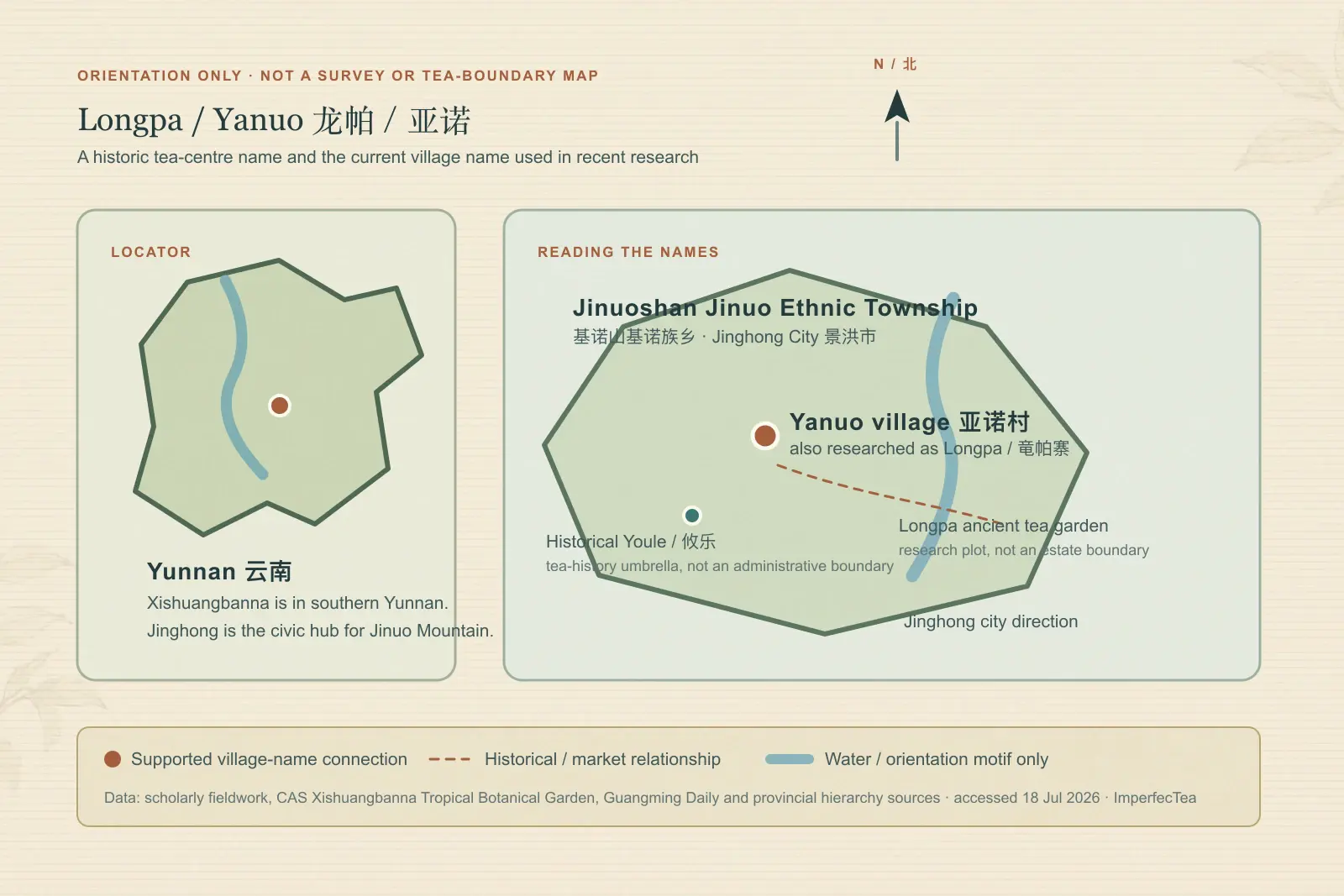
Boundary confidence: The Longpa–Yanuo name relationship and township location are supported by scholarly, institutional and research sources. The illustration is an orientation diagram, not a licensed boundary map: it does not assert a village boundary, garden boundary or surveyed tea-market extent.
- Hubei University ethnographic interview/profile
- Chinese Academy of Sciences Xishuangbanna Tropical Botanical Garden
- Guangming Daily
- Yunnan provincial village-code standard DB53/T 1176.13-2023
Longpa (龙帕) is connected to Yanuo Village (亚诺) in Jinuoshan Jinuo Ethnic Township, Jinghong. An ethnographic account identifies Longpa with official Yanuo, and Chinese Academy of Sciences work places the Longpa ancient-tea garden there.
That gives the name a more specific location than the broader historical Youle mountain.
One useful tasting record
TeaDB’s 2016 Wistaria report tasted a 2006 Longpa cake. It found stone fruit, flowers and leather in the aroma, with wood, fruit and medium oily body in the cup. Drying astringency needed careful brewing.
It is an experienced taster’s account of one commercial tea. The result suggests looking at texture and grip, but doesn’t establish that every Longpa tastes like stone fruit or ages the same way.
Village, garden and old trade name
Longpa appears in Qing-era tea-centre accounts and Jinuo longhouse history. The documented garden and the village’s cultural history describe a place; they don’t identify the ingredients of every cake carrying its name.
Youle and modern Jinuo Mountain overlap historically, while Longpa/Yanuo supplies a narrower locality. Ask which scale a seller is claiming and whether the tea is one garden’s material or a blend.
How to compare it
Put a sourced Longpa beside a broader Youle tea of similar age and storage. Keep the water and infusion times steady, then notice whether its body lasts as the aroma fades. If drying takes over, shorten the next infusion before deciding the tea is inherently rough.
For an older cake, ask about storage as well as harvest and maker. Those details may explain more of the cup than the historical mountain name.
Sources and limits
All sources were accessed 18 July 2026. The article separates a current village identity from historical and market uses of the name.
- Hubei University profile/interview on Jinuo research, states that Longpa Village’s official name is Yanuo Village and records the longhouse observation.
- CAS Xishuangbanna Tropical Botanical Garden: Longpa ancient-tea-garden orchid work, independently places Longpa ancient tea garden at Yanuo, Jinuo Township.
- Peer-reviewed field experiment at Longpa ancient tea garden, source for the sampled plot’s coordinates, elevation, large-leaf tea and shade-tree context; it is not a village survey.
- Guangming Daily: Yanuo tea-cultural gathering, contemporary community and tea-livelihood context.
- National Ethnic Affairs Commission: Jinuo customs and livelihood, historical Longpa tea-centre claim; broader historical synthesis, not a primary Qing record.
- TeaDB: 2006 Wistaria Longpa tasting, one specialist tasting account; product-specific and not independently provenance-audited.
- Yunnan provincial village-code standard DB53/T 1176.13-2023, controlling township/committee context; it does not identify Yanuo’s committee parent.
Quick answers
Frequently asked questions
What does the Longpa tea name identify?
Longpa, also called Yanuo, is a current Jinuo village within Jinuoshan Jinuo Ethnic Township, Jinghong City, Xishuangbanna.
What does Longpa tea taste like?
One aged commercial cake suggests stone fruit, flowers, oily texture and drying grip; that single sample cannot define fresh Longpa or authenticate origin.
What is Longpa commonly confused with?
Longpa or Yanuo village is not the whole of Jinuo Mountain, historical Youle or every tea marketed with the old Longpa name.
What should I ask before buying Longpa tea?
Does this lot trace to present-day Yanuo households and a named harvest, maker and garden rather than only historical Longpa?