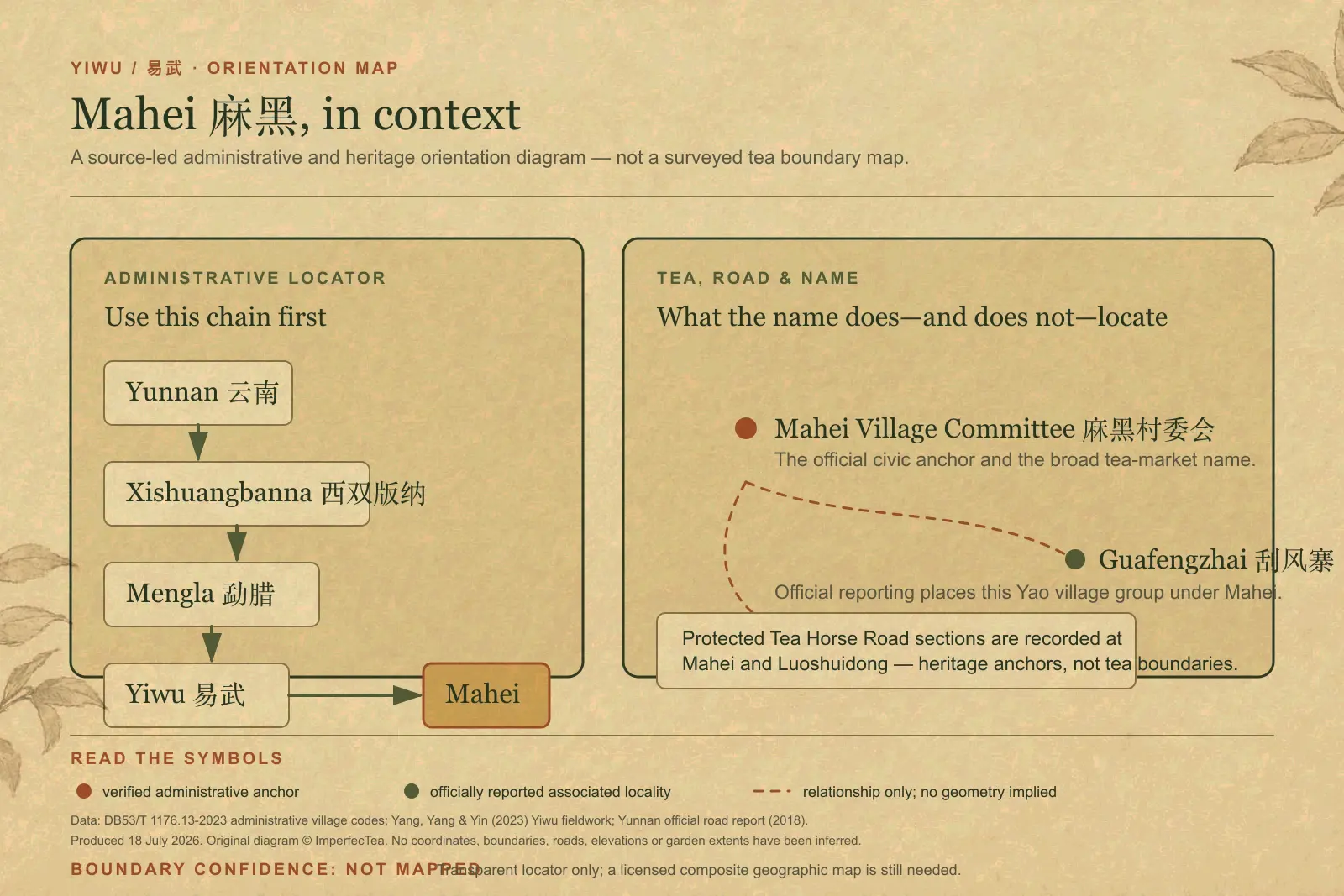
Orientation guide notes and sources
Boundary confidence: administrative hierarchy verified; no surveyed Mahei tea boundary or independently cleared natural-village coordinate set
- DB53/T 1176.13-2023 administrative village codes
- Yang, Yang & Yin (2023) Yiwu fieldwork
- Yunnan official road reporting (2018)
Mahei (麻黑) is one of six village committees under Yiwu Town, Mengla County. In tea shops, the name may refer to that wider area, a central settlement or a producer’s sourcing network. It is worth asking which before paying for a single-village claim.
What Mahei can taste like
A reviewed 2018 spring sample showed green vegetables, grass, plum and malt-like aroma, with little perceived bitterness. A 2013 Bi Yun Hao Mahei comparison had berry character, oily texture and cocoa-like bitterness. Other stored examples were more savoury, drying or initially sour.
These teas weren’t matched for processing or storage. Their range is more useful than a promise of “soft, sweet Yiwu”: Mahei can offer fragrance and rounded texture while still carrying bitterness.
Which Mahei locality?
The committee is the firm administrative anchor. Official records place Guafengzhai beneath it, while the Tea Horse Road inventory documents Mahei and Luoshuidong sections. Those narrower names describe different places within the wider landscape.
A label using Mahei doesn’t automatically identify the central settlement or one garden. Ask where the leaf was grown, rather than only where it was bought or processed.
Tea and the old road
The protected road and old-garden records show Mahei’s place in Yiwu’s production and trade. Today’s growers and processors continue to make decisions about picking, blending and sales. Historical recognition doesn’t certify a modern cake’s tree age or sourcing.
A first comparison
Try a documented Mahei beside a broad Yiwu blend from the same season and similar storage. Watch the middle infusions for oily or coating texture and see how long the sweetness lasts.
For a narrow claim, ask for the garden or household, harvest and maker, and whether the sample comes from the batch for sale. That information is more useful than a photograph of the old road.
Sources and limits
This guide uses Yunnan’s 2023 administrative village-code standard for the civic hierarchy, a peer-reviewed Yiwu field study for town-scale context and Mahei interviews, and official reporting for Guafengzhai’s nesting and present-day civic context. Independent public tasting notes are product-specific and commercial provenance remains a limitation. The local research dossier and source log record source URLs, access dates, claim confidence and conflicts.
Quick answers
Frequently asked questions
What does the Mahei tea name identify?
A current village committee under Yiwu Town in Mengla County, containing narrower village groups and tea localities including Guafengzhai.
What does Mahei tea taste like?
Claimed teas span fruit, honey, herbs, malt and storage tones, with oily texture and bitterness both possible; the profile is supported, not verified.
What is Mahei commonly confused with?
Mahei committee is not one village, one garden or every narrower origin marketed within its administrative area.
What should I ask before buying Mahei tea?
Which Mahei village group, household and garden does this lot come from, and what harvest record connects them?