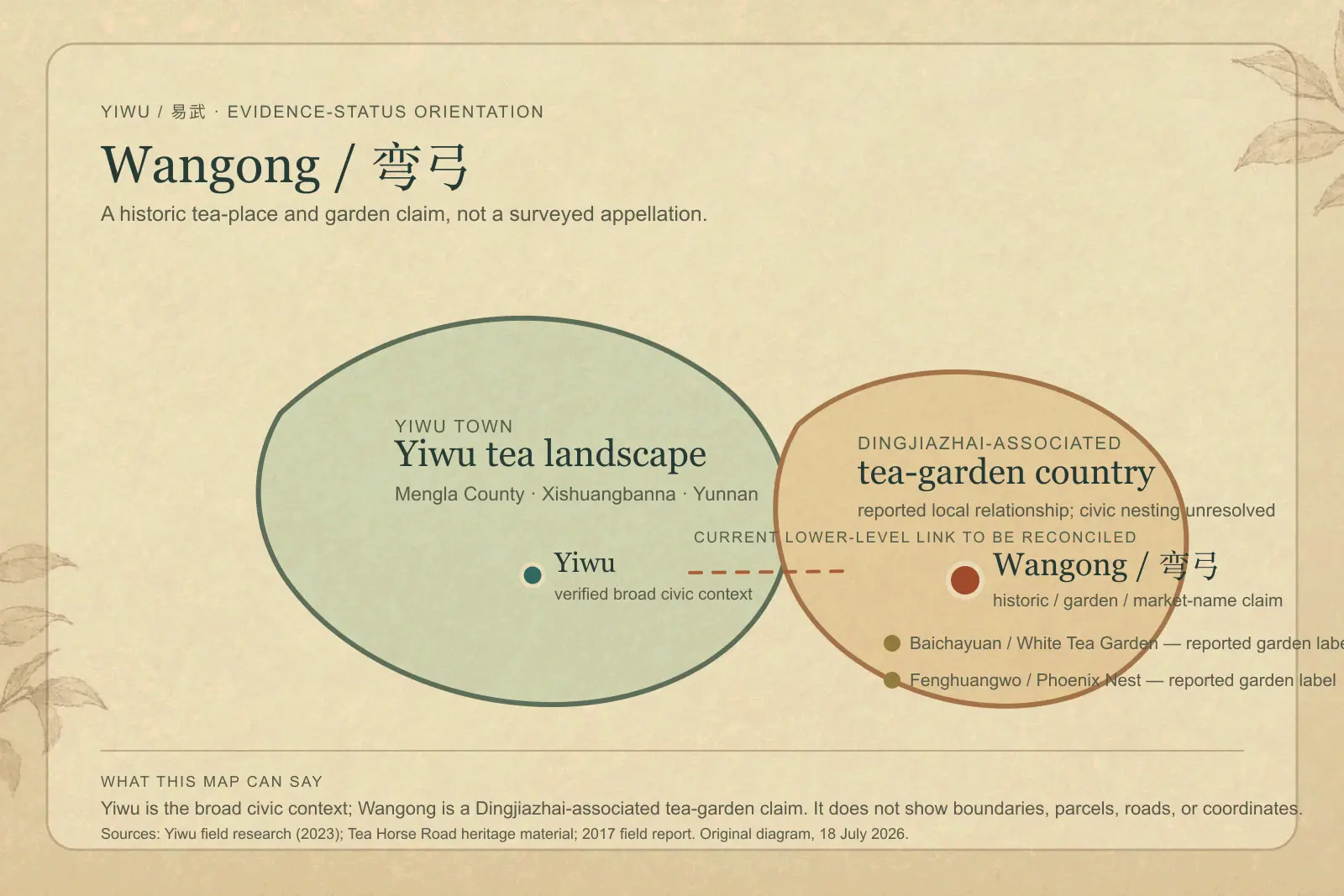
Orientation guide notes and sources
Boundary confidence: No licensed composite map, official Wangong boundary, verified locality-point set, or agreed current administrative nesting was found; the map is an orientation diagram only.
- Journal of Natural Resources, 2023
- State Council Tea Horse Road designation, 2013
- Jiemian tea-area field report, 2017
Wangong (弯弓) is a historical tea-place and garden name in the wider Yiwu landscape. Tea accounts commonly connect the present garden claim with Dingjiazhai, especially its Yao community. It doesn’t have a securely established modern administrative boundary in the sources used here.
Who manages the gardens?
A 2017 field report describes Wangong gardens managed and picked by Yao residents of Dingjiazhai Lower Village. Heritage material also records the old Yao Dingjiazhai route in the Tea Horse Road landscape.
That gives the name a human and geographic connection. It doesn’t establish that all sellers use Wangong for the same garden area, or that every lot passes through the same households.
What might the tea taste like?
Producer and specialist accounts often describe floral fragrance, sweetness and dense or silky texture, sometimes with firm bitterness and a cooling sensation. An independent comparison with Mahei found different aromatic and textural qualities.
The samples aren’t a matched multi-producer set. Use the notes as reasons to try a tea, then record what survives beyond the first fragrance. Cooling and body sensations remain personal impressions, not origin evidence.
Choosing a sample
Compare a claimed Wangong with a sourced Dingjiazhai-associated tea or a Mahei of similar age and storage. Keep the brewing identical and pay attention to the middle infusions.
Ask which household and garden supplied the leaf, how it was processed and whether the lot was blended. A precise forest name should come with a precise explanation. If the seller only knows the wider Yiwu source, the price and description should reflect that.
Sources and limits
This guide uses peer-reviewed Yiwu fieldwork for town-scale climate, historical change and production structure; State Council heritage material for the Tea Horse Road’s national designation; and field/specialist accounts only for the Wangong and Dingjiazhai association and limited sensory discussion. The full research dossier and source log retain source URLs, access date, conflicts and claim confidence.
Quick answers
Frequently asked questions
What does the Wangong tea name identify?
A reported historic site and tea-garden locality associated with Dingjiazhai households in the wider Yiwu landscape of Mengla County.
What does Wangong tea taste like?
Claimed teas often suggest floral sweetness, dense or silky texture, cooling and firmer bitterness than soft Yiwu stereotypes, but evidence remains partial.
What is Wangong commonly confused with?
Wangong is not a verified current village, all Dingjiazhai tea or a surveyed micro-origin boundary.
What should I ask before buying Wangong tea?
Which Dingjiazhai households and garden records connect this lot to Wangong, and at what claimed geographic scale?