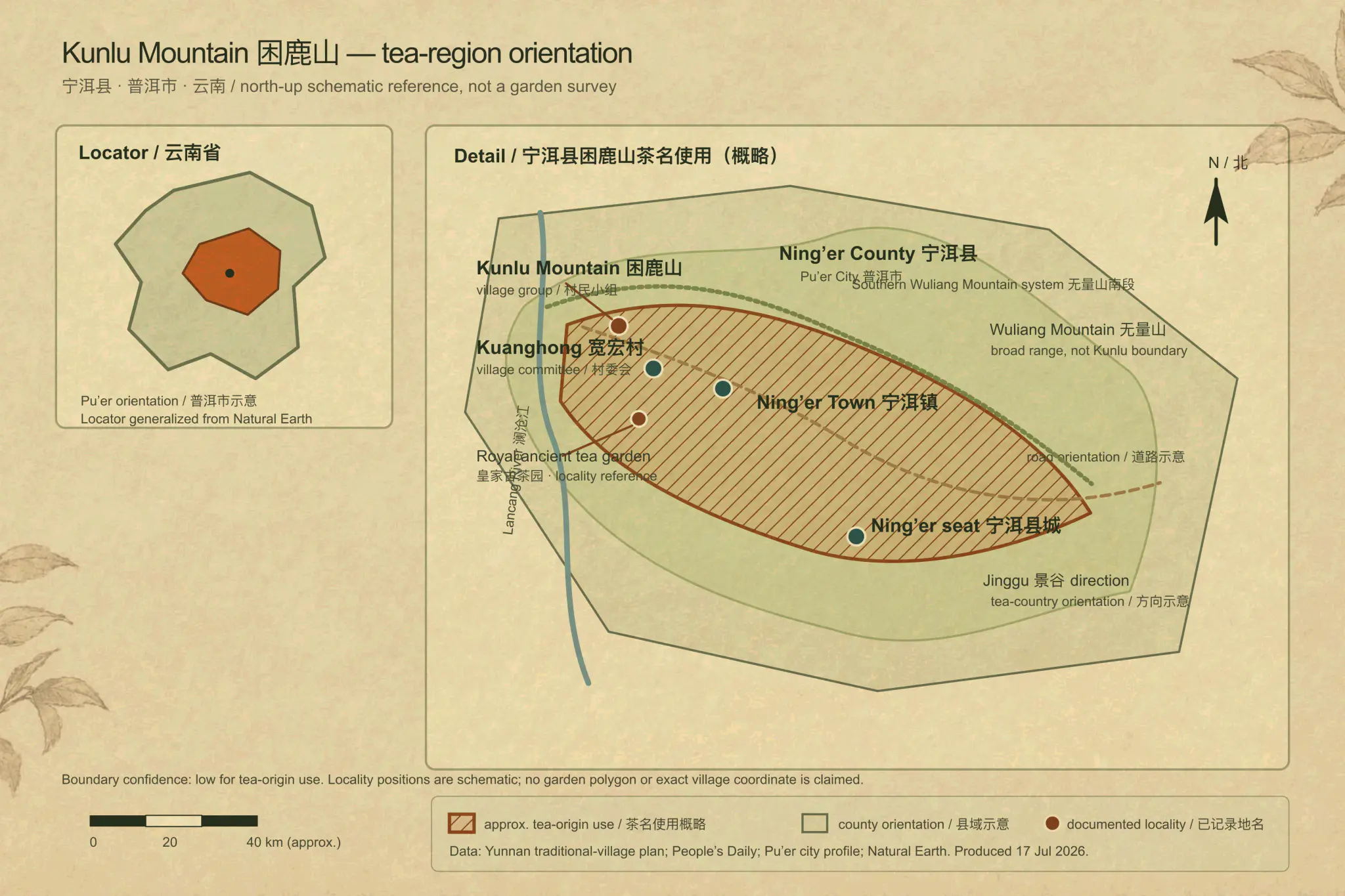
Orientation guide notes and sources
Boundary confidence: Administrative nesting is verified; all internal positions, tea-use shapes, roads, rivers, and scale are schematic and not suitable for measurement
- Yunnan provincial traditional-village catalogue for the current administrative hierarchy
- Ning'er County Audit Bureau records for the Kuanghong and Kunlu village-group address
- Natural Earth public-domain locator data; internal detail is an ImperfecTea orientation schematic
Kunlu Mountain village group is part of Kuanghong Village, Ning’er Town, in Pu’er City. It is the specific settlement behind many of the broader Kunlu Mountain stories.
Village tea and royal-garden tea
The village has old cultivated tea gardens, but “from Kunlu village” does not automatically mean a particular royal garden or ancient tree. Modern plantings and different garden lots need their own descriptions.
When a seller charges for a narrow origin, ask for the garden, household and harvest. A tribute-history account explains why the place is famous; it does not connect the leaves in your sample to that history.
Taste
Published accounts of individual lots often describe a soft, aromatic cup with sweetness after the swallow. Vegetal or hay notes, honey and stone fruit also appear. Texture varies, so a thick cup should not be treated as a village fingerprint.
Try the tea across several infusions. Does its aroma hold, and does the sweet return survive a slightly firmer brew? That is more useful than deciding whether it matches a single tasting phrase from a listing.
Before buying
Establish whether the lot comes from the village generally, a named old garden or a blend. Ask how the seller knows the claimed tree age, and check harvest season and storage. A sample can help you judge quality; it cannot authenticate the garden by taste alone.
Sources and limits
Research refreshed 10 August 2026. The most important sources are:
- Yunnan traditional-village catalogue, which lists the Kunlu Mountain village group under Kuanghong Village in Ning’er Town
- Ning’er County Audit Bureau’s 2021 final-accounts report, which repeats the current village-group address in an environmental-works record
- Yunnan’s tribute-tea craft record and UNESCO’s traditional tea-processing element
- Tao, Li, and Cai’s 2022 Kunlu village study
- Gao, Li, and Zhao’s 2016 Pu’er tea-garden soil study
- Yunnan’s ancient-tea-tree registration procedure
- Product-specific tasting evidence from Bitterleaf, TeaDB, and Oolong Owl
The guide publishes with explicit limits rather than pretending the gaps do not exist. We do not claim a cadastral royal-garden boundary, an audited public tree-age register, a village-wide organic status, a market-price range, or an ImperfecTea-controlled sensory profile. Those would improve a future revision, but none is required to explain the verified locality, the source-bounded heritage, and a responsible way to taste and buy the tea.
Quick answers
Frequently asked questions
What does the Kunlu village tea name identify?
Kunlu Mountain village group sits inside Kuanghong Village, Ning'er Town, Ning'er County, Pu'er City.
What does Kunlu village tea taste like?
Named products often show lifted floral, vegetal, hay or honey aroma, gentle-to-moderate bitterness, salivation and returning sweetness; texture and stamina vary sharply by lot.
Which Kunlu place names should I distinguish?
Kunlu village group, Kunlu Mountain, the royal ancient garden and a household or garden lot are not interchangeable claims.
What should I ask before buying Kunlu village tea?
Ask which garden or household supplied the lot, and request its harvest, material, maker, processing and storage details.