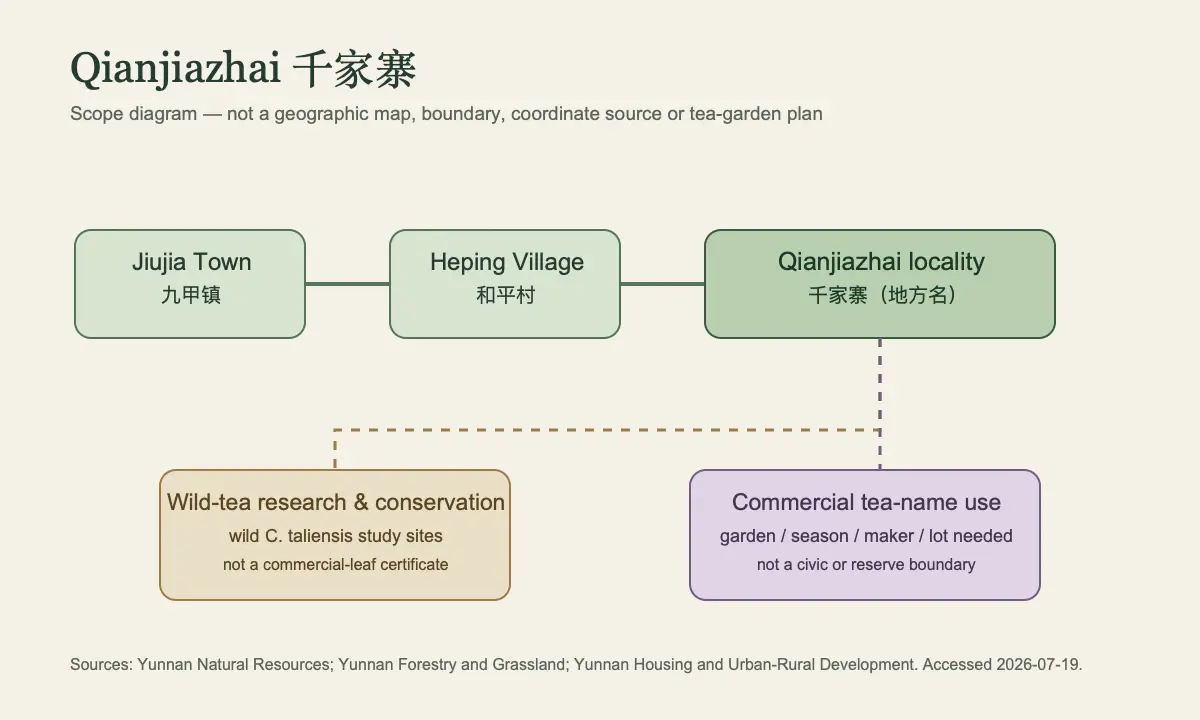
Place relationship diagram notes and sources
Diagram status: Not publication-grade: this is a scope diagram, with no asserted coordinates, road lines, locality boundaries or tea-garden geometry.
- Yunnan Natural Resources, Yunnan Forestry and Grassland Bureau, and Yunnan Housing and Urban-Rural Development Department sources logged in the dossier; schematic prepared 2026-07-19
Qianjiazhai is in Heping Village, Jiujia Town, Zhenyuan County, on the Ailao range. It is famous for wild tea trees, but the name on a commercial tea can mean something much broader than leaves from those trees.
Three things sold under one story
The protected forest contains wild Camellia taliensis. Nearby cultivated gardens produce commercial tea. The county public brand Qianjiazhai Yehao covers tea from eight ancient-tea mountain areas. These are different sources of leaf.
Ask which one a listing means. A photograph of a protected tree is not a harvest record, and a county-brand cake need not be a single-garden Qianjiazhai tea.
What the research tells us
Studies of wild C. taliensis here have sampled forest sites at 2,050, 2,200, 2,350 and 2,500 metres. They examine matters such as genetics, soil microbes and nitrogen. They do not establish the flavour of cultivated raw Pu’er sold under the same place name.
Local accounts connect the settlement’s name with the nineteenth-century Li Wenxue uprising. That is part of the area’s reported history. It should remain separate from claims about tree age or present-day harvesting rights.
Taste depends on the lot
The public examples reviewed for this guide vary considerably: a 2024 small-tree tea had smoke, astringency, fruit and sweetness; a 2023 dragon ball was described with orchid and honey; an aged 2011 tea had wood, cocoa, cherry and an oily texture.
These were different teas, ages and formats, not a matched comparison. They give reasons to sample Qianjiazhai, but no single profile that can verify its origin.
What to ask
Get the village or garden, harvest, plant material and producer. If “wild” appears in the description, ask for the species and the actual source of the leaf. If the tea uses the county brand, ask whether it is a blend and which areas supplied it.
The protected-tree landscape deserves attention in its own right. It does not make every commercial Qianjiazhai claim more specific.
Sources and limits
Sources accessed 19 July 2026. The dossier preserves claim-level confidence, conflicts, map limits and tasting provenance.
The companion dossier logs Chinese official, academic and tea-market sources, access dates, working translations and conflicts. What we still do not have: a licensed geographic composite map, natural-village/garden matrix, independent tasting record across several producers, reproducible tree-age evidence or comparable current price observations.
Quick answers
Frequently asked questions
What does the Qianjiazhai tea name identify?
Qianjiazhai is a locality associated with Heping Village, Jiujia Town, Zhenyuan County, Pu'er City, on the Ailao range.
What does Qianjiazhai tea taste like?
Cultivated examples often suggest floral, honey, fruit or citrus aroma, firm bitterness, salivation and returning sweetness; smoke, processing, age and storage cause substantial variation.
What is Qianjiazhai commonly confused with?
Protected wild-tea study sites, cultivated Heping-area leaf, the scenic name and a county-wide Qianjiazhai-branded blend are different claims.
What should I ask before buying Qianjiazhai tea?
Does Qianjiazhai mean Heping Village, another Zhenyuan mountain, a county blend or only a brand on this lot?