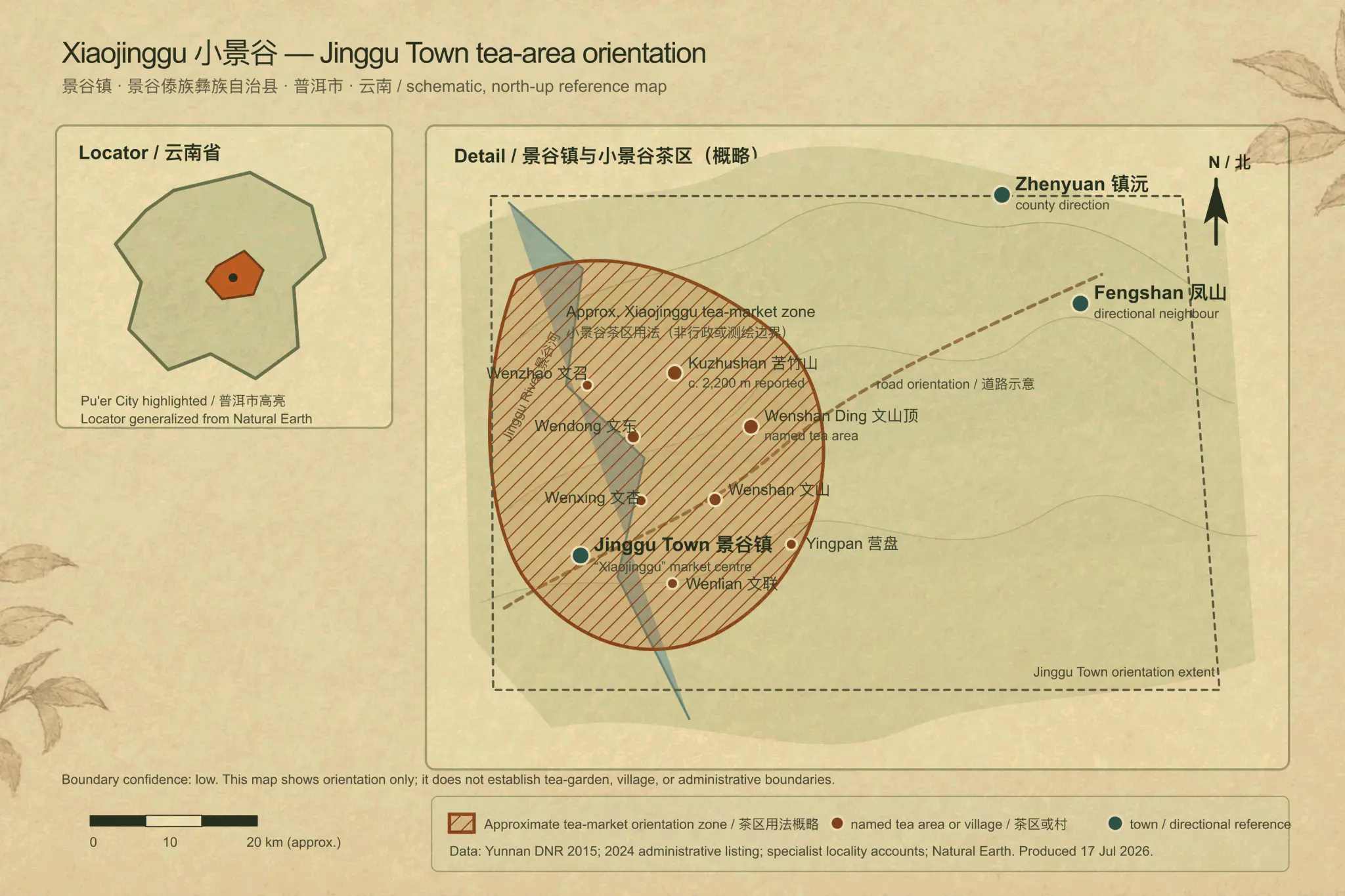
Orientation guide notes and sources
Boundary confidence: Administrative relationships come from text sources, not this graphic; all dots, roads, rivers, terrain shading, tea-use areas, and scale are schematic and cannot establish distance, boundary, or parentage
- Yunnan Department of Natural Resources records for Jinggu Town administrative villages
- Yunnan Net and Jinggu local reporting for Wenshan, Kuzhushan, and Ma'jiu relationships
- Natural Earth public-domain locator data; internal detail is an ImperfecTea orientation schematic
This Wenshan is Wenshan Village in Jinggu Town, northern Jinggu County, Pu’er City. It is neither Wenshan Prefecture in southeastern Yunnan nor the Wenshan tea district in Taiwan.
Wenshan, Kuzhushan and Wenshan Ding
Local reporting places Kuzhushan and Ma’jiu village groups under Wenshan Village. Kuzhushan is the better-known raw-Pu’er name; Ma’jiu also appears in reports on newer planting and intercropping.
Wenshan Ding is a narrower tea-area or mountain-top name used by sellers. It is not a separate village committee, and its commercial boundary is not fully established. A listing should explain how its garden relates to Wenshan rather than treating all three names as interchangeable.
For the wider town, see Xiaojinggu.
Taste
Some Kuzhushan teas begin with firm bitterness and develop grassy or floral sweetness. Others are described as softer and creamy. A published Wenshan Ding example was juicy and sweet with little bitterness.
That spread is a reason to try samples from named gardens. It is not evidence that one of the teas must be mislabelled. Plant material, harvest, processing and brewing can all differ within the village.
A working tea landscape
Wenshan has older gardens as well as modern cultivation. Reports of Zijuan purple-leaf planting and tea grown alongside medicinal crops show that the area is changing. “Forest tea” or “ancient tree” should describe a particular lot, not stand in for the whole village.
Ask for the village group, garden, producer and harvest. Where a seller claims Wenshan Ding, ask what location they mean and how they distinguish it from other Wenshan tea.
Sources and limits
Research refreshed 10 August 2026. The most important sources are:
- Yunnan Net’s 2023 Wenshan and Kuzhushan report, which supplies the clearest recent administrative relationship and attributes local garden, elevation, and history claims
- People’s Daily Yunnan’s 2024 Ma’jiu report and Jinggu’s 2025 village-industry report
- Yunnan Department of Natural Resources records for the separate Jinggu Town administrative villages
- Yunnan’s June 2024 organic certificate register, used only as a historical record: the relevant entries expired by September 2024 and prove no current holder, garden, village, or Xiaojinggu-wide certification
- Independent product-specific tasting records from Steepster and TeaTalk’s 2005 and 2012 Kuzhushan discussions
- Farmer Leaf’s 2022 Wenshan Ding field and product account, treated as commercial and product specific
The guide publishes with limits in plain sight. It does not claim surveyed Kuzhushan or Wenshan Ding boundaries, audited individual tree ages, village-wide organic status, a market-price range, or an ImperfecTea-controlled tasting profile. Better cadastral data and a controlled flight would improve a future revision, but the current evidence is sufficient for a useful, honest guide to the place names, tea styles, and buying questions.
Quick answers
Frequently asked questions
What does the Wenshan village tea name identify?
Wenshan is an administrative village in Jinggu Town, Jinggu County, Pu'er City, containing named tea areas including Kuzhushan.
What does Wenshan village tea taste like?
Kuzhushan examples often pair floral or sweet aroma with firm bitterness, salivation and returning sweetness; Wenshan Ding lots can be softer, making suborigin and processing decisive.
What is Wenshan village commonly confused with?
Wenshan Village, Wenshan Ding, Kuzhushan and the four other 'Wen' villages do not identify the same place.
What should I ask before buying Wenshan village tea?
Which Wenshan village group, tea area or garden supplied the leaf, and who processed this harvest?