Understanding Raw Pu-erh Tea Aging: The Science Behind Sha Qing and Steaming
Exploring how partial enzyme deactivation and brief steaming during compression enable raw pu-erh tea's natural aging process and flavor development over time.
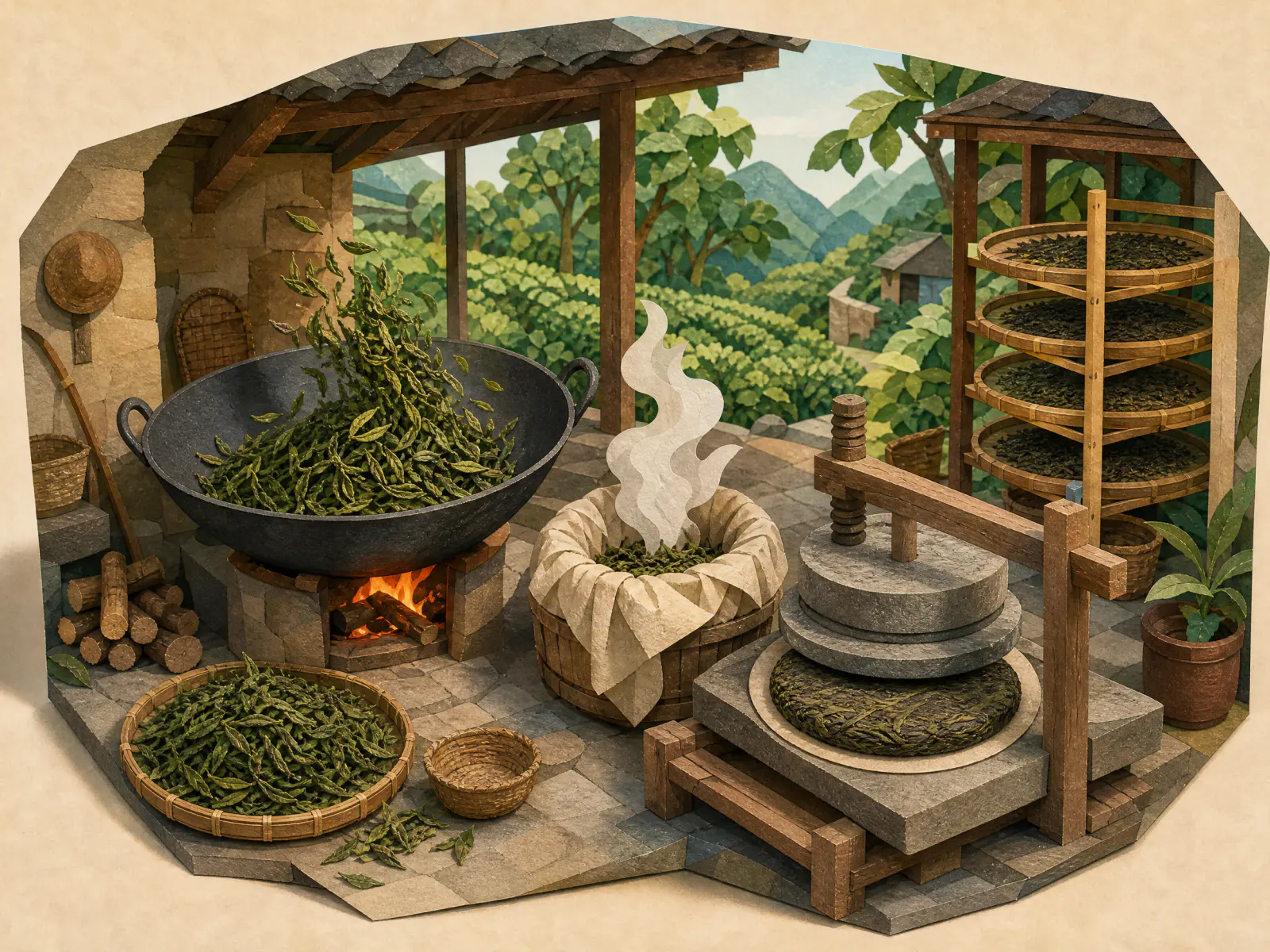
Raw (sheng) pu-erh has a funny processing puzzle. The leaves need enough heat to stop them browning too quickly, but not so much that they lose their ability to change as the tea ages. Two steps matter here: sha qing, often translated as “kill green” or fixation, and the quick steam used before a cake is pressed.
What sha qing does
After picking and withering, the leaves go through sha qing. Traditionally, that means hand-roasting them in a large iron wok over firewood, though machines are also used. The heat deactivates most oxidative enzymes, including polyphenol oxidase. Left unchecked, those enzymes would cause rapid browning and decomposition. Green tea gets a stronger version of this treatment to hold on to its fresh character.
Raw pu-erh is treated more gently, at a lower temperature or for less time than green tea. A little enzyme activity and moisture remain. The aim is to slow oxidation enough to keep the leaves stable while leaving room for gradual change. The leaves are then rolled, which bruises them and allows a small amount of oxidation, before being sun-dried. Trace enzyme activity remains, while microbes also take part in the tea’s long, slow ageing.
Without this partial treatment, the tea could spoil quickly or fail to develop the mellow, complex flavours associated with years, or even decades, of storage.
Why steaming does not stop the ageing
At this point, the loose tea is called maocha. To press it into a cake, brick, or another shape, producers usually give the dry leaves a short blast of steam, typically just 20 to 30 seconds. This softens and moistens them enough to hold together under a manual stone press or hydraulic machine. The pressed tea is wrapped in cloth and left to dry slowly on racks.
That quick steam is not the same as autoclaving or prolonged heating, so it does not completely denature every protein and enzyme. The exposure lasts seconds rather than minutes, and the dry leaf’s low moisture content limits how deeply the heat penetrates. Sha qing remains the main enzyme-deactivating step; steaming is closer to a brief rehydration.
The proof is in what happens next. Raw pu-erh continues to change after pressing through residual enzymatic oxidation and, more importantly, microbial fermentation involving bacteria, yeasts, and fungi that colonise the tea. Young raw pu-erh can begin astringent and floral, then become smoother and earthier over time.
Ripe (shou) pu-erh takes another route. It goes through a separate wet-piling fermentation before compression, with enzymes more fully deactivated to mimic accelerated ageing. Raw pu-erh skips that step and changes at its own pace.
So the short answer is reassuringly simple: pressing steam helps shape the cake. It does not undo the gentler sha qing that came before it. If you want to taste this slow change for yourself, look for well-stored cakes from reputable Yunnan producers.
Quick answers
Frequently asked questions
What is sha qing in raw pu-erh production?
Sha qing is the heating or fixation step that slows enzymatic browning after the leaf is picked. Its execution influences the young tea, but it is only one part of processing and later ageing.
Does steaming a pu-erh cake stop it from ageing?
No. Steam briefly softens dry maocha so it can be pressed. Once the cake is dried and stored, slow chemical and microbial changes can continue, although storage conditions strongly affect the result.
Does every raw pu-erh improve with age?
No. Ageing changes tea but does not guarantee improvement. Starting material, processing, compression, humidity, temperature, airflow and odour exposure all influence whether a cake becomes more enjoyable.