2025 Bingdao Five Villages Pu-erh Price Guide
Compare reported 2025 raw pu-erh prices for Bingdao Laozhai, Nanpo, Dijie, Bawai and Nuowu, with the product-stage and provenance checks those numbers still need.
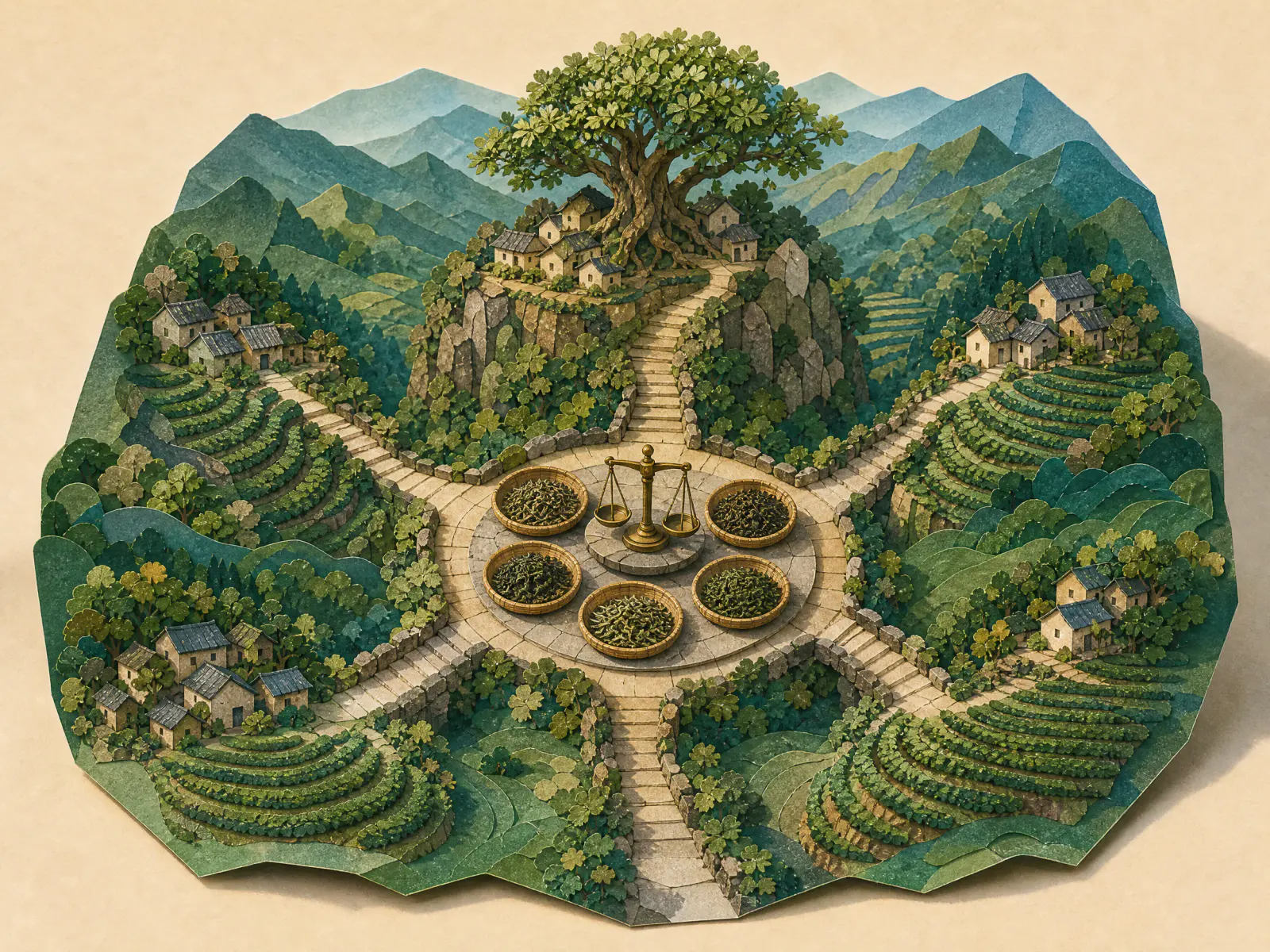
What are the five Bingdao villages, and what did tea cost in 2025?
The five villages sold under the Bingdao name are Bingdao Laozhai (or Bingdao Old Village), Nanpo, Dijie, Bawai and Nuowu. Published 2025 price compilations put Laozhai far above the other four, but the figures are asking-price or pre-quotation signals, not audited village averages. Tree category, picking standard, product stage and the exact lot still matter.
This page is the narrow companion to the main 2025 Yunnan raw pu-erh leaf price guide. For the geography behind the names, read the Bingdao village-cluster guide.
2025 Bingdao village price table
All figures below are reported CNY per kilogram. The rows preserve the categories used by the source lists; terms such as “ancient tree,” “big tree” and “small/medium tree” are seller or market categories, not ages independently verified by this site.
| Village | Reported material category | Reported 2025 range (CNY/kg) | Source |
|---|---|---|---|
| Bingdao Laozhai (冰岛老寨) | Ancient-tree claims | 26,000 to 95,000 | [1], [2], [3] |
| Bingdao Laozhai | Ancient tree, class 1 | 56,000 to 70,000 | [1] |
| Bingdao Laozhai | Ancient tree, class 2 | 28,000 to 35,000 | [1] |
| Bingdao Laozhai | Big tree | 7,000 to 8,000 | [1] |
| Bingdao Laozhai | Small/medium tree | 3,500 to 4,000 | [1] |
| Nanpo (南迫) | Ancient-tree claims | 4,500 to 6,500 | [1] |
| Nanpo | Small/medium tree | about 2,000 | [1] |
| Dijie (地界) | Ancient-tree claims | 5,500 to 6,000 | [1] |
| Dijie | Small/medium tree | about 1,600 | [1] |
| Bawai (坝歪) | Ancient-tree claims | 2,300 to 2,600 | [1] |
| Bawai | Small/medium tree | about 1,000 | [1] |
| Nuowu (糯伍) | Ancient-tree claims | 2,000 to 2,200 | [1] |
| Nuowu | Small/medium tree | about 800 | [1] |
The useful pattern is not the exact last digit. It is the large premium attached to a Laozhai claim and the equally large gap between material categories carrying the same village name.
Why do Bingdao prices vary so much?
Two Bingdao quotes can be numerically accurate yet impossible to compare. Check these differences first:
- Pin down the village. “Bingdao” may mean Laozhai, one of the other four villages, a five-village blend or a much looser Mengku-area claim.
- Confirm the product stage. Fresh leaf, sun-dried maocha and finished cakes are different products with different costs.
- Ask what the tree category means. Market tables separate ancient, big, mixed and small-tree material, but a label does not verify tree age.
- Match the picking standard and season. A selected first-spring lot is not comparable with a broader mixed picking.
- Separate asking prices from transaction prices. Public lists usually record an advertised or pre-quotation number, not a complete record of private farm-gate deals.
- Check the lot size and chain of custody. One scarce garden lot should not become the quoted price of an entire village.
How to compare a Bingdao quote
Ask the seller for one answer in each column before using a price table:
| Question | A useful answer sounds like | A weak answer sounds like |
|---|---|---|
| Which of the five villages? | “Nuowu, from this named producer” | “Bingdao mountain” |
| What product stage? | “2025 spring sun-dried maocha” | “Raw tea” |
| What material category? | A clearly defined picking or garden claim | “Ancient” with no explanation |
| What lot? | Batch, harvest date, maker and sample match | A generic certificate or wrapper |
| What unit? | CNY/kg for the same product stage | A 357 g cake compared with a kilogram of maocha |
Only compare prices after the year, season, village, product stage and material category line up. Then taste the exact batch rather than a representative sample.
Sources and limits
These links are the price compilations carried forward from the detailed research notebook. They are useful for seeing published 2025 market claims; none should be read as an audited transaction database.
[1] Zhihu. (2025, April 30). 2025年古树头春普洱茶叶价格一览表发布 [2025 ancient-tree first-spring Pu-erh tea price list]. https://zhuanlan.zhihu.com/p/1900684827084169888
[2] Weibo. 2025年云南省普洱茶产区主要村落毛料价格 [2025 Yunnan Pu-erh producing-area village raw-material prices]. https://weibo.com/ttarticle/p/show?id=2309404868349892100113
[3] China Daily. (2025, April 8). 2025年云南省1405个村寨春茶预报价 [2025 spring-tea pre-quotations for 1,405 Yunnan villages]. https://caijing.chinadaily.com.cn/a/202504/08/WS67f4bdb3a310e29a7c4a80f5.html
For the broader regional comparison and methodology, return to the 2025 Yunnan raw pu-erh leaf price guide.
Quick answers
Frequently asked questions
What are the five Bingdao villages?
The Bingdao five villages are Bingdao Laozhai, Nanpo, Dijie, Bawai and Nuowu. A label that says only Bingdao does not identify which of the five supplied the tea.
Is Naka one of the five Bingdao villages?
No. Naka is a separate tea origin associated with Mengsong in Menghai County, Xishuangbanna. It is not part of the Bingdao five-village cluster in Mengku.
Is Bingdao Laozhai the same as Bingdao?
Bingdao Laozhai is the narrower Old Village origin. Bingdao can mean the wider five-village cluster or be used loosely as a market name, so the seller still needs to name the village.
Are these Bingdao prices for fresh leaf, maocha or finished cakes?
The source lists present spring-tea raw-material or maocha indications, but public posts do not always define the product stage consistently. Do not compare them directly with a 357 g retail cake.
Does the highest Bingdao price mean the best tea?
No. A high asking price can reflect scarcity, a famous village name, claimed tree category and speculation as well as cup quality. Verify the lot and taste the exact batch before buying.