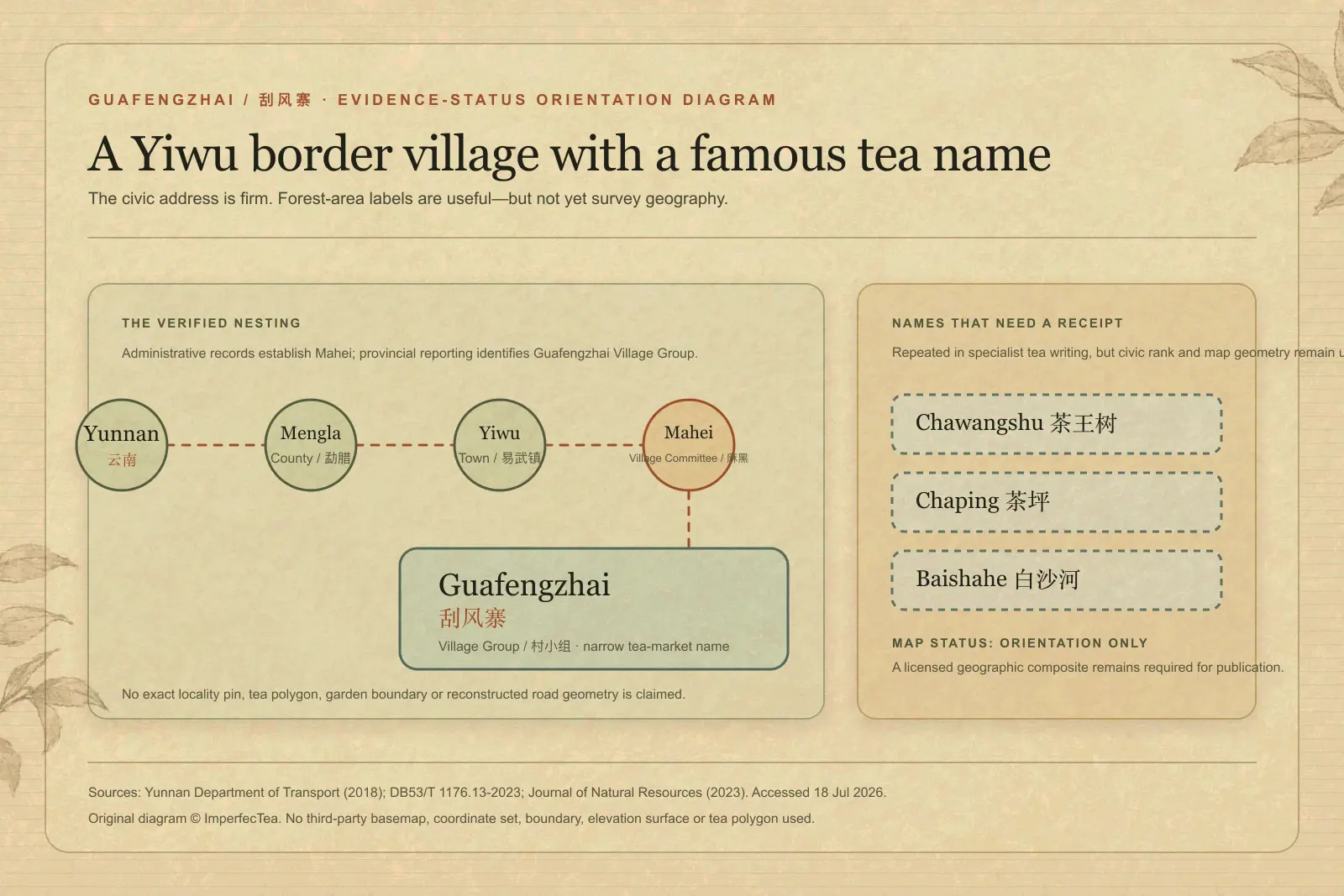
Orientation guide notes and sources
Boundary confidence: Mahei committee and Guafengzhai village-group relationship supported; no licensed composite map, surveyed tea boundary, or independently verified locality-point set has been assembled
- Yunnan Department of Transport, 2018
- DB53/T 1176.13-2023 administrative village codes
- Journal of Natural Resources, 2023
Guafengzhai (刮风寨) is a Yao village group under Mahei Village Committee, Yiwu Town, close to the Laos border. It makes a narrower origin claim than Mahei or Yiwu, but still leaves the garden and household to be identified.
What might it taste like?
Sweetness, fragrance and substantial texture recur in the small public tasting record. Some examples have a firmer bitter edge than the usual gentle Yiwu description. Slow Food’s account emphasises a sweet, fragrant tea; an independent 2018 note describes a calm but powerful session.
These accounts depend on the products’ claimed origins. Use them to decide what to sample, not to identify Guafengzhai blind.
Forest names and border trade
Commercial labels may narrow further to a forest tract or garden used by village households. Ask whether that name describes the growing place, a collection point or a producer’s lot convention.
Specialist reporting also describes Lao leaf entering local trade. Border material can make good tea, but a blend should be sold as such. “Guafengzhai” needs clarification if the seller means village-grown leaf rather than a broader supply network.
Access changed the village
Official transport and forestry reporting describes road access, processing and tea income changing local livelihoods. The work of carrying fresh leaf from forest-side gardens still matters. It affects time and handling before the leaves reach a wok.
My Guafengzhai and river-road field note keeps the village visit separate from the following day’s route south of Yiwu. The photographs record the trip, not the provenance of a retail cake.
A useful comparison
Taste a sourced Guafengzhai beside Mahei or a broad Yiwu blend from similar harvests. Look for body and a lasting finish after the opening fragrance fades.
For a purchase, ask which household and garden supplied the leaf, who processed it and whether it was blended before pressing. The smaller the forest-name claim, the more specific those answers need to be.
Sources and limits
This guide uses the current provincial administrative-village code standard for Mahei’s civic position, the 2018 Yunnan Department of Transport report for Guafengzhai’s village-group nesting and community/road context, and peer-reviewed Yiwu research for town-scale climate, industry, processing and historical context. Slow Food and independent specialist tasting/field accounts are used only for scoped sensory and named-area discussion. The local research dossier and source log keep URLs, access dates, conflicts and claim confidence visible.
Quick answers
Frequently asked questions
What does the Guafengzhai tea name identify?
A village group under Mahei Village Committee in Yiwu Town, Mengla County, near China's border with Laos.
What does Guafengzhai tea taste like?
Claimed samples often point toward fragrance, sweetness, dense texture and sometimes firm bitterness; no matched multi-producer flight establishes a village fingerprint.
What is Guafengzhai commonly confused with?
Guafengzhai village, Mahei committee, and the tea-market names Chawangshu, Chaping and Baishahe are different geographic scales.
What should I ask before buying Guafengzhai tea?
Is this a Guafengzhai village blend or a named forest-area lot, and which households and harvest records support that claim?