The Dormant Years of Raw Pu-erh: When a Good Tea Goes Quiet
Raw pu-erh can lose its young fragrance before its mature character is ready. Research supports a real flavour valley, but not a universal 4-to-10-year rule.
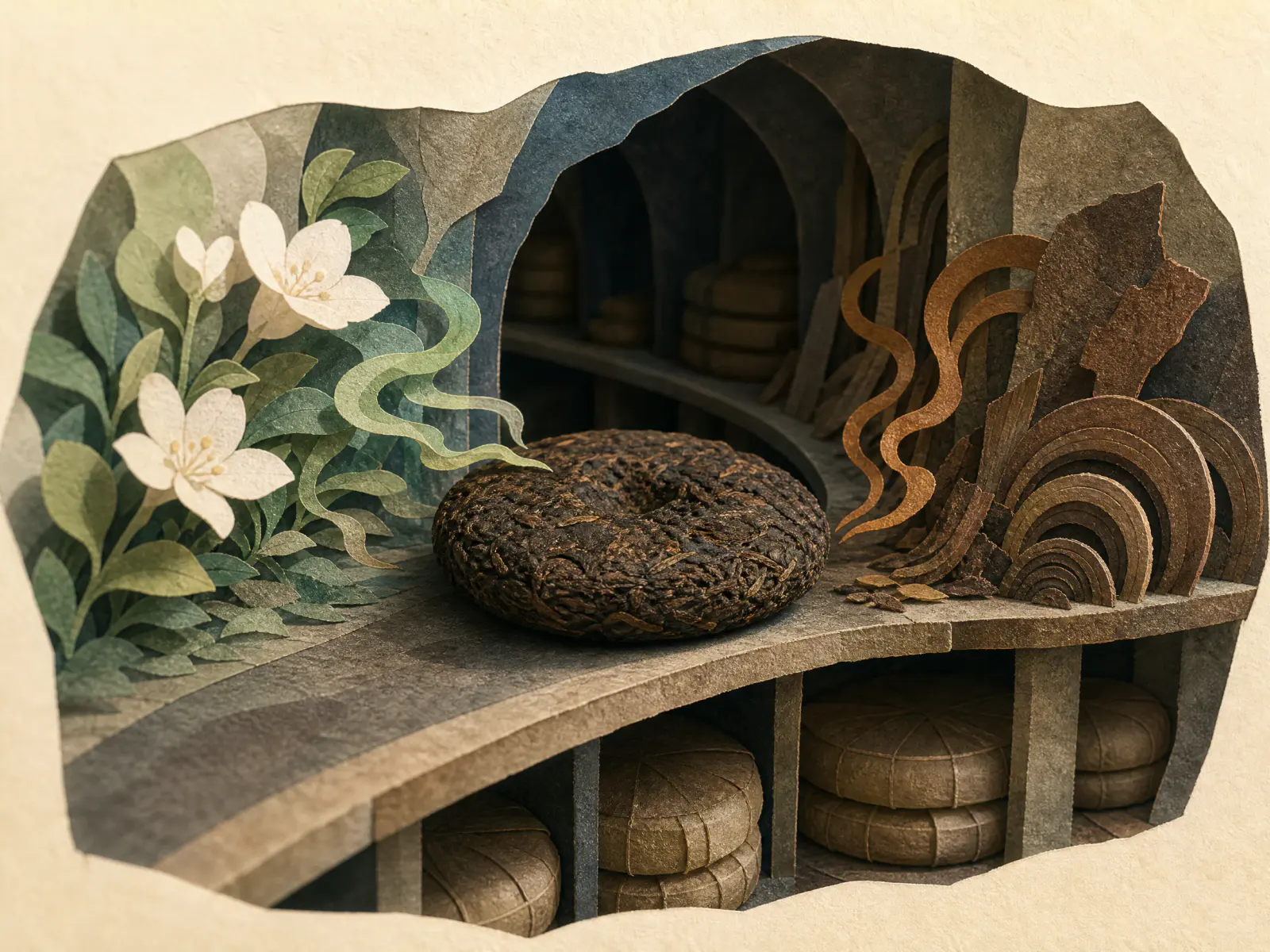
I started wondering whether one of my raw pu-erhs was fake.
When it was young, it had a high fragrance, fresh sweetness and enough detail to keep me interested. Now the aroma has faded and a woody taste is coming through, without much depth. It isn’t unpleasant. It’s boring.
One of the teas that prompted this is labelled Taozi Zhai. I had filed it beside my Yiwu teas, though Taozi Zhai circulates as a Manzhuan market locality. The Manzhuan guide covers that unresolved place name. Here, I want to understand the dull cup.
Drinkers sometimes call this an awkward phase or the “dormant years”: a tea loses its youthful brightness before developing much aged character. The phrase is plausible, but also convenient for a seller defending an expensive cake. I wanted to know whether research supports it.
A dip in the tasting scores
A 2025 Foods study compared one manufacturer’s Wenshan raw pu-erhs aged from one to ten years. They had been stored in a dry, ventilated warehouse below 25°C and 70% relative humidity. Five trained tasters assessed the teas alongside chemical measurements.
The one-year tea scored 92.20. Scores fell to 83.70 at year four, then recovered, reaching 94.35 at year nine. Fruity, floral and green aromas receded before woody and herbal notes fully developed. That sounds familiar: the high notes go, wood appears, and the tea feels less interesting for a while.
These were different vintages, though, not the same cake tasted every year. Harvest and batch differences could help explain the pattern. It shows a dip in this set of teas, not a schedule every cake will follow.
A 2023 study of Guangdong-stored Dayi 7542 also found substantial aroma changes around years three to five. Other storage studies describe declining bitterness and astringency alongside growing woody aroma and mouth-filling depth. The changes happen at different rates, which could leave a tea feeling temporarily unbalanced.
What might return?
An older tea won’t necessarily recover its original fragrance. In the Wenshan study, later teas earned higher scores for being mellow, sweet and thick, even though total aroma compounds never returned to their year-three peak.
For my Taozi Zhai, I’m watching what remains beneath the fading aroma. Does it still have weight? Is the aftertaste lasting? Do later infusions have anything to offer? A muted tea with clean storage and substantial texture gives me more reason to wait than one losing everything at once.
Neither outcome proves where the tea came from. Genuine tea can disappoint, and falsely labelled tea can age. Nor do these studies promise that an individual dull cake will recover.
How I’ll follow this cake
I’ll taste it every three to six months, using the same water, porcelain vessel and infusion times. A fixed ratio, such as 7 g per 100 ml, makes changes easier to notice. I’ll compare pieces from the edge and centre and record aroma, texture, aftertaste and the last infusion I enjoy.
I’ll also keep an older, similarly processed Manzhuan or Yiwu-area tea beside it as a reference. The comparison won’t authenticate either tea, but it should help me describe what is changing.
A recently shipped cake deserves time to settle before I call it dormant. Mustiness, visible growth or suspicious dampness calls for a storage check. I won’t try to wake up a dull cake by making it wetter. The Hong Kong storage guide covers a practical home setup, and How Raw Pu-erh Ages explains the processing background.
For now, I’ll keep a small amount accessible and store the rest cleanly. If the body and aftertaste hold up while the aroma changes, I’ll keep watching. If they keep thinning, I’ll stop assuming that more time will help.
Research cited
Xu J, Deng X, Wu Y, et al. Characteristic Changes and Potential Markers of Flavour in Raw Pu-Erh Tea with Different Ageing Cycles Analysed by HPLC, HS-SPME-GC-MS, and OAV. Foods. 2025;14(5):829.
Guo J, Yu Z, Liu M, et al. Analysis of Volatile Profile and Aromatic Characteristics of Raw Pu-erh Tea during Storage Based on GC-MS and Odor Activity Value. Foods. 2023;12(19):3568.
Ma B, Ma C, Zhou B, et al. Quantitative Descriptive Analysis, Non-Targeted Metabolomics and Molecular Docking Reveal the Dynamic Aging and Taste Formation Mechanism in Raw Pu-erh Tea During Storage. Food Chemistry: X. 2025;25:102234.
Ren Y, Hou Y, Granato D, Zha M, Xu W, Zhang L. Metabolomics, Sensory Evaluation, and Enzymatic Hydrolysis Reveal the Effect of Storage on the Critical Astringency-Active Components of Crude Pu-erh Tea. Journal of Food Composition and Analysis. 2022;107:104387.
Chen L, Long Y, Qu H, et al. Non-Volatile Metabolite Profiles and Taste Quality of Pu-erh Raw Tea on Different Storage Years by Metabolomics and 1H qNMR. Food Research International. 2025;219:116967.
Zhang J, Shen X, Zhang Q, Zhou Y, Li G, Li J. Comparative Study on Changes of Aroma and Flavor Components of Raw Pu-erh Tea Produced in Different Producing Areas and Storage Years. Food Research and Development. 2021;42(9):11-18.
Quick answers
Frequently asked questions
Does raw pu-erh tea go through a dormant phase?
Raw pu-erh can pass through a period when young aroma and freshness decline faster than mature character develops. Storage studies show non-linear chemical and sensory changes, including a measured middle-age flavour valley in one sample set. Dormancy is a useful description of that possibility, not a fixed biological stage.
When do the dormant years of raw pu-erh happen?
There is no universal age range. Several studies found important shifts around years three to five and later separation around years eight to ten, but their teas and storage differed. Leaf, processing, compression, temperature, humidity, oxygen exposure and storage history can move or erase the apparent transition.
Does the character of dormant raw pu-erh come back?
It can become expressive again, but it does not recover the same young aroma. Fresh volatiles are lost or transformed while woody, herbal, dried-fruit and aged notes may develop. Some teas find a satisfying mature balance; others keep fading. Published research does not support a promise that every good cake recovers.
Does a dormant phase prove that a pu-erh cake is genuine?
No. A dull period cannot authenticate a village, garden, tree age or wrapper. Genuine tea can be damaged or uninteresting, and falsely labelled tea can also acquire generic aged flavours. Dormancy may explain a sensory pattern, but provenance still requires evidence independent of the taste of one cake.
How should you test a supposedly dormant pu-erh cake?
Retaste it every three to six months with the same water, porcelain vessel, leaf ratio and infusion sequence. Record aroma, bitterness, astringency, sweetness, thickness, salivation, aftertaste and stamina separately, while logging storage conditions. Compare it with a documented older reference instead of relying on memory or the wrapper.