Tea Fraud - Why I'm Paranoid About What I'm Drinking
The uncomfortable reality of fraud in the tea industry and why authenticity might be impossible to guarantee.
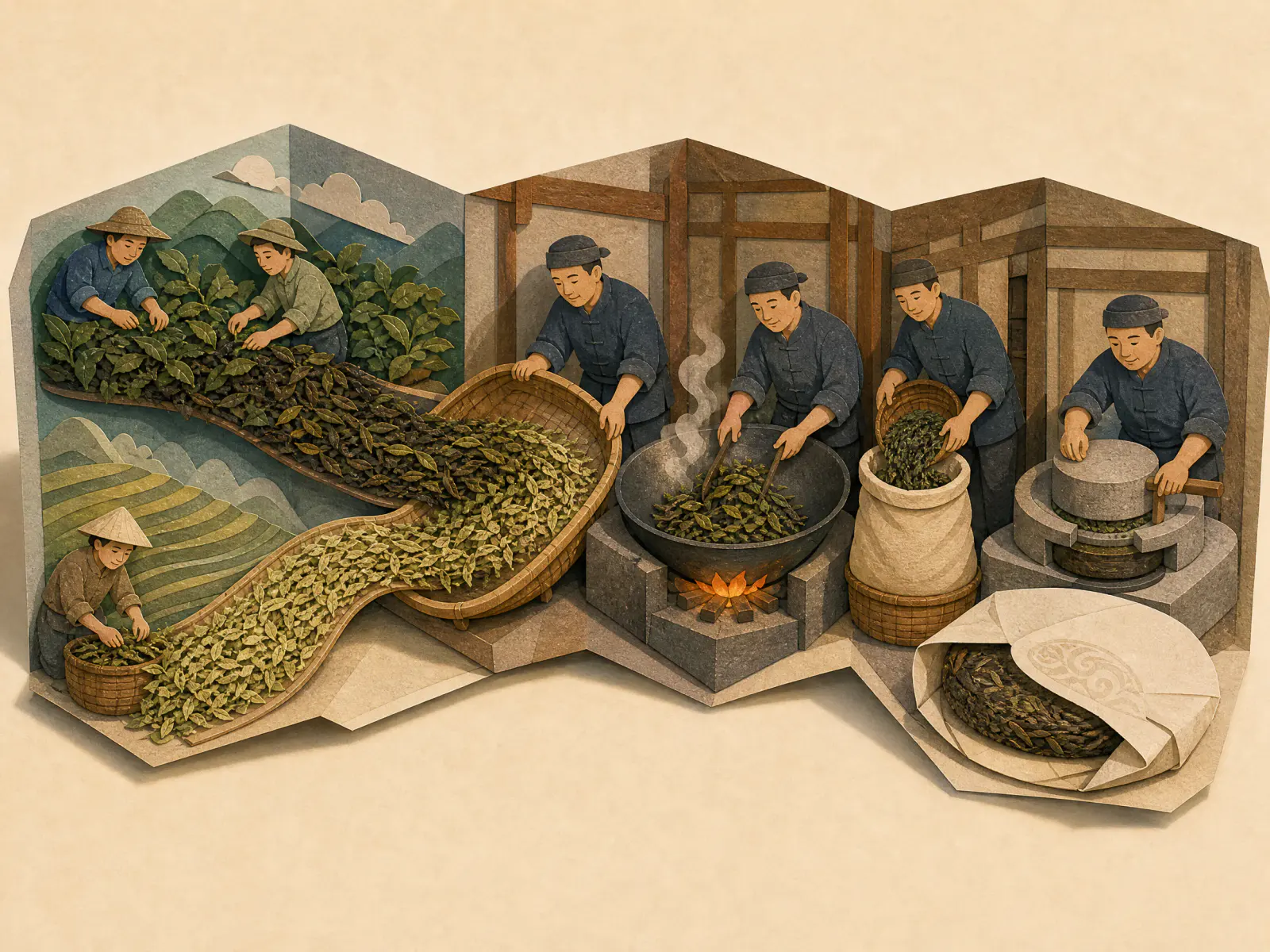
Fraud is the worry that follows me around whenever I buy tea. A lot of hands touch the leaf before it reaches my cup, and each handoff gives someone an opportunity to substitute cheaper material.
Gushu (古树, “ancient tree”) is particularly difficult to check. I can taste bitterness, texture and a lasting finish. None of those tells me the tree’s age or proves which garden supplied the leaf.
Where a claim can go wrong
Leaf can be mixed during picking, processing, wholesale handling or pressing. A farmer who sells maocha may rely on someone else to make the cakes. Even an honest first purchase leaves later handoffs to account for.
The wrapper introduces another problem. Custom printing is cheap, and a prestigious village or vintage can be printed on ordinary tea. A convincing package doesn’t repair a missing sourcing record.
Wholesalers I’ve spoken to inspect and taste before buying, but they also handle large quantities. I don’t expect one person, or one test, to remove all uncertainty. That frustration was part of why I originally called this site “Imperfect Tea.”
What I ask before buying
I want the Chinese place name, the harvest and a named maker. I also ask whether the cake comes from one garden, a village blend or a broader area, and whether the sample is from the batch for sale.
Records should follow the tea through maocha production and pressing. A certificate or photograph may help, but I want to know how it connects to this batch. If the seller changes the story when I ask, I usually stop there.
Price and volume are useful checks. A cheap cake claiming a tiny, expensive origin needs an explanation, as does a seemingly endless supply. The Bingdao price guide provides dated context, not a test of authenticity.
What tasting can tell me
I give a tea three to five sessions before settling on an opinion. Dry and wet leaves can suggest a picking standard or processing choices. In the cup, I record bitterness, returning sweetness, salivation and texture separately, then compare with a sample whose sourcing I trust.
That helps me decide whether I like the tea and whether its behaviour fits the description. It still won’t verify a village or tree age. Even laboratory origin methods depend on the reference samples they were built from.
Clear returns matter too. I am less willing to take a chance on a seller who refuses leaf photographs, supplies no harvest information and offers no way to resolve a problem.
Renting the tree
Some buyers go much further. I’ve seen old trees with name signs reserving their seasonal harvest. A solar-powered CCTV camera can even let a buyer watch remotely. The most committed buyers pick the leaf themselves or hire workers they trust.
I understand the appeal, though that is a lot of work for a cup. For my own buying, I’d rather start with a modest claim I can follow than pay for precision the seller can’t explain.
The Bingdao five-village guide shows how much one place name can conceal. The 2025 Yunnan leaf-price report explains the difference between fresh-leaf, maocha and cake prices. Both are useful before buying a sample.
Sources and evidence limits
- Shuangjiang Market Regulation Bureau case notice (2024), a documented Xiaohusai-labelled cake enforcement case.
- Li Yanlong et al., Food Chemistry 496 (2025), research on stable-isotope traceability for Pu-erh origin; a promising analytical method, not a household taste test.
- CNIPA announcement no. 616 (2025), for the narrow production-area wording used around Bingdao Laozhai/Bingdao Zhengshan.
Quick answers
Frequently asked questions
Can you identify genuine ancient-tree Pu-erh by taste?
No single taste or body sensation can prove tree age. Huigan, texture, bitterness and stamina can describe a cup, but cultivar, season, processing, storage and brewing also affect them. Taste is useful for quality assessment, not a complete provenance certificate.
Do large leaves prove a Pu-erh tea is gushu?
No. Leaf size reflects cultivar, shoot maturity, sorting and processing as well as tree material. Large intact leaves and a dramatic rinse may be interesting observations, but they do not establish the age of the source trees.
What evidence makes an ancient-tree Pu-erh claim more credible?
Look for an exact Chinese place and garden scale, a named farmer or processor, dated harvest and batch records, continuity from maocha to pressing, plausible volume and price, and consistent answers across the supply chain. No single document removes every risk.
Is a cheap Bingdao ancient-tree cake always fake?
A famous narrow-origin, ancient-tree claim priced far below comparable raw material is implausible, but price alone cannot authenticate tea. First check whether Bingdao means Laozhai, one of five villages, a broader blend, a brand name, or only a style reference.