Tea Fraud - Why I'm Paranoid About What I'm Drinking
The uncomfortable reality of fraud in the tea industry and why authenticity might be impossible to guarantee.
Can you identify genuine gushu Pu-erh?
Not from the cup alone. Gushu (古树, “ancient tree”) is a provenance and tree-age claim, while tasting tells you what happened in this sample. Huigan, texture, bitterness, leaf size and stamina can all describe tea, but none can establish a tree’s age or the chain of custody from garden to cake.
The strongest practical approach is to build a stack of imperfect evidence: an exact place and claim scale, a named maker, harvest and batch records, plausible volume and price, continuity through pressing, and a seller whose answers remain consistent. Even that reduces uncertainty rather than eliminating it.
Fraud is the worry that follows me around whenever I buy tea. A lot of hands touch the leaf before it reaches my cup, and every handoff creates another chance to swap expensive material for something cheaper.
Tea people sometimes joke that the only way to guarantee a harvest is to pick it yourself, or sit in Yunnan and watch every leaf being picked. The more I learn about the supply chain, the less that sounds like a joke.
Where the swaps can happen
-
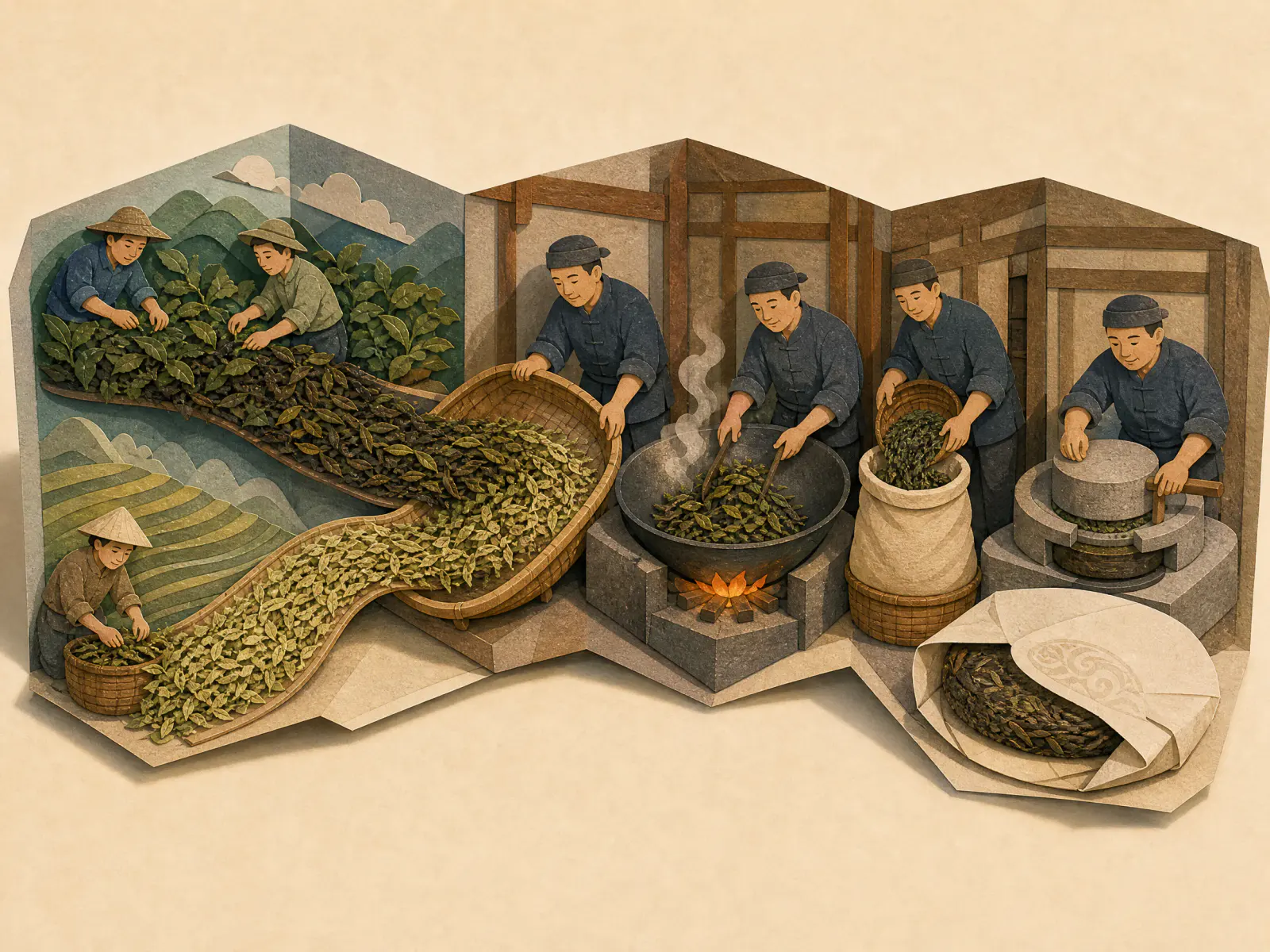
At harvest: Farmers may pay pickers up to 150 RMB a day for long hours of manual work. A picker or farmer could bulk up ancient-tree leaf with younger terrace material. Checking every batch is nearly impossible, and the large price gap between old and young trees creates a powerful incentive.
-
At the factory: Cheaper leaf can be added during the “kill green” stage to increase the volume.
-
At the maocha wholesaler: Other leaves can be mixed into bulk loose tea. Wholesalers and buyers I have spoken to try to inspect and taste before buying, but people get tired and thousands of kilograms change hands every day. There is plenty of room to manoeuvre while the tea stays loose. Once it is pressed into a cake, the blend can no longer be altered.
-
At the wrapper: Custom wrappers on Taobao cost less than 1 RMB each, and printers will put almost anything on them. Adding “ancient tree” or an attractive vintage can increase the sale price dramatically.
-
At cake compression: Not every farmer can press their own cakes. Until the cake is finally pressed, another party can still interfere with the blend.
Making peace with imperfect tea
Reading about all this was depressing. If a swap can happen at the picking stage, how can I ever be completely sure that the tea is what the seller says it is?
That question is one reason I chose the name “Imperfect Tea” for this site. I do not expect 100% certainty any more. Perhaps getting 80% of what we think we bought, while staying curious and careful, is something we can live with.
How I lower the odds of being fooled
None of these checks can guarantee provenance, but together they make a bad story easier to spot.
Before buying
- Compare the price and claimed volume. A narrow famous-origin, ancient-tree story priced below ordinary regional material needs a convincing explanation. Use the Bingdao price guide as dated context, not an authentication certificate.
- Ask for the exact Chinese place, its administrative parent, garden or blend scale, season, maker and batch. “From Yunnan” and “Bingdao” can both be too broad.
- Look for traceability: harvest records, batch identifiers, farmer or processor continuity and pressing records. A report or certificate is one layer of evidence, not the whole chain.
- Be suspicious of “legendary” vintages. Treat reasonably priced 1990s ancient-tree stock as fake until the seller proves otherwise.
When the tea arrives
- Brew it across three to five sessions before deciding what you think. First impressions can mislead.
- Inspect dry and wet leaf for consistency with the seller’s processing and picking claim, while remembering that leaf size and intactness do not prove tree age.
- Pay attention to huigan, shengjin, texture, bitterness and stamina as separate quality observations. None authenticates the garden.
- Taste it beside a known genuine sample if you can. Palate memory is one of our best tools.
| Evidence | What it can tell you | What it cannot prove alone |
|---|---|---|
| Exact Chinese place and parent | Whether the claim is geographically coherent | That this batch came from there |
| Harvest and batch records | Whether a traceable story exists | That no substitution occurred |
| Price and available volume | Whether the economics are plausible | Authenticity or quality |
| Dry and wet leaf | Picking, sorting and processing clues | Tree age |
| Huigan, texture and stamina | How this cup behaves | Village, garden or gushu status |
| Laboratory origin work | Whether measured markers fit a reference set | An unbroken chain of custody for every cake |
Red flags
- Seller refuses to show close-up photos of the dry leaf or wet leaf
- The story changes when you ask specific follow-up questions
- Prices are significantly below market rate with no clear explanation
- Wrappers are printed with generic “ancient tree” with no producer/harvest date
- No possibility of return or refund
The extreme option: rent the tree
Some farmers now let buyers rent a tree for the season. They take you through the garden, put your name on a sign beside the tree, and reserve its harvest for you. I have seen large ancient trees carrying these name signs. In a very 2025 twist, a solar-powered CCTV camera can watch the tree so the buyer can check it remotely at any time.
I actually think this is a clever idea. The most committed tea drinkers can harvest the tree themselves or hire workers they trust. It is an extraordinary amount of effort for one honest cup, but that tells you how hard provenance can be.
What I now trust most
I trust claims that remain modest when the evidence is broad. A transparent Mengku blend is more believable than a cheap “single-tree Bingdao Laozhai” cake. A producer who distinguishes fresh leaf, maocha and finished cake prices is more useful than one headline number. A seller who says “we do not know” at the edge of the chain is giving me information.
The Bingdao five-village guide shows why claim scale matters. The 2025 Yunnan leaf-price report explains why fresh leaf, maocha and retail cake numbers should not be mixed. If a tea’s main evidence is how the wrapper makes you feel, buy a sample rather than the story.
Sources and evidence limits
- Shuangjiang Market Regulation Bureau case notice (2024), a documented Xiaohusai-labelled cake enforcement case.
- Li Yanlong et al., Food Chemistry 496 (2025), research on stable-isotope traceability for Pu-erh origin; a promising analytical method, not a household taste test.
- CNIPA announcement no. 616 (2025), for the narrow production-area wording used around Bingdao Laozhai/Bingdao Zhengshan.
Quick answers
Frequently asked questions
Can you identify genuine ancient-tree Pu-erh by taste?
No single taste or body sensation can prove tree age. Huigan, texture, bitterness and stamina can describe a cup, but cultivar, season, processing, storage and brewing also affect them. Taste is useful for quality assessment, not a complete provenance certificate.
Do large leaves prove a Pu-erh tea is gushu?
No. Leaf size reflects cultivar, shoot maturity, sorting and processing as well as tree material. Large intact leaves and a dramatic rinse may be interesting observations, but they do not establish the age of the source trees.
What evidence makes an ancient-tree Pu-erh claim more credible?
Look for an exact Chinese place and garden scale, a named farmer or processor, dated harvest and batch records, continuity from maocha to pressing, plausible volume and price, and consistent answers across the supply chain. No single document removes every risk.
Is a cheap Bingdao ancient-tree cake always fake?
A famous narrow-origin, ancient-tree claim priced far below comparable raw material is implausible, but price alone cannot authenticate tea. First check whether Bingdao means Laozhai, one of five villages, a broader blend, a brand name, or only a style reference.