Why Yiwu Tea Feels So Thick
Yiwu raw pu-erh can taste gentle while its tea soup feels unusually dense. Tea chemistry offers a good explanation, and also explains why the same leaf can make an awkwardly thick kombucha.
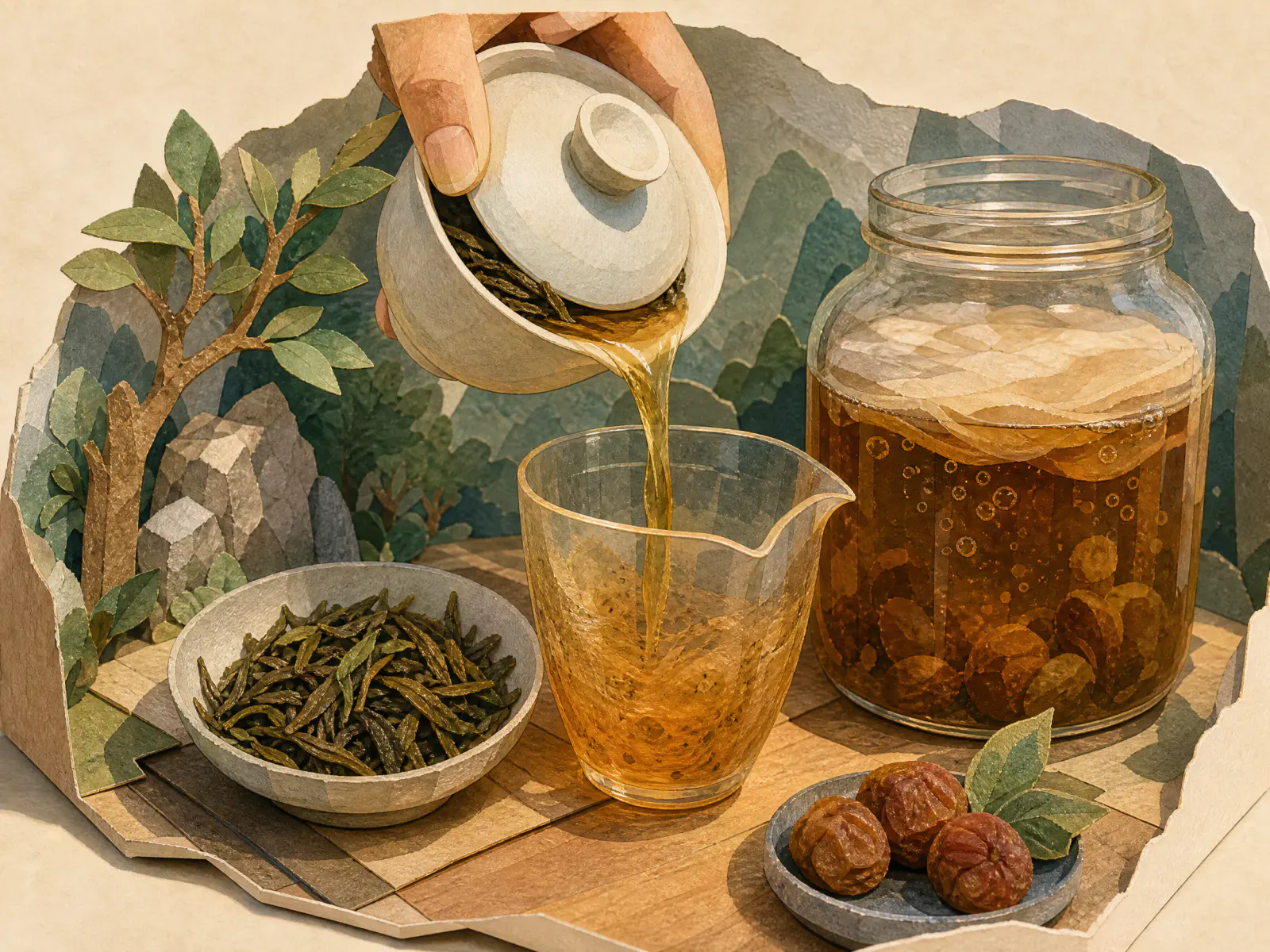
Some Yiwu teas taste gentle but feel surprisingly dense. The liquor coats the mouth and lingers after the obvious flavour has faded. I noticed that texture for the wrong reason when I used Yiwu for kombucha: my batch turned out much thicker than I wanted.
That sent me looking for an explanation. Sugar contributes, but the research points to a mixture of dissolved material, tiny suspended particles and how we perceive them. It doesn’t establish that Yiwu is always thicker than other raw pu-erh.
What gives tea body?
Bitterness and fragrance can make a cup seem strong without making it feel thick. Body involves the liquid’s flow, the coating it leaves and how it interacts with saliva. Sweetness can also make us perceive more weight.
Long-chain carbohydrates, including polysaccharides and pectin, can bind water. Proteins and polyphenols can form small particles that affect texture. Their structure matters: one tea-polysaccharide experiment found roughly a fourfold difference in apparent viscosity between two preparations.
A 2025 LWT study altered the suspended particles in Keemun black tea by centrifuging the infusions. Tasters’ thickness ratings changed alongside soluble solids, proteins and polysaccharides. That’s useful evidence for tea body, though it wasn’t a study of Yiwu.
What the Yiwu measurements show
A study comparing Manxiu and Zhengjialiangzi, two Yiwu sites, found quite different results:
| Dry-leaf measurement | Manxiu | Zhengjialiangzi |
|---|---|---|
| Tea polyphenols | 18.25% | 16.35% |
| Catechins | 13.42% | 13.38% |
| Total soluble sugar | 0.92% | 0.55% |
| Free amino acids | 1.18% | 1.28% |
| Water extract | 45.57% | 32.14% |
Water extract measures how much material can move from dry leaf into hot water under the test conditions. Manxiu had more extractable material and soluble sugar, which could contribute to a fuller cup. The difference within Yiwu is worth keeping in mind before assigning one chemistry to the whole region.
The study didn’t measure viscosity or compare Yiwu with other mountains. It gives us a possible explanation, not proof of a regional trait.
Brewing can change the result too. Leaf quantity, temperature, contact time and water chemistry all affect the infusion. Compare cups at the same drinking temperature; cooling alone can change how thick they feel.
Why my kombucha was too thick
Fermentation adds more variables. Residual sugar can increase perceived thickness, while cellulose, microbial biomass and other fermentation products can contribute suspended material. The tea’s original body may be only part of the result.
Published experiments have successfully made kombucha with raw pu-erh. My batch tells me that this combination of tea, sugar, culture and fermentation schedule didn’t produce the brisk drink I wanted. It doesn’t rule out Yiwu as a base.
Next time, I’d compare small batches of Yiwu, another sheng and my usual kombucha tea, keeping the recipe and conditions the same. Comparing their flow before fermentation, then after fermentation and filtration, could help locate the difference. That would be a rough comparison; normal sanitation and acidification checks would still come first.
I also find Yiwu relaxing, but I wouldn’t connect that feeling to its thickness. There is no controlled regional trial behind that impression. For tasting, I’ll keep recording body separately from aroma and bitterness. That distinction describes what I enjoy more accurately than calling the tea “strong.”
Read the Yiwu tea mountain guide for the place behind the label, or From Guafengzhai to the River Road for the visit.
Research cited
Wang J, Xue Q, Hu Y, Yang H. Analysis of Physicochemical Composition of Yiwu Ancient Tree Tea. Science and Technology of Food Industry. 2021;42(15):211-217.
Li Y, Pan W, Feng Z, et al. Deciphering composition-structure-taste relationship of black tea-infusion via assessments of nanoparticles by centrifugal treatment. LWT. 2025;222:117601.
Li L, Wang D, Zhou X, Ding Q. Study on Food Functionality of Tea Polysaccharides. Journal of Tea Science. 2006;26(2):102-107.
Payne ER, Aceves Martins M, Dubost J, Greyling A, de Roos B. Effects of Tea, L-theanine, or L-theanine Plus Caffeine on Cognition, Sleep, and Mood in Healthy Participants. Nutrition Reviews. 2025;83(10):1873-1891.
Zhang J, Ma H, Wang H, et al. Flavor and sensory profile of kombucha fermented with raw Pu-erh tea and evaluation of the antioxidant properties. LWT. 2024;200:116220.
Yao L, Ma H, Yao L, et al. Initial Sugar Concentration on Sensory Characteristics of Raw Pu-Erh Tea Kombucha and Multi-Omics Analysis. Foods. 2025;14(18):3216.
Wu Y, Chen Q, Ruan H, He G. Optimization of Liquid Fermentation Process for Improved Exo-Polysaccharides Production by Kombucha ZJU1. Advance Journal of Food Science and Technology. 2013;5(2):217-224.
Salinas-Ruiz JP, Guevara García J, Rios Tovar D, et al. Effects of Fermentation Time and Temperature on the Physicochemical Quality of Kombucha. Foods. 2026;15(7):1226.
Quick answers
Frequently asked questions
Why does Yiwu pu-erh tea feel thick?
A plausible explanation combines dissolved and suspended material in the infusion: soluble sugars, longer-chain polysaccharides, pectin, proteins and polyphenol complexes. Yiwu-specific measurements show high water-extract potential in one sample, while broader tea research links soluble solids and polysaccharides with perceived thickness. Direct regional viscosity comparisons are still missing.
Is thick tea the same as strong tea?
No. Strength can mean bitterness, aroma or flavour concentration, while thickness concerns body, coating and perceived weight. A tea may have restrained aroma and bitterness yet carry substantial non-volatile material. Conversely, a sharply bitter or fragrant cup can still feel physically thin.
Does all Yiwu tea have a thick mouthfeel?
No controlled study shows that every Yiwu tea is thicker than tea from other Yunnan regions. Two measured Yiwu samples differed sharply in water extract, soluble sugar and aroma compounds. Garden, plant material, season, processing, storage, brewing and water can all change the body of the cup.
Do tea polysaccharides make Yiwu tea thick?
They are a credible contributor, not a complete regional proof. Long-chain polysaccharides and pectin can bind water and interact with proteins and polyphenols, while general tea studies connect soluble polysaccharides with thickness. Yiwu research has not yet measured matched polysaccharide structure, pectin and viscosity against other origins.
Is Yiwu raw pu-erh suitable for kombucha?
It can be, but Yiwu is not guaranteed to produce the brisk style you want. The starting tea, sugar level, extraction, microbial culture and fermentation schedule all shape texture. My batch became too thick; published studies show that other raw pu-erh kombuchas fermented successfully, so the result is batch-specific rather than a regional rule.