勐海
Menghai (勐海): Tea Region Guide
Menghai is a county in western Xishuangbanna with two major roles in Pu'er: it grows tea in areas such as Bulang and Nannuo, and it is an important centre for blending, pressing and ripe-tea production.
On the shared Yunnan mapMenghai 勐海Open the regional map →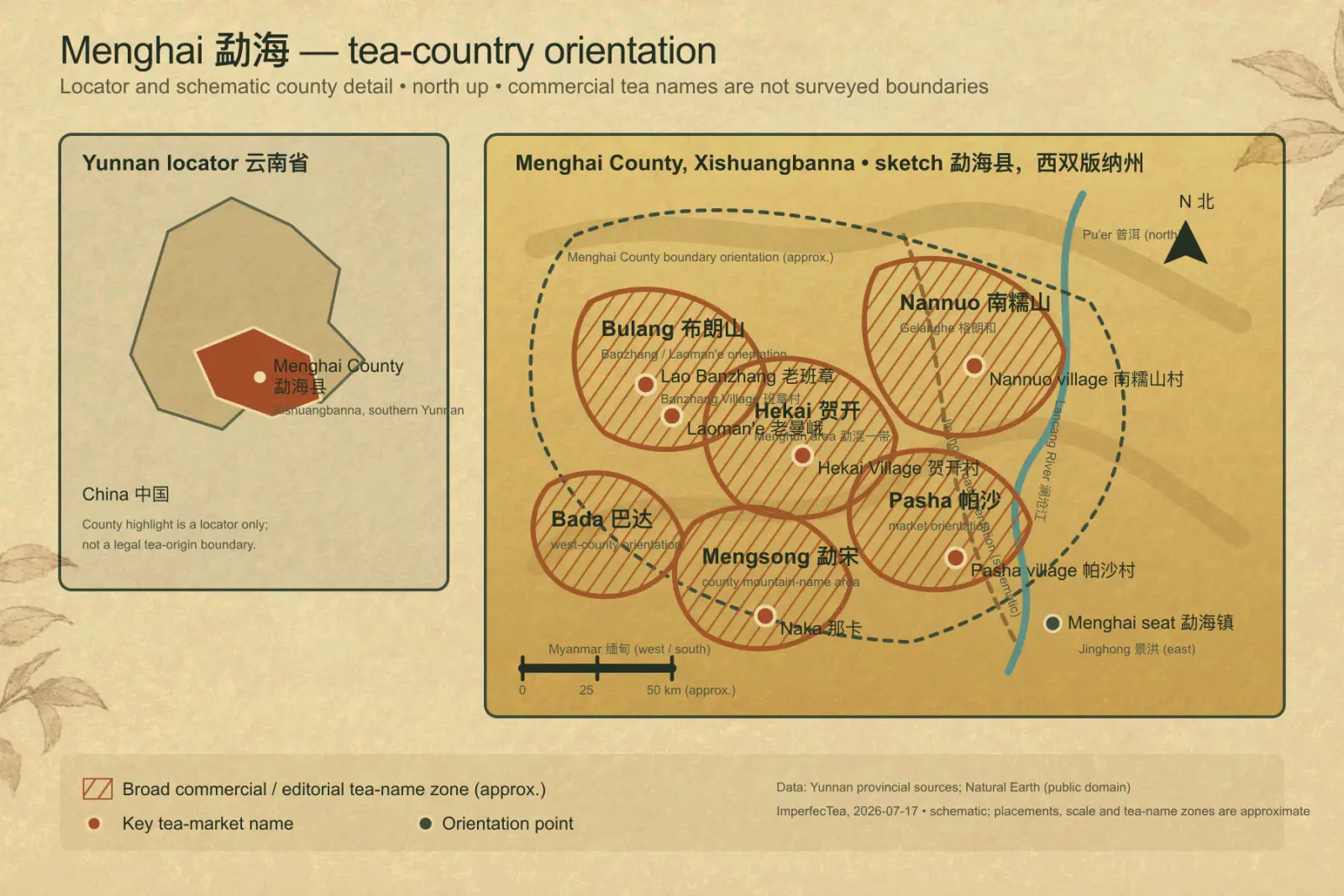
Menghai is a county in western Xishuangbanna with two major roles in Pu’er: it grows tea in areas such as Bulang and Nannuo, and it is an important centre for blending, pressing and ripe-tea production. A Menghai factory address does not necessarily identify where the leaves grew.
The main areas
| Tea name | Where to place it |
|---|---|
| Bulang, Lao Banzhang, Laoman’e | Bulang Mountain Township; Lao Banzhang is one village group within the wider area |
| Hekai | Menghun Town |
| Nannuo and Pasha | Gelanghe Hani Ethnic Township; separate tea areas |
| Mengsong and Naka | Mengsong in Menghai County; distinguish it from similarly named places |
| Bada | Western Menghai |
Yiwu, a common tasting comparison, is in Mengla County to the east.
Taste beyond bitterness
Menghai raw teas have a reputation for strength. Individual Bulang and Laoman’e samples can be firmly bitter, followed by sweetness and salivation. Nannuo and Hekai examples are often described as gentler, though none of these names guarantees a style.
When sampling, look beyond the first sharp sip. Does the bitterness clear? Does the tea keep its texture through the middle infusions? Is the finish pleasant when the cup cools? Those observations are more useful than ranking teas by how forceful they feel.
Aroma and texture also depend on harvest, processing and storage. Smoke or a rough, drying finish deserves closer examination rather than automatic credit as mountain character.
The factory connection
The Fo Hai experimental factory of 1939–1940 preceded the Menghai Tea Factory. Its later blending and fermentation work helped establish the county’s reputation in modern Pu’er.
For ripe tea especially, the recipe, fermentation and storage may explain more of the cup than the original village. Ask whether “Menghai” describes the leaf source, producer or a style the seller is trying to convey.
Buying and comparing
For a village-priced tea, get the Chinese locality, season, maker and blend description. A Lao Banzhang claim requires more detail than a general Menghai blend; the price does not verify it.
Try a clearly sourced Bulang tea beside a Nannuo or Hekai lot of similar age. Start with short infusions, and lower the dose if a young tea is difficult to drink. A fair comparison should give both teas a chance to show more than bitterness.
Explore Bulang and Nannuo for the village-level differences.
References
- Yunnan Provincial Ethnic Affairs Commission, 2026, county tea-industry and village reporting
- Yunnan Daily via Yunnan Rural Revitalization Bureau, 2025, 2024 county tea-industry figures
- Yunnan Department of Agriculture and Rural Affairs, 2022, Banzhang-area organic garden report
- Yang & Zheng et al., Bulang ancient-tea study, volatile and bioactive analysis of Bulang samples
- Yunnan Ethnic and Religious Affairs Commission, 2025, Hekai village enterprise context
- Yunnan administrative-village standard DB53/T 1176.13, 2023, administrative placement of Banzhang, Hekai, Nannuo, and Pasha
- Yunnan Agriculture Yearbook 2022, tea-village recognition
- Yunnan agriculture report on Banzhang, Banzhang industry context
- Ministry of Commerce time-honoured-brand record, Menghai Tea Factory founding history
- Yunnan Agriculture’s Dà Yì production-technique account, factory blending and fermentation heritage
- Whole-genome resequencing study, Nannuo and Hekai assamica research samples
- TeaDB Menghai County guide, Bulang drinking report, and Menghai County report, specialist tasting context
- Natural Earth, public-domain map base data
Quick answers
Frequently asked questions
Where is Menghai in the Pu-erh tea map?
Menghai is a county in Xishuangbanna, Yunnan, west of the Lancang River. It includes several major tea systems rather than one mountain or flavour.
Which famous Pu-erh areas are in Menghai?
Menghai includes Bulang Mountain and Lao Banzhang, Nannuo, Mengsong and Bada, among other villages and gardens. Each name covers a different scale.
Does a Menghai label identify where the leaf grew?
Only broadly. It may identify a county, factory style or blend. Ask for the mountain, village, season, material and producer when a narrower origin matters.