西双版纳傣族自治州
Xishuangbanna (西双版纳): Pu-erh's Deep South
The Six Ancient Tea Mountains, Yiwu's caravan trade, the 1939 Menghai factory, and the most name-dropped village in tea — a tour of Yunnan's southern pu-erh heartland, with honest buying and brewing advice.
On the shared Yunnan mapXishuangbanna 西双版纳Open the regional map →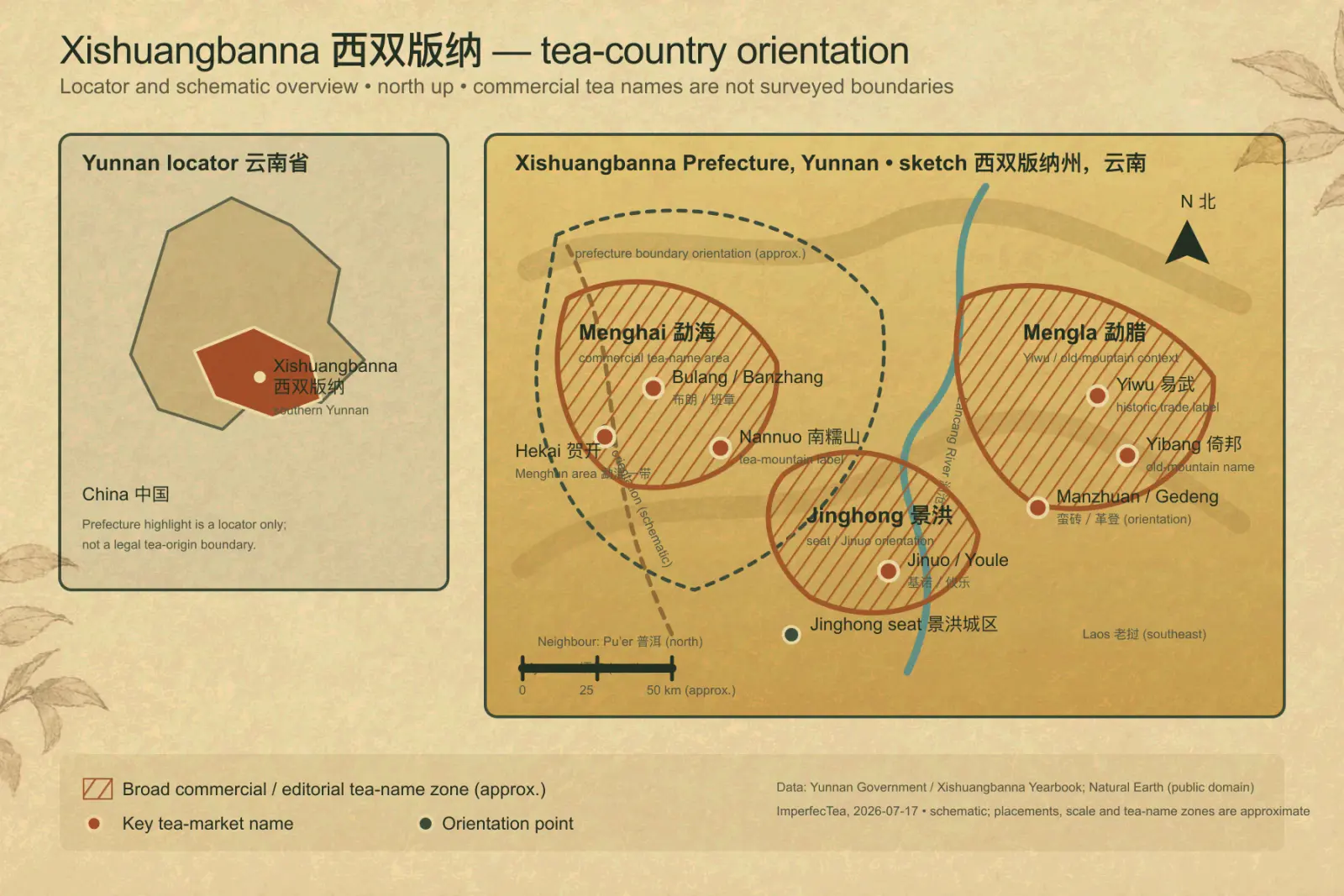
Where the pu-erh story piles up
Xishuangbanna (西双版纳, Xīshuāngbǎnnà) is Yunnan’s deep south: a tropical Dai Autonomous Prefecture pressed against Laos and Myanmar, cut through by the Lancang River (澜沧江, the Mekong, once it leaves China), and carrying more pu-erh history per square kilometre than anywhere else on the map. The historic Six Ancient Tea Mountains (古六大茶山) are here. Yiwu (易武), the trading town whose 1836 bridge inscription was already bragging about exceptional tea output, is here. The Menghai Tea Factory, founded by Fan Hejun in 1939 and the wellspring of the Dàyì tradition and modern ripe pu-erh, is here. So is Lao Banzhang (老班章), the most name-dropped village in the entire business.
Which is exactly why “Xishuangbanna” on a wrapper deserves a raised eyebrow. The prefecture covers about 19,000 square kilometres and three county-level divisions, and the legal pu-erh geographic indication is broader still, 11 prefectures and 75 counties across Yunnan. So “pu-erh” doesn’t mean Banna, and “Banna” doesn’t mean Banzhang. A wrapper is a claim, not a fact: the useful ladder runs prefecture → county → mountain → village → garden → season → maker, and every rung you can actually verify is worth more than the one below it. That’s the one disclaimer this guide needs. Everything after it is the fun part.
At a glance
| Field | Notes |
|---|---|
| Name | Xishuangbanna Dai Autonomous Prefecture / 西双版纳傣族自治州; also Sipsongpanna, or just “Banna” |
| Where | Southernmost Yunnan, south of Pu’er, bordering Laos and Myanmar |
| Counties | Jinghong City (景洪市), Menghai County (勐海县), Mengla County (勐腊县) |
| Elevation | Roughly 477 to 2,429 m across the prefecture, terrain extremes, not a tea-garden range |
| Key names | Menghai / Bulang / Lao Banzhang / Hekai / Nannuo in the west; Yiwu / Yibang / Manzhuan / Gedeng / Mangzhi in the east; Jinuo (Youle) near Jinghong |
| Tea style | Yunnan large-leaf raw (sheng) and ripe (shu) pu-erh |
| Flavor shorthand | Menghai side: bold, bitter-sweet; Yiwu side: fragrant, gentler, tendencies, not guarantees |
Menghai, Yiwu, and the river between
The prefecture sorts into three practical chunks. Menghai, the western county, is home to Bulang (布朗山), Banzhang, Hekai (贺开), Nannuo (南糯山), and the famous factory. Mengla, in the east, contains Yiwu and most of the old tea-mountain trading story. Jinghong, the prefectural seat, has its own tea country, including Jinuo Mountain (基诺山), historically “Youle” (攸乐), the spelling you’ll still see on wrappers. The Lancang is a handy landmark between them, but it does not neatly divide an “east style” from a “west style,” however much market copy wants it to.
The history explains the name recognition. A 1729 Qing reorganisation placed six Banna east of the Lancang under Pu’er Prefecture, and Yiwu grew into a major tea-trade centre in the decades that followed. The Six Ancient Tea Mountains, Yiwu plus Yibang (倚邦), Manzhuan (蛮砖), Gedeng (革登), Mangzhi (莽枝) and Youle, are a real cultural and trade category with real caravan-era weight behind them. What they are not is a modern quality grade or a surveyed boundary.
A few village-level notes worth carrying around. Hekai, in Menghai’s Menghun Township (勐混镇), was described in a 2025 Yunnan Daily report as a contiguous old-tea-garden landscape under community governance, one of the better-documented old-garden areas in the prefecture. Nannuo sits close to the main roads, which makes it the mountain most people actually visit; accessibility is not the same thing as uniformity. And “Yiwu” today is far broader than its famous villages: a cake stamped 易武正山 (Yiwu zhengshan, “Yiwu proper mountain”) is still not automatically Mahei (麻黑) or Luoshuidong (落水洞). Keep the Chinese characters; they’re where the information lives.
What might show up in the cup
The classic contrast, and it’s a real tendency, backed by years of specialist tasting notes like TeaDB’s Menghai and Bulang reports, is that Menghai-side teas lean potent and structured, with bitterness up front and sweetness returning after the swallow, while Yiwu-side teas lean fragrant and gentler on entry. Then a different harvest, a blend, or an aggressive firing reverses the whole picture, which is why TeaDB’s own Bulang report spends so much time on variation within Bulang.
The vocabulary worth learning: 回甘 (huí gān), the sweetness that returns in the throat after you swallow, and 生津 (shēng jīn), the salivation a good young sheng provokes. Both are things you feel, not things a lab measures. When comparing teas, keep dose, water, vessel and timing fixed, and make the first session descriptive rather than diagnostic, a clean, thick, persistent tea can be excellent without proving anyone’s old-tree story.
From leaf to cake
For raw pu-erh, fresh leaf is withered, heat-fixed (杀青, shā qīng), rolled, and sun-dried into 晒青毛茶 (shaiqing maochá) before sorting, blending and pressing. Every one of those steps can shout louder than the mountain. Scorch comes from overheated firing; a very green, vegetal cup from incomplete fixation; sourness from a difficult wet-season drying. None of these is “Banna character,” and none should be romanticised as such.
For ripe pu-erh, fermentation and storage dominate origin cues even more thoroughly. Menghai’s factory history and the provincial recognition of the Dàyì processing tradition explain why this county is the spiritual home of shu, but a factory address doesn’t tell you where the leaf grew. Compression matters too: a stone-pressed cake, a tight hydraulic cake and loose maocha extract differently even from identical leaf, so open a compressed sample properly before blaming the region for a harsh first steep.
Terroir, briefly
Banna sits on the northern tropical margin with monsoon seasonality; spring is the reference season for premium sheng. Beyond that, resist the urge to turn a prefecture climate blurb into a garden weather report. What the research actually shows is local variation: a Menghai study found forest tea plantations and monoculture differ materially in plant-life structure; another found slope-linked differences in soil chemistry at a single organically managed site; genetic work confirms substantial diversity in Yunnan’s large-leaf populations, including the documented cultivar Menghai Dayecha (勐海大叶茶). Varied, yes. Uniform, no.
And terroir includes people. Dai, Hani, Bulang, Lahu, Jinuo and other communities do the picking, processing and stewardship, and have for a very long time. Xishuangbanna has had an ancient-tea-tree protection regulation since 2011, and its 2023 industry plan pushes greener gardens and standardised processing, protection is live, ongoing work, and it does not certify any individual wrapper’s tree-age claim.
Buying
Read the wrapper broad to narrow: 西双版纳 names a prefecture, 勐海 or 勐腊 a county, 易武 or 布朗山 a tea-market area, and a natural village, garden, season and named maker are better still. “Ancient tree” (古树, gǔshù), “wild,” “king,” and zhengshan are claims to investigate, not grades anyone issues.
Ask a seller:
- Which county, township, village and garden supplied the leaf?
- Single garden, village blend, or multi-origin blend, and what fraction is the headline name?
- Which season and year? Who made the maocha, and who pressed it?
- What does “old tree” mean here: garden age, oral history, or a documented assessment?
- Can they show purchase records, a farmer or cooperative relationship, batch numbers, storage history?
There’s no honest single Xishuangbanna price band, maocha and cakes, spring and autumn, tree claims and storage histories aren’t comparable units. A transparent “Menghai-area spring blend, made by X, stored in Y” is frequently a better buy than an undocumented celebrity-village claim at ten times the price.
Brewing
For young sheng, start at 5 to 6 g per 100 ml, near-boiling water, a quick rinse only if tightly compressed, then 5 to 10 second infusions, lengthening gradually. Too bitter? Drop the dose or temperature slightly before declaring the tea rough. Then try a four-tea flight with known provenance, a Menghai/Bulang lot, Hekai or Nannuo, a Yiwu lot, and a Jinuo/Youle, at identical parameters. The point isn’t to crown a winner; it’s to learn whether the differences survive controlled brewing.
References
- Yunnan Provincial Government, Xishuangbanna profile, prefecture administration and context
- Xishuangbanna Yearbook geographic entry, area and elevation figures
- GB/T 22111-2008 standard record, the pu-erh geographic-indication standard
- Yunnan Pu-erh GI protection rules, the 11-prefecture protection area
- Xishuangbanna 2024 pu-erh standards-system record, local standards framework
- Yunnan Civil Affairs on Yiwu and the old mountains, Yiwu trade history and the 1836 inscription
- Yunnan Academy of Social Sciences on the 1729 reorganisation, Qing administrative history
- Yunnan Agriculture on Dàyì/Menghai processing, factory and processing tradition
- Yunnan Agriculture, 2023 Xishuangbanna industry plan, current tea-industry policy
- CNIPA on the Menghai tea certification mark, county certification mark
- Yunnan Daily on Hekai, Hekai old-garden reporting
- Yunnan People’s Congress 2025 inspection report, ancient-tea-tree protection work
- Yunnan tea-germplasm ddRAD study, genetic diversity in Yunnan tea
- Menghai Dayecha botanical study, the 勐海大叶茶 cultivar
- Menghai management-systems study, forest plantation vs monoculture ecology
- 2014 Menghai climate-event study, precipitation variability and quality
- 2025 Menghai slope/soil study, slope-linked soil differences
- XTBG 2025 forest-habitat summary, forest cover and tea quality
- TeaDB Menghai overview and TeaDB Bulang report, specialist tasting accounts
- Natural Earth, public-domain map locator data
Quick answers
Frequently asked questions
Why is Xishuangbanna important to Pu-erh tea?
The prefecture contains historic production and trade centres east of the Lancang River as well as famous modern origins around Menghai to the west. It remains central to Pu-erh history and commerce.
Are Yiwu and Lao Banzhang in the same tea mountain?
No. Yiwu belongs to the eastern tea systems of Mengla County, while Lao Banzhang is in the Bulang Mountain area of Menghai County west of the Lancang River.
Does Xishuangbanna tea have one taste?
No. The prefecture contains many mountains, villages, plant materials and processing traditions. Compare specific, similarly made lots rather than treating the regional name as a flavour guarantee.