丙山
Bingshan (丙山): Tea Region Guide
Bingshan is written 丙山, not 冰山 (“ice mountain”).
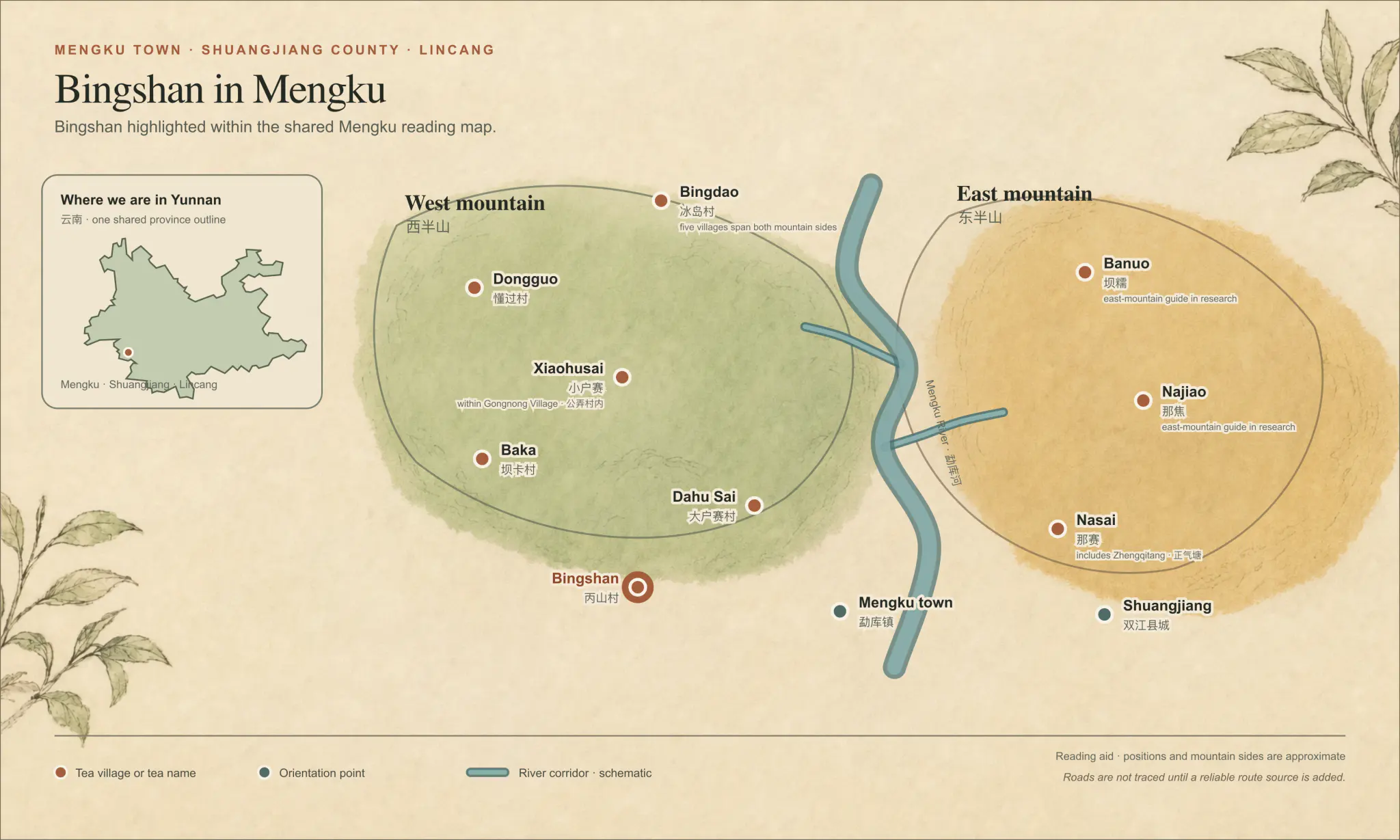
Bingshan is written 丙山, not 冰山 (“ice mountain”). It is a village in western Mengku, separate from Bingdao.
It is also a substantial working tea village. Yunnan reporting in 2024 described more than 14,200 mu of harvestable gardens. Earlier CCTV reporting followed local households and a cooperative improving processing and sales.
Old gardens within a larger tea area
Lincang’s cultivated ancient-tea resource notice lists a Bingshan garden of 2,827.6 mu. That protected resource and the village’s total harvestable area are different measurements. The notice does not mean all Bingshan tea comes from ancient trees.
A listing may describe a household garden, cooperative blend or tea processed in the village. Ask which, especially when an old-garden claim affects the price.
The Jingma tea tradition
Bingshan Wa “Jingma tea” traditional processing was listed as municipal intangible cultural heritage in 2019. This is a specific local craft, not a synonym for every raw-Pu’er cake produced in Bingshan.
If a seller invokes 惊马茶, ask who made the tea and what part of that process the batch follows. The tradition deserves a clearer explanation than a heritage logo on a listing.
Taste and buying
Trade descriptions mention fruit or honey aroma, firm bitterness and returning sweetness. There is not enough independent comparative tasting here to turn those into a village-wide profile.
Try a sample beside a Dongguo or Xiaohusai tea of similar age. Notice whether the bitterness clears, whether texture lasts into the middle infusions and how the cooled cup tastes. Keep the brewing consistent.
The useful details to get from a seller are the settlement or garden, harvest, material category and processor. A modestly priced Bingshan tea may be worth drinking without carrying an ancient-tree or heritage claim.
References
- Yunnan provincial administrative-village standard, DB53/T 1176.9, 2023, Bingshan as an administrative village under Mengku
- Yunnan Net, “临沧:茶山‘披绿衣’ 采茶制茶忙”, 2024 harvestable-garden and per-person figures
- CCTV, “云南省临沧市双江县组建茶叶合作社 茶农增收产业增效”, households, cooperative organization and processing context
- Lincang municipal fourth-batch cultivated ancient-tea resource notice, Bingshan Village ancient-garden area and boundary record
- Lincang municipal fourth-batch intangible-cultural-heritage list, Bingshan Wa Jingma tea traditional processing craft
- Lincang Agriculture and Rural Affairs Bureau on Mengku large-leaf tea, cultivar and GI context
- Natural Earth, public-domain locator data
Quick answers
Frequently asked questions
Where is Bingshan tea village?
Bingshan (丙山) is an administrative village in the western Mengku tea system of Shuangjiang County, Lincang, Yunnan. It should not be confused with Bingdao (冰岛).
What does Bingshan Pu-erh taste like?
Individual lots vary with garden, season, plant material and processing. Use regional tasting descriptions as comparison prompts, not a flavour guarantee attached to the village name.
How can I check a Bingshan tea claim?
Ask for the Chinese place name, settlement or garden, harvest season, material category, processor and batch record. The Bingshan name alone does not verify tree age or a protected old garden.