勐库
Mengku (勐库): Tea Region Guide
Mengku is a town in Shuangjiang County, Lincang, best known internationally for Bingdao.
On the shared Yunnan mapMengku 勐库Open the regional map →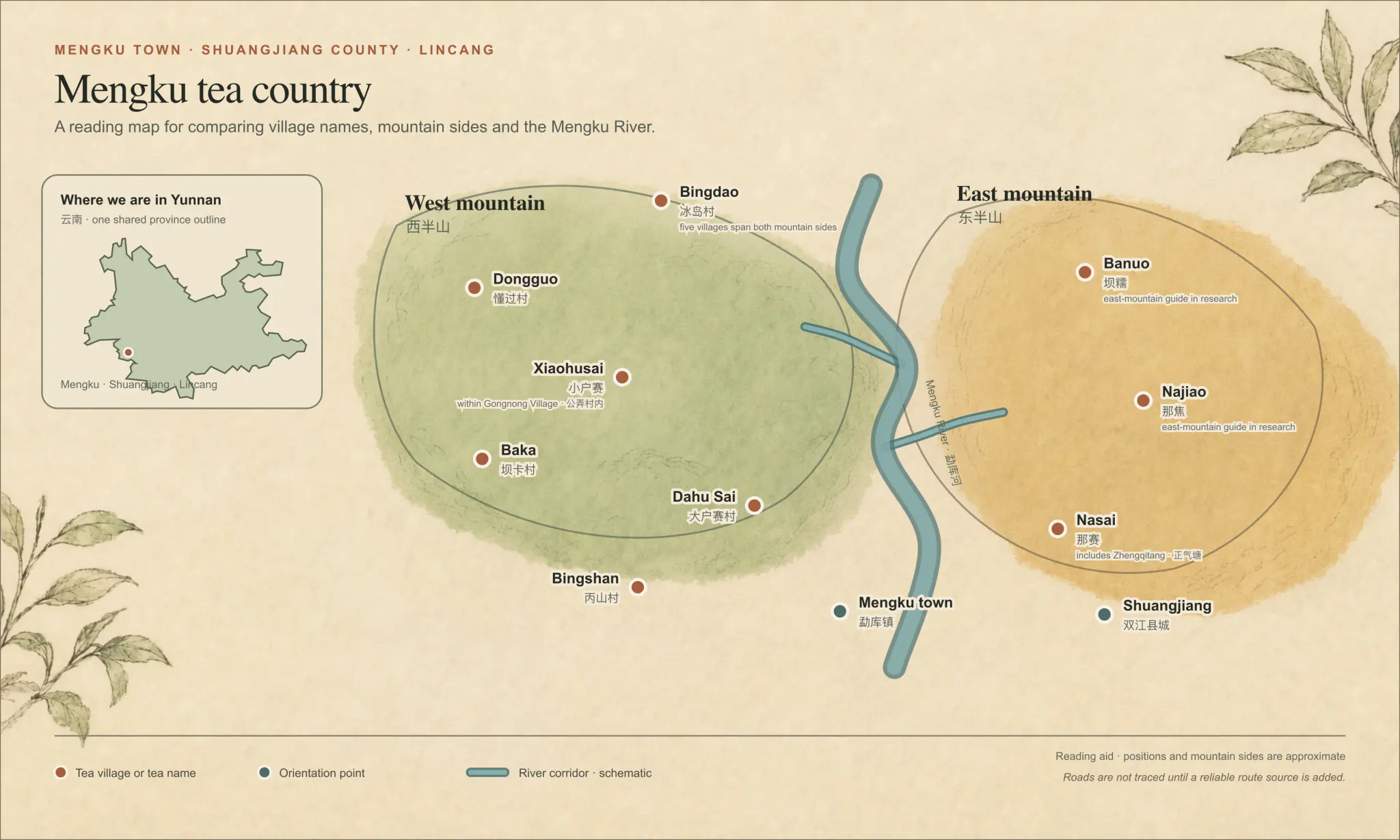
Mengku is a town in Shuangjiang County, Lincang, best known internationally for Bingdao. It has sixteen administrative villages and a much wider range of tea than that one famous name suggests.
East and west Mengku
The Mengku River runs roughly north to south. Tea sellers use East Half Mountain 东半山 and West Half Mountain 西半山 to organise the places on either side. These are useful directions, but a tea from either side may blend several gardens.
Bingdao Village contains five natural villages: Laozhai, Dijie, Nanpo, Bawai and Nuowu. Bingdao Laozhai is the narrow premium name; “Bingdao” in a listing may refer to the whole administrative village, a blend or a looser commercial association.
Elsewhere, Gongnong Village contains Xiaohusai. Dahu Sai, Dongguo, Baka and Bingshan are separate administrative villages. Xigui belongs to Bangdong in Linxiang District and is outside Mengku altogether.
Taste
Named Mengku raw teas often have floral or fruit aromas, a bitter-sweet structure and noticeable salivation. Some feel thick or coating. The sweetness associated with Bingdao can lead buyers to expect a tea with no bitterness, which is not a reliable test of origin.
In TeaDB’s account, a 2013 autumn tea sold as Bingdao began tangy and vegetal, became bitter under longer steeping and then showed fruit sweetness. A separate retailer comparison found one Dijie lot more delicate and a Nanpo lot more body-forward. These are observations about particular teas, not fixed rankings of the villages.
Plant material
Mengku large-leaf tea is a recognised, seed-propagated tea population associated with the area. Its cultivation extends beyond a single village. The plant name, an old-garden photograph and a Bingdao wrapper each make different claims about a cake.
The wider Daxue Shan landscape also contains wild tea populations. Those should not be assumed to supply ordinary cultivated Mengku raw tea.
Start with a clear lot
Ask exactly which village a tea comes from and whether it blends gardens or tree categories. Get the harvest season, maker and storage history. A seller using “Bingdao five villages” should say which villages are included.
For a first comparison, try a general Mengku tea and a clearly sourced Xiaohusai, Dahu Sai or Dongguo lot. Use the same water and leaf ratio. If bitterness dominates, shorten the next infusion before drawing a conclusion about the village.
The east versus west guide gives a closer look at the geography.
References
- Yunnan provincial administrative-village standard DB53/T 1176.9, 2023, Mengku’s administrative village list
- China Internet Information Center report, 2023, Bingdao Village’s five natural villages, elevation, and garden figures
- Lincang ancient-tea-garden protection notice, Bingdao/Nuowu protected-garden context
- Lincang Agriculture and Rural Affairs Bureau and Shuangjiang tea-industry report, GI protection and traceability policy
- International Camellia Register, Mengku large-leaf cultivar identity
- Food Science and Technology paper, Mengku large-leaf as a national elite cultivar
- Lincang Discipline Inspection Commission, “Mengku tea” and Lincang Daxue Shan profile, climate, wild-tree, and historical-cultivation accounts
- TeaDB Lincang regional guide and January 2015 Lincang report, specialist tasting context
- Bitterleaf region-buying guide, Lincang buying framing
- Bitterleaf 2021 autumn Dijie & Nanpo lot, paired village comparison
- TeaDB, “Big Region. Small Region. Tree Age.”, the small-origin authenticity problem
- Natural Earth, public-domain map base data
Quick answers
Frequently asked questions
What is the difference between east and west Mengku tea?
The terms orient buyers to opposite sides of the Mengku river system, but they are broad comparison categories. Village, garden, season and processing matter more than a simple east-versus-west rule.
Which tea villages are in Mengku?
Well-known names include the Bingdao five-village cluster, Xiaohusai, Dahu Sai, Dongguo, Baka and Banuo. Their administrative relationships and market use differ.
Does Mengku tea have one typical flavour?
No. Bitterness, fragrance, sweetness and body vary widely across villages and batches. Use a regional profile to design comparisons, not to authenticate a tea by taste.