勐海
Menghai (勐海): the county that built modern pu-erh
The factory town behind ripe pu-erh is also home to Lao Banzhang, the most faked name in tea. What Menghai actually tastes like, who's behind the famous villages, and how to buy without getting played.
On the shared Yunnan mapMenghai 勐海Open the regional map →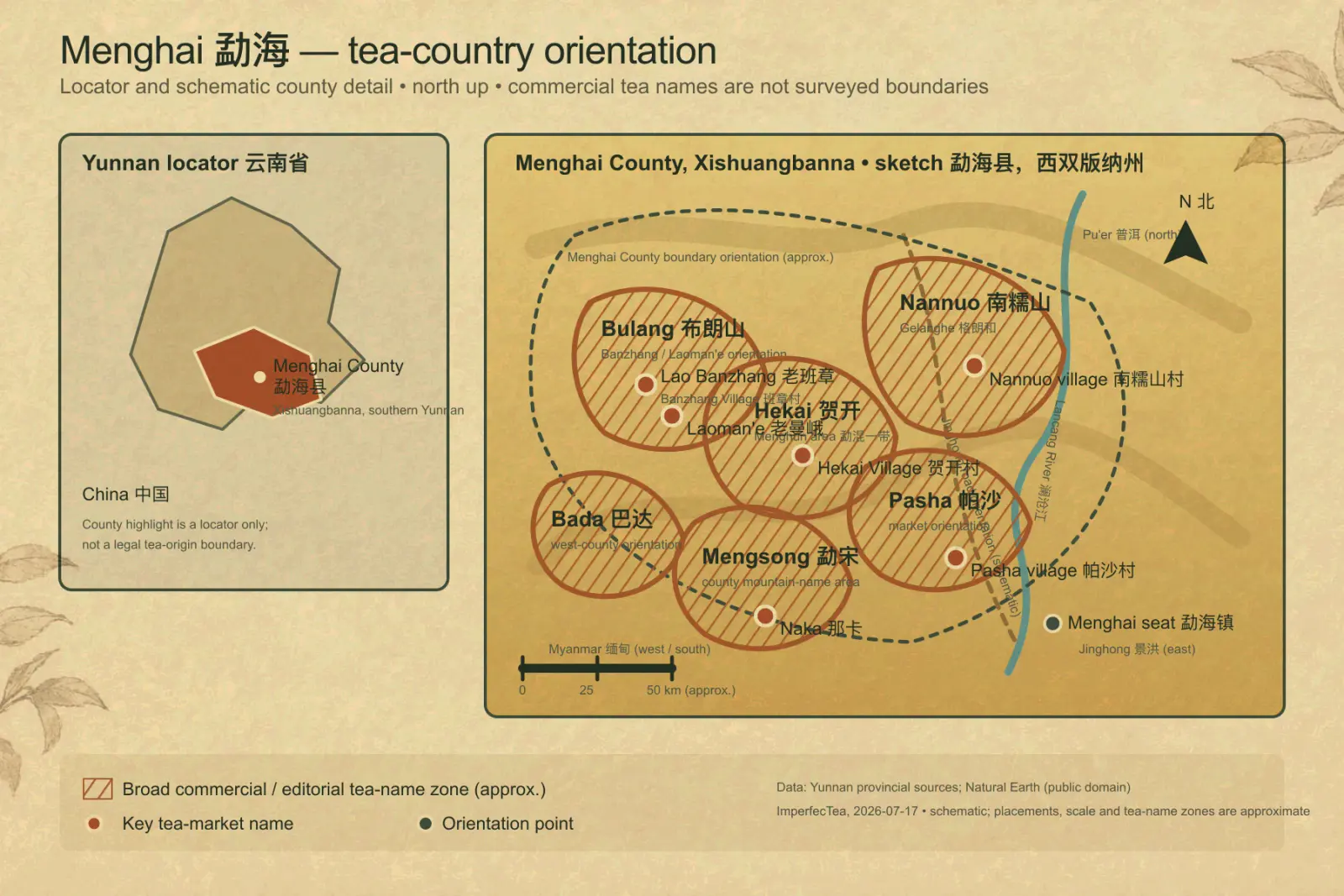
If ripe pu-erh has a birthplace, it’s Menghai (勐海, Měnghǎi). In 1939 to 1940 the Fo Hai experimental tea factory went up in this border county in western Xishuangbanna, the predecessor of the Menghai Tea Factory, whose blending and fermentation techniques became the template for modern factory pu-erh and are now officially recognized as intangible cultural heritage. That’s why “Menghai” appears on so many wrappers: it can mean a place, a factory, or a whole style of tea.
The same county contains the most expensive name in raw pu-erh: Lao Banzhang (老班章), a village group in the Bulang mountains where prices and forgeries have both gone vertical. So Menghai is two things at once, the home of honest, workmanlike factory blends, and the epicenter of pu-erh’s wildest village-name speculation. Getting comfortable with both halves is the whole game.
Menghai sits west of Jinghong, the prefectural seat, and runs to the Myanmar border. For a first pass, start in the south-west with Bulang Mountain (布朗山) and the Banzhang villages, move through Hekai (贺开) and Pasha (帕沙), then compare Nannuo Mountain (南糯山), Mengsong (勐宋), and Bada (巴达). Yiwu, the usual point of comparison, is over in Mengla County to the east, a different world entirely.
At a glance
| Field | Reference |
|---|---|
| Location | Menghai County (勐海县), western Xishuangbanna, Yunnan; borders Myanmar |
| Elevation | Varies widely; sampled Bulang ancient-tea material sits at 1,300 to 1,900 m |
| Key villages | Lao Banzhang, Laoman’e, Hekai, Nannuo, Pasha, Naka |
| Tea style | Large-leaf assamica; raw sheng plus extensive factory blending and ripe production |
| Flavor shorthand | Bitter-sweet, thick, long finish; floral-honeyed to herbal depending on village |
What might show up in the cup
The classic Menghai reputation is force. Young sheng from western-Xishuangbanna names tends to hit with more immediate bitterness and grip than a softly processed Yiwu, then pay you back: the sweet return (回甘, huí gān) and the wave of salivation that follows a sip (生津, shēng jīn) are where these teas earn their keep. Aromas run from dry herbs and warm sugar through flowers, honey, and fruit, with the occasional whiff of smoke.
Within that, the villages argue with each other. Samples sold as Laoman’e (老曼峨) are famous for an even stronger bitter structure than their Banzhang neighbors. Nannuo and Hekai lots are often gentler. A rain-season pick or careful, light processing can make any of them softer than the county’s tough-guy reputation suggests. Pay attention to texture in the mid-session, watery, oily, dense, drying, and to how long the finish holds. Those tell you more than whether the first sip made you wince, and they’re more honest measures than any promise of dramatic “cha qi.”
One caveat, said once: the county name guarantees none of this. Plant material, season, picking standard, the kill-green (杀青, shā qīng), blending, and storage can each override geography. Treat the profile above as a hypothesis to test, not a scorecard.
The names behind the name
“Menghai” is broad. “Bulang” is still broad. Even a single village contains multiple gardens and households, and a cake may be blended after the leaf leaves the village. Here’s the ladder:
- Bulang Mountain / Banzhang (布朗山/班章). Bulang is a whole mountain-township market name. Lao Banzhang is a village group under Banzhang Village Committee in Bulang Mountain Blang Ethnic Township (布朗山布朗族乡), not a synonym for all Bulang, and the single most faked name in pu-erh.
- Laoman’e (老曼峨). Banzhang’s bitter sibling in the same Bulang area, and often a more affordable way to taste what the mountain does.
- Hekai (贺开). In Menghun Town (勐混镇), with a village-owned tea company and real industry behind it. A transparent Hekai lot teaches you more about this landscape than an unverified “pure Lao Banzhang” ever will.
- Nannuo Mountain (南糯山) and Pasha (帕沙). Both under Gelanghe Hani Ethnic Township (格朗和哈尼族乡). Nannuo contains many villages and garden situations, it is not one flavor, and Pasha is its own name, not a substitute for either neighbor.
- Mengsong (勐宋) and Naka (那卡). Mengsong is a county tea area; Naka is a frequently marketed locality within it. Several different Chinese places share the sound “Mengsong,” so ask for characters.
- Bada (巴达). A western-county name that mostly proves the point: once Bada is in the conversation, nobody can tell you what “Menghai flavor” is.
Terroir and history, the short version
Menghai’s mountain-and-valley terrain gives tea gardens very different exposures and temperatures. The best specific numbers available: a peer-reviewed study of Bulang ancient-tea material places its samples at 1,300 to 1,900 m, and a documented organic garden near Banzhang sits at 1,700 to 1,900 m with a mean temperature of 18 to 19 °C and 1,300 to 1,500 mm of annual rain. This is Yunnan large-leaf assamica country, genome researchers have sampled material called Nannuoshan 14 and Hekai 33 from ancient-tea areas here.
The scale is enormous: a 2025 provincial report attributes 905,900 mu of tea planting, 41,100 tonnes of tea output, and RMB 2.595 billion in agricultural output value to the county for 2024. Blang, Dai, Hani, and other communities grow and process this tea, and farm management, picking standard, and who controls the maocha often matter more to your cup than the mountain printed largest on the wrapper. The famous villages now attract conservation projects and tea tourism, along with powerful incentives to overstate origin and tree age.
Buying: the wrapper is a claim, not a fact
Here is the one rule worth memorizing. A wrapper can honestly say “Menghai” and mean county leaf, a blend built around county material, or tea merely processed by a Menghai factory. A village name makes a narrower claim; “ancient tree” (古树, gǔshù), “arbor,” and “organic” pile on further claims, and every claim needs its own evidence. A romantic tree photo answers none of them.
Look for the characters, 勐海, 布朗山, 班章, 老班章, 贺开, 南糯山, 帕沙, and then ask the seller five questions:
- What are the Chinese village and village-committee names?
- What harvest season and year?
- Single garden, village blend, mountain blend, or county blend?
- Who bought and processed the fresh leaf, and who pressed the cake?
- What records connect this lot to the stated origin, farmer receipt, dated production log, lot code, field photos, direct purchase?
For value, try a clearly identified county blend, a transparent Hekai, Pasha, or Nannuo lot, or a well-documented factory recipe before paying a large premium for “Lao Banzhang” with a weak paper trail.
Brewing
Start with 7 to 8 g per 100 to 110 ml gaiwan, water at 95 to 100 °C, a short rinse only if a compressed cake needs it, then 5 to 8 second early infusions. For a fresh, forceful sample, drop to 6 to 7 g or 92 to 95 °C with very quick pours. Don’t call a tea weak after one flash steep, or too bitter after a 25-second first infusion, and if smoke, sourness, or harsh dryness dominates, rebrew gently before blaming the mountain.
The most instructive session is a four-tea flight with identical parameters: a traceable Bulang or Banzhang-area tea, a Hekai or Pasha lot, a Nannuo or Mengsong reference, and a Yiwu from Mengla. Match harvest year, compression, and price as closely as you can. It will show you more than tasting one premium claimed-old-tree cake against anonymous factory material ever could.
References
- Yunnan Provincial Ethnic Affairs Commission, 2026, county tea-industry and village reporting
- Yunnan Daily via Yunnan Rural Revitalization Bureau, 2025, 2024 county tea-industry figures
- Yunnan Department of Agriculture and Rural Affairs, 2022, Banzhang-area organic garden report
- Yang & Zheng et al., Bulang ancient-tea study, volatile and bioactive analysis of Bulang samples
- Yunnan Ethnic and Religious Affairs Commission, 2025, Hekai village enterprise context
- Yunnan administrative-village standard DB53/T 1176.13, 2023, administrative placement of Banzhang, Hekai, Nannuo, and Pasha
- Yunnan Agriculture Yearbook 2022, tea-village recognition
- Yunnan agriculture report on Banzhang, Banzhang industry context
- Ministry of Commerce time-honoured-brand record, Menghai Tea Factory founding history
- Yunnan Agriculture’s Dà Yì production-technique account, factory blending and fermentation heritage
- Whole-genome resequencing study, Nannuo and Hekai assamica research samples
- TeaDB Menghai County guide, Bulang drinking report, and Menghai County report, specialist tasting context
- Natural Earth, public-domain map base data
Quick answers
Frequently asked questions
Where is Menghai in the Pu-erh tea map?
Menghai is a county in Xishuangbanna, Yunnan, west of the Lancang River. It includes several major tea systems rather than one mountain or flavour.
Which famous Pu-erh areas are in Menghai?
Menghai includes Bulang Mountain and Lao Banzhang, Nannuo, Mengsong and Bada, among other villages and gardens. Each name covers a different scale.
Does a Menghai label identify where the leaf grew?
Only broadly. It may identify a county, factory style or blend. Ask for the mountain, village, season, material and producer when a narrower origin matters.