普洱市
Pu’er City (普洱市): the city that renamed itself after tea
Pu’er City used to be called Simao — then it took the tea’s name. A tour of the counties and villages behind Yunnan’s most confusing wrapper word, and the questions that turn it into real provenance.
On the shared Yunnan mapPu’er 普洱Open the regional map →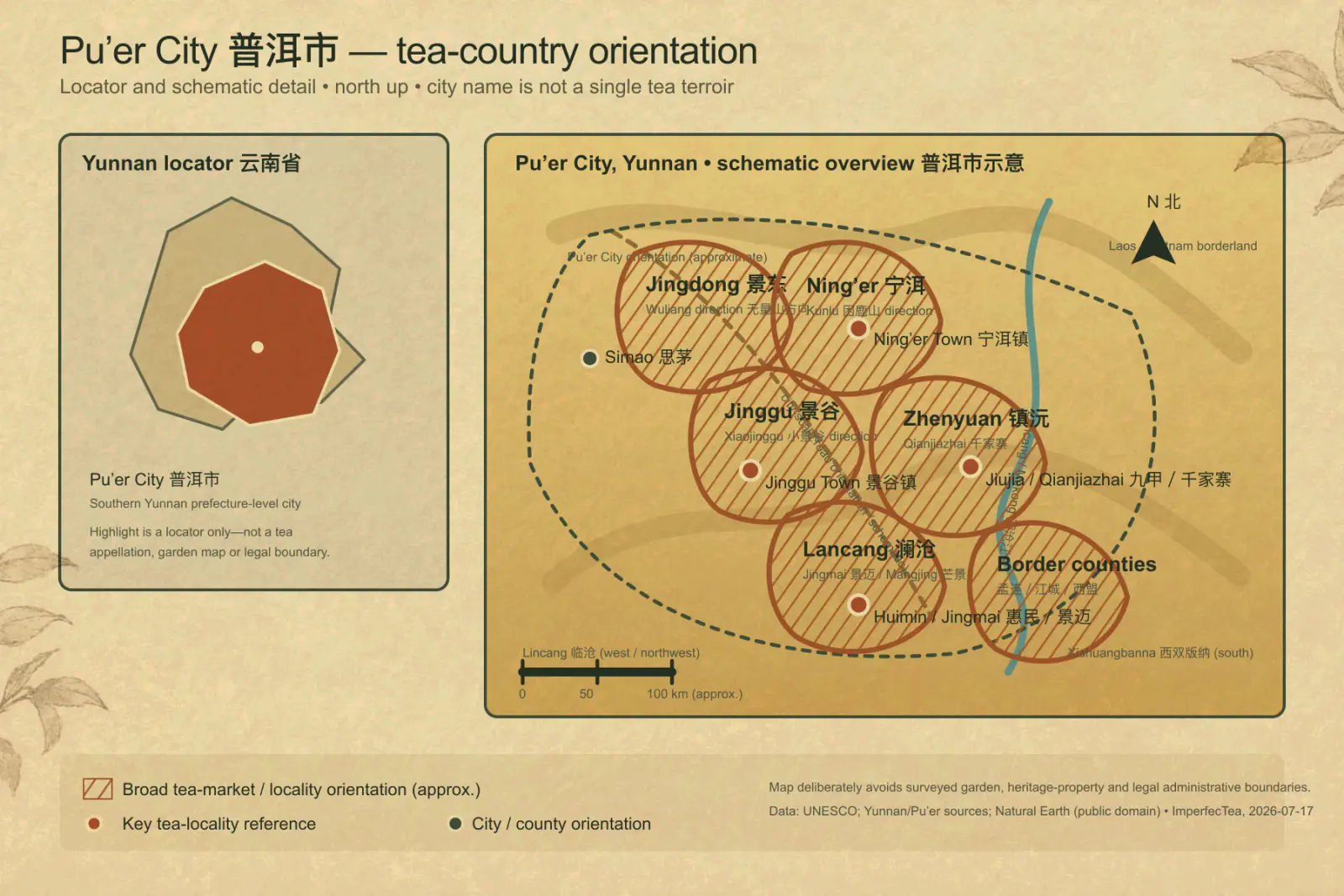
The city that took the tea’s name
Most tea regions are named after a place. Pu’er went the other way. The city on the map used to be called Simao (思茅); the modern prefecture-level city now wears the tea’s name instead. And to complete the tangle, the historic town most associated with the name “Pu’er” isn’t in Simao District at all, it’s over in Ning’er County. So one word can mean a tea, a city, or a centuries-old trading hub, and a wrapper that just says 普洱 hasn’t told you which.
It also hasn’t told you much about origin, because Pu’er City (普洱市, Pǔ’ěr Shì) is enormous. It borders Laos, Vietnam and Myanmar. It contains Simao District plus nine autonomous counties spread across very different river basins, elevations and communities. Its 2023 tea statistics: 2.09 million mu of gardens, 152,000 tonnes of tea, RMB 45 billion in industry value, and the 2025 figures came in higher still. Somewhere inside all that sits Jingmai, a UNESCO-listed old tea-forest cultural landscape. Treating this as one flavour region is like treating “Europe” as one wine.
So here’s the rule this whole guide orbits: the wrapper is a claim, not a fact. “Pu’er City” on a label is an administrative address, not a village, a tree age, a season or a maker. Everything below is about turning that claim into sharper questions, starting with which county?
Orientation
| Field | Working reference |
|---|---|
| Location | Southern Yunnan, between Lincang (northwest) and Xishuangbanna (south); borders Laos, Vietnam and Myanmar |
| What it is | A prefecture-level city, Simao District plus nine autonomous counties, not a mountain |
| Key tea localities | Jingmai and Mangjing (Lancang), Kunlu (Ning’er), Xiaojinggu (Jinggu), southern Wuliang (Jingdong), Qianjiazhai (Zhenyuan) |
| Typical style | Mostly sheng from Yunnan large-leaf material; ripe, black, green and white teas are made here too |
| Flavor shorthand | No honest city-wide answer. Jingmai lots often floral and honeyed; elsewhere firmer, greener or more bitter |
Think of the city as a set of routes rather than one terroir. Southwest, in Lancang County, are Jingmai (景迈) and Mangjing (芒景) and their old tea forests. North and northeast are Ning’er’s Kunlu area, Jinggu’s Xiaojinggu trade name, and the Jingdong flank of the Wuliang range. Zhenyuan’s Qianjiazhai turns up in “Ailao” and wild-tea conversations, though Ailao is a range that crosses several prefectures. The Lancang (Mekong) River makes a handy landmark, not a flavour ingredient.
What it tastes like: everything
There is no “Pu’er City taste,” and anyone offering you one is selling simplicity. Named Jingmai samples are frequently described as floral, honeyed or orchid-like, a real pattern across specialist tasting accounts. But a young sheng from elsewhere in the city can run from sweet-fragrant to aggressively bitter, woody, green or smoky, depending on the leaf, the picking date, the kill-green and everything after. A 2024 study of raw Pu’er from 26 tea mountains found exactly what you’d expect: diversity, not a municipal signature.
What travels better than flavour words are habits of attention. Watch for the returning sweetness (回甘, huí gān) and salivation (生津, shēng jīn), when they arrive and how long they stay, remembering that leaf ratio and steep time move them too. Treat 茶气 (chá qì, that hard-to-pin body sensation) as your experience, not the tea’s résumé. And keep age separate from address: storage studies show raw Pu’er genuinely changes over the years, but an aged aroma is not proof of a county, and bad storage will out-shout any terroir.
The names worth knowing
Jingmai and Mangjing (景迈 / 芒景). The city’s crown jewel and by far its best-documented tea landscape: a UNESCO property of 7,167.89 hectares (plus an 11,927.85-hectare buffer) of old groves, forests and villages in Lancang County, shaped by generations of Blang and Dai stewardship, with tea grown under the forest understorey. One catch, heritage status protects a landscape, not your specific cake. A “Jingmai” wrapper may mean the property, the buffer zone, the broader mountain, or a style-alike blend, and those are very different claims. More in the Jingmai guide.
Ning’er and Kunlu (宁洱/困鹿山). Ning’er carries the historic Pu’er name; Kunlu is a much narrower village-group and ancient-garden origin in Kuanghong. Samples get called fragrant, refined and sweet-returning, and “royal tribute” talk needs named evidence. See the Kunlu guide.
Jinggu and Xiaojinggu (景谷/小景谷). Jinggu is a county; Xiaojinggu is the trade name for the tea country around Jinggu Town, aromatic, bitter-sweet, often fuller than its fame suggests. Ask for the Chinese village name, not just “old-tree Xiaojinggu.” See the Xiaojinggu guide.
Jingdong and southern Wuliang (景东/无量山南段). Jingdong County touches the broad Wuliang range, which spills past the city line into Dali. “Wuliang” is a physical range and market name, not a city appellation. See the Wuliang guide.
Zhenyuan and Qianjiazhai (镇沅/千家寨). The most concrete place behind many wild-tea stories, in Jiujia Township. Wild, transitional and cultivated material are different things, and a tree age needs a dating method. See the Ailao guide.
Everyone else. Menglian, Jiangcheng, Mojiang, Simao and Ximeng (孟连、江城、墨江、思茅、西盟) grow plenty of tea but rarely get reduced to an export-facing mountain name, which means a bare city label can hide them entirely.
Old trees, big numbers, and wrapper words
Of those 2.09 million mu, the 2023 breakdown was 1.90 million mu of modern tea gardens and 190,000 mu of cultivated ancient tea gardens. Big numbers prove scale, not old-tree content in your 357-gram cake. The ground truth is mixed: a 2025 report from Ning’er’s Zhushan describes plantations planted in 1992 sitting alongside lower-density “imitation ancient” gardens.
The vocabulary deserves precision, because the city’s own regulations use it precisely. Pu’er’s ancient-tea-tree rules distinguish wild, transitional and cultivated ancient trees, defining cultivated ancient trees as more than 100 years old. That’s a management category, not a wrapper certification, no cake arrives with a survey record attached. “Plantation” and “terrace” describe managed gardens, which can make excellent tea. “Ecological garden” is not a legal grade. “Arbor” (qiaomu) describes growth form, not age. “Wild” should mean a botanical population, not “looks unmanaged.” And 古树 (gǔshù, ancient tree) should point to a documented tree or a defined garden category, not a font choice.
The history explains the naming mess. The old Pu’er/Ning’er and Simao trade centres linked tea-growing hinterlands to the Tea Horse Road networks, which is why “Pu’er” became a name bigger than any one mountain, attached to plenty of tea that was never grown here at all.
Buying: questions that earn the premium
- Which county, township, village and, if claimed, garden? In Chinese names, please.
- Single village, a blend, or just pressed somewhere in Pu’er City?
- Picking dates and material category. Does “ancient tree” mean each tree, a defined garden, or a seller’s grade?
- Who bought the leaf, who made the maocha, who pressed the cake, and where was it stored?
- Is there a batch number, farmer record, harvest photo or map that can be checked?
- For Jingmai: the UNESCO property, the buffer zone, the broader mountain, or a style-alike blend?
Red flags: a city name posing as village precision, an exact tree age with no dating method, “wild” with no explanation, a heritage logo doing the work of documentation. A transparent, modestly named county lot usually beats an anonymous “ancient Pu’er City” cake. And be wary of anyone quoting a “Pu’er City price”, price is a lot-level observation, not a municipal fact.
Brewing and a fair flight
Start at 5 to 6 g per 100 ml in a small gaiwan, near-boiling water, rinsing only if the cake is tightly compressed or dusty. Keep the first four steeps to 5 to 10 seconds, then stretch gradually. If a young lot is brutally bitter, drop the leaf or the temperature a touch before declaring it flawed; if it’s a fragrant Jingmai-style tea, don’t bury the aroma under long early steeps.
For a proper city flight, line up four transparently sourced teas: a Jingmai or Mangjing lot, a Ning’er/Kunlu lot, a Jinggu/Xiaojinggu lot, and one outside reference from Mengku or Yiwu, matched for vintage, storage and price as closely as you can. If you can’t get that provenance, enjoy the session anyway; just know you’re comparing seller stories, not terroirs.
References
- Yunnan Rural Revitalization 2024 press briefing, 2023 city-wide tea area, output and industry value
- Yunnan Agriculture and Rural Affairs, 2025, updated 2025 tea figures and certification context
- Yunnan Agriculture / Yunnan Daily, July 2025, the Ning’er Zhushan village garden report
- UNESCO World Heritage Centre, property 1665, the Jingmai old tea-forest cultural landscape listing
- Jingmai cultural-landscape protection regulation, the landscape’s dedicated legal framework
- Pu’er Ancient Tea Tree Resources Protection Regulation, definitions of wild, transitional and cultivated ancient trees
- Yunnan survey-registration procedure for ancient tea trees, how ancient trees are formally registered
- TeaDB’s Pu’er Prefecture overview and Pu’er explainer, specialist context on the naming tangle
- 2024 multi-mountain raw-Pu’er flavour study, aroma diversity across 26 tea mountains
- Raw Pu’er storage study, how aroma changes with storage time
- Genetic analysis of ancient tea trees, domestication and diversity of Chinese Assam tea
- Natural Earth, public-domain base-map data
Quick answers
Frequently asked questions
Is all Pu-erh tea grown in Pu'er City?
No. Pu-erh is a tea category and protected geographic product associated with a wider part of Yunnan. Major production also comes from Lincang and Xishuangbanna.
Which tea mountains are in Pu'er City?
Important systems include Jingmai in Lancang County, Kunlu in Ning'er, Ailao and Qianjiazhai around Zhenyuan, and parts of Wuliang and Jinggu.
How specific should a Pu'er City tea label be?
Look beyond the city to county, township, village or garden, then ask for season, material, maker and batch. The city name covers too much territory to predict one style.