普洱市
Pu’er City (普洱市): Tea Region Guide
Pu'er City covers a large part of southern Yunnan.
On the shared Yunnan mapPu’er 普洱Open the regional map →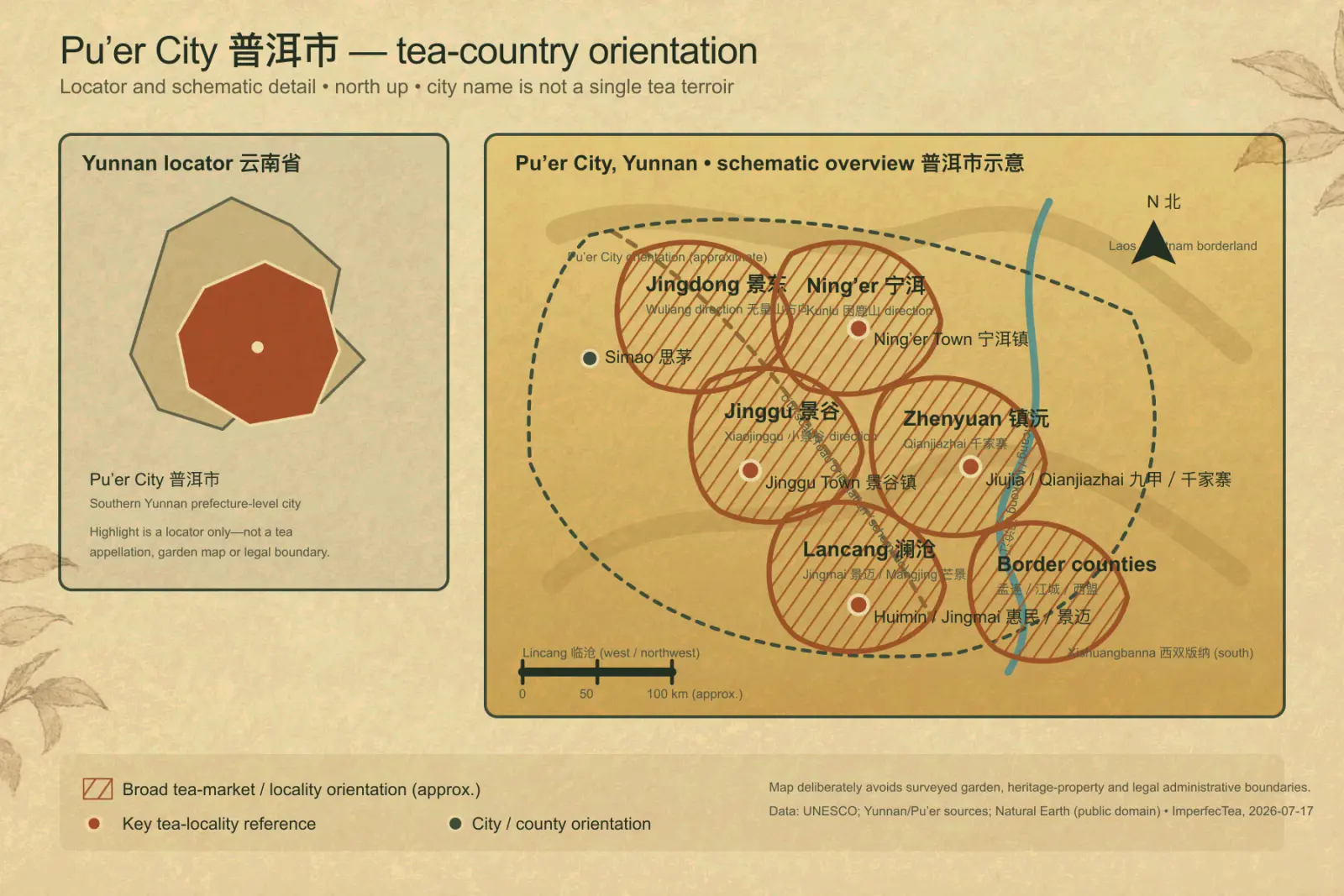
Pu’er City covers a large part of southern Yunnan. Its tea country includes Jingmai, Kunlu, Xiaojinggu and parts of the Wuliang and Ailao ranges. The city name alone tells you little about a cake’s flavour.
There is also a naming wrinkle: today’s prefecture-level city was formerly called Simao, while the historic Pu’er town is in Ning’er County. “Pu’er” can refer to the tea, the modern city or the older trading centre.
The main tea areas
| County | Names to look for | What to clarify |
|---|---|---|
| Lancang | Jingmai, Mangjing | Named village and garden; whether the claim concerns the heritage property or a broader area |
| Ning’er | Kunlu | Village tea, a named old garden or a wider blend |
| Jinggu | Xiaojinggu, Kuzhushan, Wenshan Ding | Town, village and garden are different levels of origin |
| Jingdong | Wuliang | Which part of the range supplied the leaf |
| Zhenyuan | Qianjiazhai, Ailao | Cultivated tea, wild plant material or a county-brand blend |
Menglian, Jiangcheng, Mojiang, Simao and Ximeng also produce tea. A city-labelled blend may include places that receive much less attention in village-focused tea shops.
What to expect in the cup
Individual Jingmai teas are often described as floral and honeyed. Kunlu examples can be soft and aromatic; Kuzhushan examples often begin with firmer bitterness. Each area also has exceptions, and the city produces black, green, white and ripe teas as well as raw Pu’er.
For a useful comparison, try two clearly sourced raw teas from different counties, matched for age and storage. Follow their texture and aftertaste across several infusions. There is no need to find a shared “Pu’er City taste.”
Old gardens and modern production
The city’s 2023 figures reported 2.09 million mu of tea gardens, including 190,000 mu described as cultivated ancient gardens. Most of the reported area was modern tea planting. That distinction is easily lost when a listing uses photographs of old trees to represent a much larger production region.
Jingmai’s UNESCO status recognises a cultural landscape maintained by its communities. It does not certify an individual cake’s source. The same care applies to Kunlu’s tribute stories and Qianjiazhai’s famous wild trees.
Before paying for a narrow origin, ask for the county, village, garden, harvest and producer. Clarify whether the leaf grew there or was only processed there. Then taste a sample: documentation and drinking quality answer different questions.
Continue with Jingmai, Kunlu or Xiaojinggu.
References
- Yunnan Rural Revitalization 2024 press briefing, 2023 city-wide tea area, output and industry value
- Yunnan Agriculture and Rural Affairs, 2025, updated 2025 tea figures and certification context
- Yunnan Agriculture / Yunnan Daily, July 2025, the Ning’er Zhushan village garden report
- UNESCO World Heritage Centre, property 1665, the Jingmai old tea-forest cultural landscape listing
- Jingmai cultural-landscape protection regulation, the landscape’s dedicated legal framework
- Pu’er Ancient Tea Tree Resources Protection Regulation, definitions of wild, transitional and cultivated ancient trees
- Yunnan survey-registration procedure for ancient tea trees, how ancient trees are formally registered
- TeaDB’s Pu’er Prefecture overview and Pu’er explainer, specialist context on the naming tangle
- 2024 multi-mountain raw-Pu’er flavour study, aroma diversity across 26 tea mountains
- Raw Pu’er storage study, how aroma changes with storage time
- Genetic analysis of ancient tea trees, domestication and diversity of Chinese Assam tea
- Natural Earth, public-domain base-map data
Quick answers
Frequently asked questions
Is all Pu-erh tea grown in Pu'er City?
No. Pu-erh is a tea category and protected geographic product associated with a wider part of Yunnan. Major production also comes from Lincang and Xishuangbanna.
Which tea mountains are in Pu'er City?
Important systems include Jingmai in Lancang County, Kunlu in Ning'er, Ailao and Qianjiazhai around Zhenyuan, and parts of Wuliang and Jinggu.
How specific should a Pu'er City tea label be?
Look beyond the city to county, township, village or garden, then ask for season, material, maker and batch. The city name covers too much territory to predict one style.