临沧
Lincang (临沧): one word, a hundred teas
Bingdao, Xigui, Mengku, Fengqing — Yunnan's most sprawling tea prefecture, and how to shrink a city-sized label down to a cup you can actually understand.
On the shared Yunnan mapLincang 临沧Open the regional map →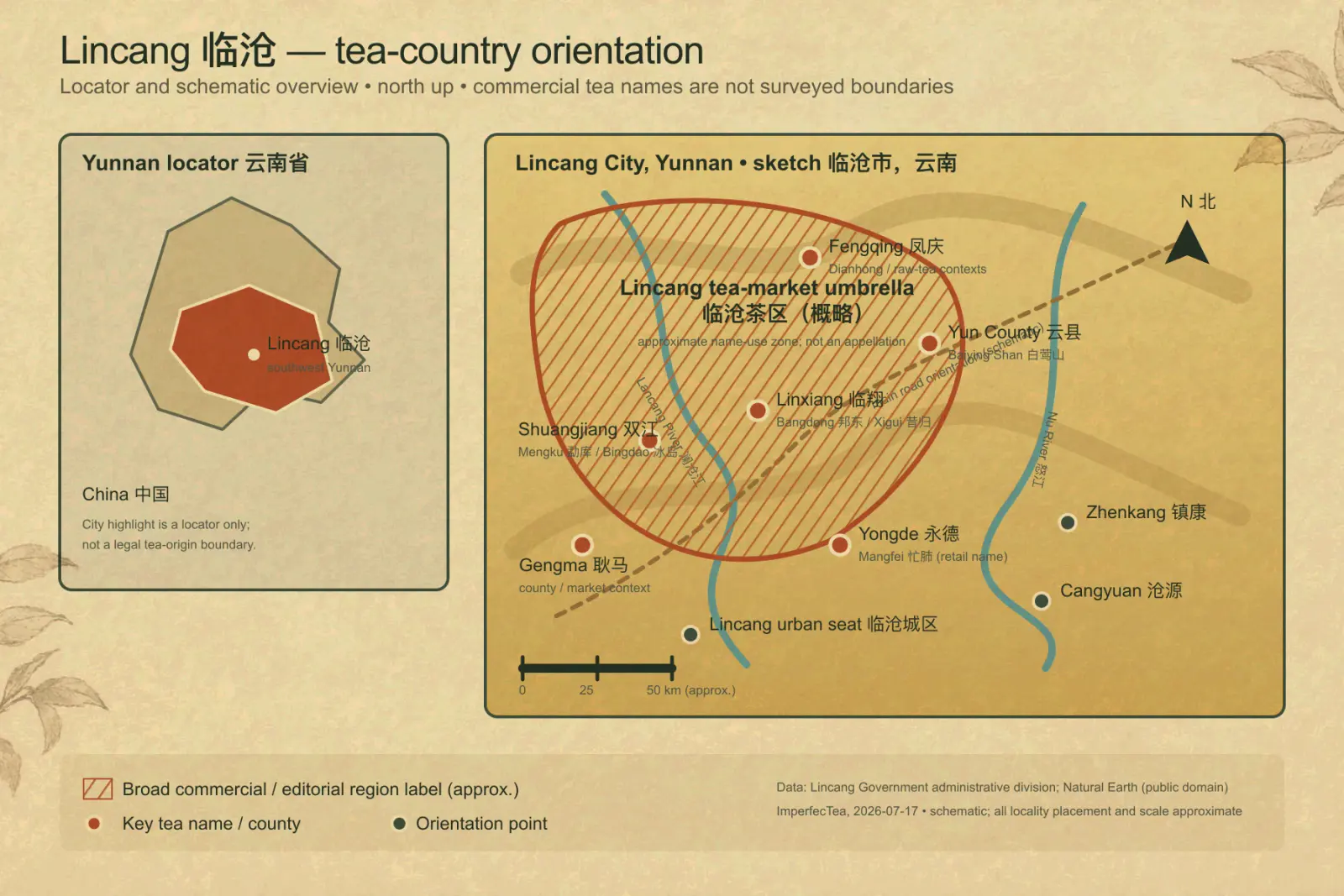
Lincang (临沧, Líncāng) is where some of the most expensive raw pu-erh on earth comes from, Bingdao (冰岛, “Ice Island”) and Xigui (昔归) are both Lincang names, and it’s also a prefecture-level city of 23,620 km² with terrain running from 450 m river valleys up to the 3,429 m Yongde Daxueshan. In 2023 it reported 2.093 million mu of tea gardens and 172,000 tonnes of tea. So when a wrapper says “Lincang,” it has told you roughly as much as a wine label that says “France.”
That’s not a complaint; it’s the key to the whole region. Lincang is a map, not a flavor. The city’s own tea plan splits it into belts: raw pu-erh in Shuangjiang and Linxiang, ripe pu-erh in Yongde and Zhenkang, Dianhong black tea in Fengqing and Yun County, green tea in Gengma and Cangyuan. The fun of Lincang is watching the label shrink, city, county, township, village, garden, and noticing how much more the tea starts to mean at each step.
At a glance
| Location | Prefecture-level city in southwest Yunnan, between the Lancang (澜沧江) and Nu river systems, bordering Myanmar |
| Elevation | City terrain 450 to 3,429 m; garden elevations vary by locality and must be checked per lot |
| Key names | Mengku/Bingdao (Shuangjiang), Bangdong/Xigui (Linxiang), Mangfei (Yongde), Xiangzhuqing (Fengqing), Baiying Shan (Yun County) |
| Tea styles | Raw and ripe pu-erh, Dianhong black tea, green tea, split by county in city policy |
| Flavor shorthand | Named young sheng often fragrant, bitter-sweet, mouth-coating, persistent, highly variable |
The lay of the land
Lincang sits in Yunnan’s southwest borderlands, east of Baoshan and west of Pu’er. It has eight county-level divisions: Linxiang District (临翔区), the counties of Yun (云县), Fengqing (凤庆), Yongde (永德), and Zhenkang (镇康), and three autonomous counties, Gengma (耿马), Cangyuan (沧源), and Shuangjiang (双江). Shuangjiang’s full name is worth reading once: the Shuangjiang Lahu, Va, Blang and Dai Autonomous County (双江拉祜族佤族布朗族傣族自治县). Eleven long-resident minority communities, Yi, Wa, Dai, Lahu, Blang, Lisu, De’ang, and others, do the farming and processing behind every famous name here. They’re the industry, not the backdrop.
For a pu-erh drinker, the practical geography is a handful of source chains, and getting them straight saves you money:
- Mengku (勐库) is a township in Shuangjiang; Bingdao is a cluster of five natural villages inside Bingdao Village, within Mengku. “Sai Bingdao” (“rivals Bingdao”), applied to nearby Xiaohusai (小户赛), is a sales nickname, not a grade.
- Bangdong (邦东), home of Xigui, is a township in Linxiang District, not in Mengku, despite how often the two get blurred together.
- Yongde and Fengqing are whole counties. Mangfei (忙肺) is a recognized name in Yongde; Xiangzhuqing (香竹箐) is a famous tea-tree locality in Fengqing, a county otherwise dominated by Dianhong, its factory history dates from 1939. A “Fengqing” label might mean black tea, raw material, or one specific hillside.
- Yun County’s Baiying Shan (白莺山) is another recognized name that shouldn’t be collapsed into the citywide umbrella.
Notice the asymmetry: a cake can be truthfully “Lincang” while telling you almost nothing, and a cake claiming a tiny village is making a strong claim that needs strong evidence. The wrapper’s precision and its trustworthiness are separate things.
What might show up in the cup
There is no single Lincang flavor, but there is a pattern worth testing. Named young sheng from around the region gets described as fragrant, flowers, fresh green notes, fruit, honey, with a bitter-sweet structure, a coating or oily texture in premium lots, and clear returning sweetness (回甘, huí gān) and salivation (生津, shēng jīn). Bingdao-family and Xigui-family teas often carry claims of cooling and throat sensation. Good leaves can stay articulate across many steeps.
Hold all of that loosely. TeaDB’s Lincang tastings, Mengku, Daxue Shan, Bangdong, Xigui, come with repeated warnings that advertised provenance may be shaky, and one of their Mengku-area “Bingdao” samples turned distinctly bitter when pushed, showing tangy, vegetal, and fruit-sweet sides. A celebrated name buys you no effortless softness. Read the infusion arc instead of the sales adjective: a fragrant opening can hollow out by steep five; a quiet start can bloom into sweetness after the swallow. And remember how much isn’t geography at all, overheated kill-green (杀青, shā qīng) leaves scorch, incomplete firing leaves an aggressively green cup, wet weather during drying makes sourness. None of those faults is “strong Lincang character.”
Plants, policy, and people
The one plant fact worth memorizing: Mengku large-leaf tea (勐库大叶种茶) holds a national agricultural-product geographical indication, registered in 2015, and the city treats it as a priority population for protection. That’s genuine significance, and it still doesn’t authenticate a village, a garden, or a tree age, because the city also reports multiple tea-group types and many cultivated varieties. Likewise, Lincang runs a program to recognize and protect old tea gardens, which is a real conservation context, not proof that any given cake is forest-grown or ancient. A dramatic photo and the word gǔshù (古树, “old tree”) are not a dating method.
The 2023 statistics deserve one careful footnote: the reported 209.3万亩 of tea gardens uses wàn mǔ (万亩), ten thousand mu, so 2.093 million mu total, alongside 124,900 tonnes of sun-dried pu-erh raw material. Citywide totals demonstrate scale. They say nothing about whether a tiny named village can actually supply all the cakes bearing its name, which, given Bingdao’s fame, is a question worth sitting with.
Buying Lincang
Read the label in layers, and expect each layer to be backed up:
- 临沧 / Lincang, broad origin info, useful, guarantees nothing about Mengku, Xigui, or old trees.
- County → township → village, Shuangjiang → Mengku → Bingdao Village → a named natural village. Ask for the Chinese characters, not just a romanization.
- Garden and material, old cultivated garden, arbor, plantation, or alleged wild, with a method behind any age claim.
- Lot facts, season and year, producer, processing site, blend statement, pressing date, storage, batch code.
Questions worth asking a seller:
- Which Chinese village, and natural village, if applicable, did the leaf come from?
- Single village, single garden, or blend? What percentage is the claimed name?
- Harvest season and year, picking standard, cultivar or population, garden category?
- Who processed the maocha, where was it pressed, and what’s the lot record?
- How was tree age determined, producer statement, inventory, or measurement?
- Can they distinguish Lincang city, Mengku township, Bingdao Village, and Bangdong/Xigui, instead of treating them as interchangeable?
No price band here: current listings mix grades, seasons, storage, and authentication risk too freely for honest numbers. As a value play, try clearly identified township or county lots, or named-but-less-hyped villages, before paying Bingdao or Xigui money. The famous places aren’t fake, their premiums just raise the cost of weak documentation.
Brewing and a flight worth running
Start a fresh raw Lincang-labelled tea at 7 g per 100 ml in a porcelain gaiwan, freshly boiled water, a rinse only if the leaf needs opening, then 5 to 8 second infusions for the first four steeps. Turning sharp or drying? Drop to 5 to 6 g or shorten steeps before declaring it “too strong.” Give tightly compressed cakes a pause after the rinse rather than forcing a long first steep.
Then run the flight that makes the region make sense, with labels and storage as comparable as you can manage:
- A traceable Mengku township lot next to a more specific Bingdao-family or Xiaohusai lot;
- A documented Bangdong/Xigui or other Linxiang lot;
- A Yongde or Fengqing raw with clear processing details;
- A non-Lincang comparator, Jingmai, or a Menghai/Bulang tea.
Record aroma, bitterness at steeps 2 to 4, texture at 4 to 6, salivation after swallowing, and what remains once the tea cools. The goal isn’t a winner. It’s seeing how much “origin” survives once leaf, season, and maker change, which is the honest way to learn what Lincang actually means.
References
- Lincang City Government, administrative divisions, city hierarchy, area, and county-level divisions
- Lincang City Government, “Beautiful Lincang” profile, location, border context, rivers, and resident communities
- Lincang City Government, natural-resource profile, citywide relief from 450 to 3,429 m
- Lincang Agriculture Bureau, 2023 statistics response, tea-garden area, output, and sun-dried raw-material figures
- Lincang City tea-industry plan, the county-by-county split of black, raw, ripe, and green tea development
- Lincang Agriculture Bureau, GI response, Mengku large-leaf tea geographical indication and old-garden protection
- Food Science & Nutrition, raw pu-erh flavor chemistry, how origin, plant material, and processing interact in raw pu-erh
- TeaDB, Lincang guide, specialist tastings of named Lincang teas
- TeaDB, January 2015 Lincang report, sample-level tasting notes, including the pushed “Bingdao” session
- ImperfecTea Mengku guide, Bangdong guide, Yongde guide, and Fengqing guide, deeper dives into each source chain
- Natural Earth, public-domain base data for the map
Quick answers
Frequently asked questions
What tea is Lincang known for?
Lincang is known for raw Pu-erh origins such as Mengku, Bingdao and Bangdong, as well as Fengqing's Dianhong black tea. It is a large prefecture, not one flavour profile.
Is Bingdao the same as Lincang tea?
No. Bingdao is one famous village cluster within Mengku and represents only a small part of Lincang's tea landscape. A Lincang label may refer to many other counties and systems.
How should beginners compare Lincang Pu-erh?
Taste transparent lots from different systems at similar age and processing—for example Mengku, Bangdong and Yongde—before paying a premium for narrow famous-village claims.