勐库
Mengku (勐库): Bingdao fever and the river that splits a township
Home of Bingdao, pu-erh's most hyped village, and of the Mengku large-leaf cultivar that seeded half of Yunnan. How to navigate the east/west shorthand, the five-village cluster, and the wrappers that promise too much.
On the shared Yunnan mapMengku 勐库Open the regional map →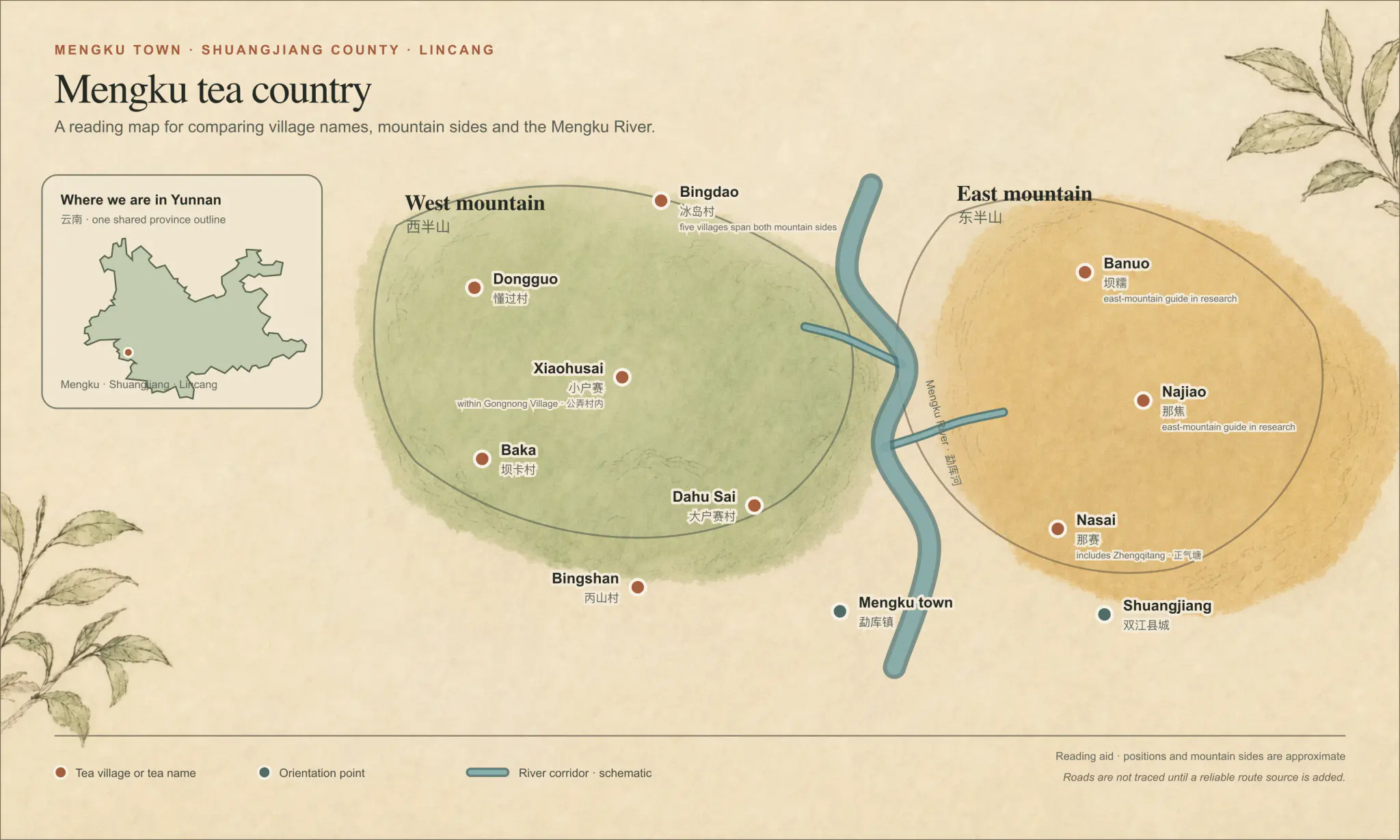
Bingdao (冰岛) means “ice island,” and it has become the most feverish name in Lincang tea, a cluster of five small villages whose old-tree spring maocha commands prices that make grown tea collectors flinch. Here’s the problem with fever: TeaDB puts it plainly when it warns that far more tea is sold under tiny prestigious-origin names than could plausibly exist. Bingdao Laozhai’s fame and small claimed supply make it a substitution magnet.
Bingdao sits inside Mengku (勐库, Měngkù), a township in Shuangjiang County, Lincang, western Yunnan, and Mengku is much bigger and more interesting than one expensive village. Sixteen administrative villages, a river that splits the tea country in two, and a large-leaf tea population important enough to be a nationally recognized cultivar. If you learn to read the township, the Bingdao hype gets a lot easier to see through.
At a glance
| Field | Reference |
|---|---|
| Location | Mengku Township (勐库镇), Shuangjiang County, Lincang, western Yunnan |
| Elevation | Bingdao Village reports 1,400 to 2,500 m; township-wide range unverified |
| Key villages | Bingdao five villages, Gongnong/Xiaohusai, Dahu Sai, Dongguo, Baka |
| Tea style | Raw sheng from Mengku large-leaf tea (勐库大叶种), a recognized cultivar population |
| Flavor shorthand | Aromatic, bitter-sweet, mouth-coating, cooling; Bingdao-family lots sold as especially sweet |
The river and the two half-mountains
The Mengku River (勐库河) runs from north to south through the township, and the market organizes everything around it: East Half Mountain (东半山) and West Half Mountain (西半山). It’s genuinely useful shorthand for navigating a tea menu, and genuinely useless as a flavor law. A tea labeled 东半山 or 西半山 may be a broad blend; a village cake may itself blend gardens or tree categories. The river tells you where to look, not what you’ll taste.
The provincial administrative standard lists sixteen villages under Mengku, including Bingdao (冰岛), Baka (坝卡), Dongguo (懂过), Dahu Sai (大户赛), Gongnong (公弄), Bingshan (丙山), Banggai (邦改), Hudong (护东), and Mangna (忙那). The famous handful:
- Bingdao Village (冰岛村) sits in northern Mengku and comprises five natural villages: Bingdao/Laozhai (冰岛/老寨), Dijie (地界), Nuowu (糯伍), Bawai (坝歪), and Nanpo (南迫). Laozhai, the “old village”, is the premium name, often printed simply as 冰岛, and it now carries a national agricultural-product geographical indication. A GI makes the name more formal than a mountain nickname; it does not make any particular wrapper honest.
- Gongnong (公弄村) contains Xiaohusai (小户赛), a three-settlement tea origin distinct enough to have its own guide on this site. Don’t let anyone sell it to you as generic “Bingdao side” material.
- Dahu Sai (大户赛) and Dongguo (懂过) are real villages with their own settings and processing networks, not interchangeable “West Mengku.”
And one correction worth flagging loudly, because an earlier version of this guide got it wrong: Xigui (昔归) is not in Mengku. It belongs to Bangdong in Linxiang District, to the north-east. A label that treats Xigui as West Mengku is mixing up neighboring Lincang market names.
What might show up in the cup
Named samples from this area tend toward flowers, fruit, fresh green notes, and sugar or honey in the aroma; bitter-sweet and green in youth on the palate; medium-to-thick, coating, sometimes silky texture. Lincang teas in general can show noticeable astringency when pushed. Bingdao-family lots are marketed as sweeter and softer, with cooling sensations and throat feel featuring heavily in the sales copy, record those as perceptions, not as proof of anything.
The most useful published tasting note is an unglamorous one. TeaDB’s 2013 autumn “Bingdao” sample started tangy and vegetal, turned bitter under extended steeping, and only then showed fruit sweetness and 回甘 (huí gān, the returning sweetness after the sip). That report is valuable precisely because it isn’t the effortless-sweetness script. Bitterleaf’s regional guide likewise frames Lincang as fragrant and sometimes astringent, and recommends affordable Mengku material as the entry point rather than treating Bingdao as a baseline. One paired retailer lot from 2021 found Dijie more delicate and Nanpo more body-forward, one maker’s autumn comparison, but a hint at how much the five villages differ among themselves.
Read a session in phases: floral-green top notes early, the relationship among bitterness, salivation, and texture in the middle, then stamina in the late steeps. A hard, smoky, sour, or overly green cup is usually a processing problem, heavy-handed or under-done 杀青 (shā qīng, kill-green), wet handling, rough rolling, not an east-bank or west-bank signature.
Terroir, plants, and history
Bingdao Village’s own reported range of 1,400 to 2,500 m shows how vertical this landscape is; local accounts describe a warm, humid mountain-monsoon climate with 1,600 to 2,000 mm of annual rain in the Mengku tea areas. The wider Mengku Daxue Shan (大雪山) holds a documented population of wild ancient tea trees, and Lincang has placed protected ancient-tea-garden status on parts of the Bingdao area.
The plant matters here more than in most townships. Mengku large-leaf tea (勐库大叶种) is a sexually propagated population recognized by the International Camellia Register and described in peer-reviewed work as a national elite cultivar originating in Mengku, regional plant material with real standing, though its name on a wrapper proves nothing about which village grew the leaf. A Lincang local-history account traces Mengku tea cultivation to the Ming to Qing period and reports the later spread of Mengku large-leaf material across the region. The Shuangjiang Mengku ancient-tea-garden and tea-culture system was recognized as a China Important Agricultural Heritage System in 2015 and reached a national GIAHS reserve list in 2019, and the county now runs GI protection, a tea testing and traceability center, and Bingdao ecological-protection and tourism projects. Shuangjiang’s full county name honors its Lahu, Va, Blang, and Dai communities, the real contemporary story is growers and cooperatives navigating a high-value name economy, not a costume-drama “ethnic tea style.”
Buying: make the label get smaller
Every word on a Mengku wrapper is a claim at a different scale, and the price should track the smallest verifiable one:
- 勐库 / Mengku, usually a broad township or brand association. Ask whether it means township-pure leaf, a wider Shuangjiang blend, or just styling.
- 冰岛 / Bingdao, could mean Bingdao Village, Laozhai specifically, a five-village blend, nearby “Bingdao family” material, or a brand name. Ask which.
- 冰岛五寨 / Bingdao five villages, should say which of the five are included, not just invoke them collectively.
- 古树 / gǔshù (old tree) and 乔木 / qiáomù (arbor), descriptions, not documents. Garden age is not tree age.
Then ask the seller: What exact Chinese locality, township, administrative village, natural village, garden? Single garden, single village, five-village blend, township blend, or leaf from outside Mengku? Harvest date, leaf grade, tree category, and processing approach? Who bought, pressed, and stored it, and is there a batch number or farmer record? If the wrapper invokes the GI or “Bingdao,” who is the authorized user?
A low price isn’t proof of fraud and a high price isn’t proof of purity. For actual value, buy an openly described Mengku township, Xiaohusai, Dahu Sai, or Dongguo lot from a transparent producer and compare it at the same age and processing level as the famous stuff.
Brewing
Baseline: 7 g per 100 ml porcelain gaiwan, 95 to 100 °C, 5 to 8 second steeps for the first three pours, rinsing only if compression demands it. Porcelain keeps things neutral when you’re testing origin claims. Shorten pours or drop the temperature slightly for a harsh young tea; go to boiling and longer steeps for something older or thin. If your body does something interesting mid-session, write it down as your own reaction, not as documented 茶气 (chá qì).
The four-tea flight that teaches the most: a general Mengku township sheng; a Bingdao Village or named five-village lot with the exact village disclosed; a Xiaohusai or Dahu Sai lot; and a Bangdong/Xigui or Yongde tea as the neighboring-Lincang control. Same ratio, same water, same timing. The goal isn’t a winner, it’s finding out which differences survive once price and label mythology are held still.
References
- Yunnan provincial administrative-village standard DB53/T 1176.9, 2023, Mengku’s administrative village list
- China Internet Information Center report, 2023, Bingdao Village’s five natural villages, elevation, and garden figures
- Lincang ancient-tea-garden protection notice, Bingdao/Nuowu protected-garden context
- Lincang Agriculture and Rural Affairs Bureau and Shuangjiang tea-industry report, GI protection and traceability policy
- International Camellia Register, Mengku large-leaf cultivar identity
- Food Science and Technology paper, Mengku large-leaf as a national elite cultivar
- Lincang Discipline Inspection Commission, “Mengku tea” and Lincang Daxue Shan profile, climate, wild-tree, and historical-cultivation accounts
- TeaDB Lincang regional guide and January 2015 Lincang report, specialist tasting context
- Bitterleaf region-buying guide, Lincang buying framing
- Bitterleaf 2021 autumn Dijie & Nanpo lot, paired village comparison
- TeaDB, “Big Region. Small Region. Tree Age.”, the small-origin authenticity problem
- Natural Earth, public-domain map base data
Quick answers
Frequently asked questions
What is the difference between east and west Mengku tea?
The terms orient buyers to opposite sides of the Mengku river system, but they are broad comparison categories. Village, garden, season and processing matter more than a simple east-versus-west rule.
Which tea villages are in Mengku?
Well-known names include the Bingdao five-village cluster, Xiaohusai, Dahu Sai, Dongguo, Baka and Banuo. Their administrative relationships and market use differ.
Does Mengku tea have one typical flavour?
No. Bitterness, fragrance, sweetness and body vary widely across villages and batches. Use a regional profile to design comparisons, not to authenticate a tea by taste.